








Soldering solar cells to build a low-cost photovoltaic panel

HOW TO SOLDER SOLAR CELLS TO BUILD A LOW-COST PHOTOVOLTAIC PANEL WITH RESPECT

The use of solar energy has not been opened up because the oil industry does not own the sun

Ralph Nader

A bit of information that I hope will be useful for you to build a photovoltaic panel:

Photovoltaics is a technology that allows the direct conversion of sunlight into electrical energy, exploiting the so-called photovoltaic effect.

This effect is based on the property of certain appropriately treated semiconductor materials (including silicon, a very common element in nature) to directly generate electrical energy when hit by solar radiation, without the use of any fuel.

The most basic device capable of performing this conversion is the photovoltaic cell, which can produce about 1/1.5 Watts of power when exposed to radiation of 1000 W/m2 (standard irradiation conditions).

A solar cell, also known as a photovoltaic cell, is a device that converts light energy into electrical energy.

Sometimes the term solar cell is used to refer to devices that capture solar energy, while the term photovoltaic cell is used when the light source is unspecified.

The solar cell, used to produce energy, has an efficiency between 13 and 22%.

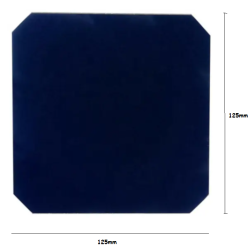
Usually, the cells, made with semiconductor material like silicon, which is widely used in this field, are 0.25 mm thick and have a square shape of 125 x 125 mm (5"x5") or 156 x 156 mm (6"x6").

OPERATION

When the cell is exposed to light, if impurities are introduced into the crystalline structure of the silicon used for the construction of solar cells, an electric field is created, which is then transformed into energy.

Photovoltaic conversion is a physical phenomenon that allows the direct transformation of light energy into electrical energy in elementary structures, the photovoltaic cells.
These devices are made of semiconductor materials, materials that conduct electric current and whose resistivity decreases with increasing temperature and the presence of impurities.

The photovoltaic effect consists of generating an electric potential difference, thanks to the integration of a radiant energy flow with matter.

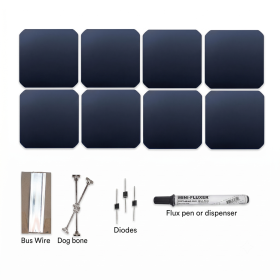
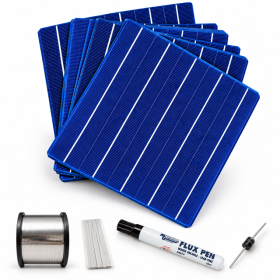
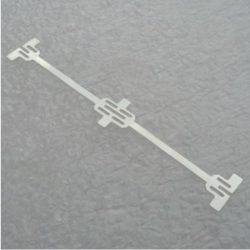
In our photovoltaic KITS, found in the dedicated category on the site, you will find two types of soldering wire, the TAB wire and the BUS wire. You can easily recognize them because the first is thinner and will be used to solder the cells together to form strings, while the BUS Wire is used to join the strings of cells together.

Another very important component of the KIT is the flux or rosin flux, which is used to allow proper soldering; for soldering, we recommend using a 60W/80W flat-tip soldering iron, like a split screwdriver (it is very economical, costing about €10.00), and we recommend placing the cells on a smooth glass surface or other thermally insulating materials.

In the KITS, we do not provide the glass and framing because they are easily obtainable from glaziers or DIY stores, to avoid increasing shipping costs that would then affect your final savings.

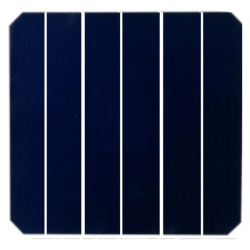
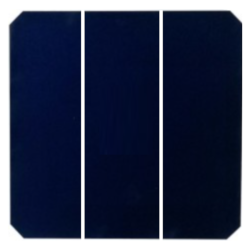
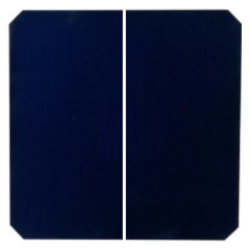
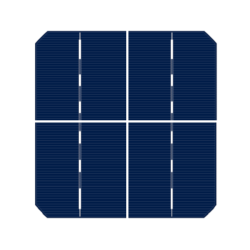
The solar cell, as you can see in the photo below, has the negative pole on the front side, the blue-colored one, while the positive one is on the back side; the bands you see in the middle are called connection bands or Bus bars and are used to connect the cells together.

Diagram of polycrystalline solar cells

soldering polycrystalline solar cells

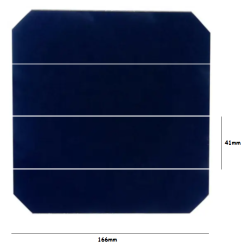
Since each solar cell has a voltage of 0.55V (0.6V Peak), to build a panel that charges a 12V battery, you will need at least 30 cells that you will have to connect in series with each other (the positive pole of one cell goes with the negative of the other) to obtain an adequate voltage. To build a solar panel, the first thing you will need to take care of is precisely the soldering of the solar cells, in a "serpentine" type scheme that I report below, in which we have 3 strings of 6 solar cells connected in series, so considering 0.55V per cell, you will have a photovoltaic panel with a voltage of about 10V at a current of 3.8A if we take for example in consideration the 3"X6" inch (76X156 mm) 3BB (3 connection bars) polycrystalline solar cell from:

Solar cell connection string

Below we provide some example data on the measurements of the voltage-current characteristic curve of a solar cell sold in our store; we thank Prof. Alessio Piana and his students for sharing this magnificent work with us.

CIRCUIT DIAGRAMS

Circuit diagrams for laboratory test of 3X6 polycrystalline photovoltaic cell

PHOTO 1

Images of laboratory tests performed on the 3X6 solar cell, measurement instrument setup

PHOTO 2

Laboratory TEST on 3X6 polycrystalline photovoltaic - Vr-I characteristic as illumination varies Table

PHOTO 3

Laboratory TEST on 3X6 polycrystalline photovoltaic - Vr-I characteristic graph as illumination varies

PHOTO 4

Laboratory TEST on 3X6 polycrystalline photovoltaic - Vr-I characteristic graph as illumination varies

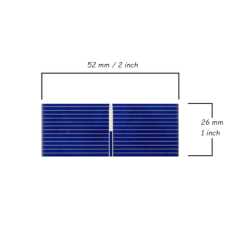
Below, another laboratory test on an already assembled solar panel composed of 36 solar cells 1"x3" inches available in our online store

PHOTO 1

Laboratory TEST on assembled solar panel composed of the KIT of 36 solar cells 1X3 inches 26X78 mm

PHOTO 2

Laboratory TEST on photovoltaic panel assembled from our kit of solar cells 1X3 inches 26X78 mm

PHOTO 3

Laboratory TEST on photovoltaic panel assembled from our kit of solar cells 1X3 inches 26X78 mm Measurement table

PHOTO 4

Laboratory TEST on photovoltaic panel assembled from our kit of solar cells 1X3 inches 26X78 mm Graph values

PHOTO 5

Laboratory TEST on photovoltaic panel assembled from our kit of solar cells 1X3 inches 26X78 mm measurements with ammeter and digital voltmeter

PHOTO 6

Laboratory TEST on photovoltaic panel assembled from our kit of solar cells 1X3 inches 26X78 mm lamp distance measurement

PHOTO 7

Laboratory TEST on photovoltaic panel assembled from our kit of solar cells 1X3 inches 26X78 mm measurements with tester

PHOTO 8

Laboratory TEST on photovoltaic panel assembled from our kit of solar cells 1X3 inches 26X78 mm current and voltage measurements of the panel with voltmeter and ammeter

It will be very important to mount the solar cells effectively to ensure a long panel life, low risk of corrosion, and breakage. There are several options to achieve a good result, such as encapsulating the cells within a double-glazed window or using special silicone resins like QSIL 216 or Ethylene Vinyl Acetate (EVA) sheets available in our store.

Below are some short videos showing how to solder the ribbon on the solar cells and how to apply the flux; enjoy watching and for any doubts or information do not hesitate to contact us.