



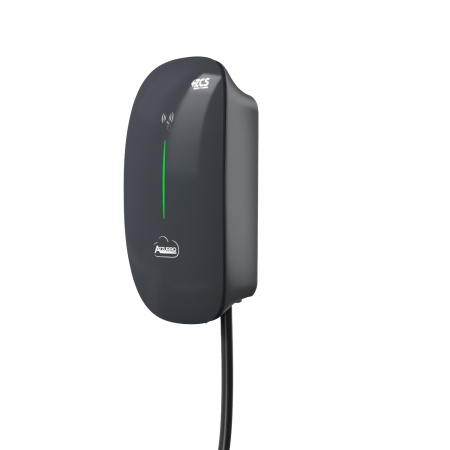

22 kW Three-Phase Wallbox ZCS Azzurro Caro, 7m Cable
22 kW three-phase wallbox from the ZCS Azzurro Caro Series with a 7-metre tethered Type 2 cable, 3P+N+PE 400 V - 32 A supply. IP65 and IK08 rated for outdoor wall mounting.
Includes a 30 mA AC RCD with 6 mA DC detection, removing the need for a separate Type B residual current device. Start via Plug&Play, RFID card or app; Wi-Fi, Bluetooth and Ethernet connectivity with OCPP 1.6 JSON and dynamic load balancing for solar self-consumption.
The ZCS Azzurro ZV3-22K-CARO-CAB 22 kW three-phase wallbox is an electric vehicle charging station from the Caro Series by Zucchetti Centro Sistemi, supplied with a 7-metre Type 2 charging cable already attached. It is designed for residential and commercial installations on a 400 V three-phase supply and integrates with photovoltaic systems and ZCS Azzurro inverters so you can charge using self-generated energy.
22 kW is the wallbox rating, not your car's charging speed
This is the single most important thing to understand before buying. The 22 kW figure is what the wallbox can deliver, but real charging speed is capped by your vehicle's on-board charger (OBC). The vast majority of electric cars on the market accept a maximum of 11 kW on AC, and some only 7.4 kW: connected to this wallbox they will charge at their own maximum, not at 22 kW.
So why choose the 22 kW version? Three practical reasons: it is future-proof for vehicles that do accept 22 kW AC, it lets you share power between two cars or between car and home without a bottleneck, and it runs with a wider thermal margin when delivering 11 kW, reducing stress on components.
ZV3-22K-CARO-CAB technical specifications
| Output power | 22 kW |
| Supply | 3P+N+PE - 400 V AC |
| Rated / maximum current | 32 A |
| Frequency | 50/60 Hz |
| Charging connector | Tethered Type 2 cable, 7 m |
| Ingress protection | IP65 |
| Impact protection | IK08 |
| Residual current protection | Built-in 30 mA AC RCD + 6 mA DC detection |
| Start modes | Plug&Play / RFID card / app |
| RFID reader | Mifare ISO |
| Communication | Wi-Fi, Bluetooth, Ethernet |
| Protocol | OCPP 1.6 JSON |
| Enclosure material | PC943 plastic |
| Installation | Wall mounted |
| Operating temperature | -30 °C / +50 °C |
| Product dimensions | 374 x 226 x 164 mm (H x W x D) |
| Net weight | 4 kg |
| Certifications | CE, CB, RoHS, REACH, EN 303645 |
| Warranty | 2 years |
How long does it take to charge my car?
The times below are for a full charge and account for each model's real on-board charger limit. Trim levels vary, so always check the AC power your own vehicle accepts.
| Car | Battery | Max AC on board | Full charge |
| Dacia Spring | 26.8 kWh | 7.4 kW | about 4 hours |
| Fiat 500e | 42 kWh | 11 kW | about 4 hours |
| Jeep Avenger | 54 kWh | 11 kW | about 5 hours |
| Renault 5 E-Tech | 52 kWh | 11 kW | about 5 hours |
| Volkswagen ID.3 | 58 kWh | 11 kW | about 5.5 hours |
| BYD Atto 3 | 60 kWh | 11 kW | about 6 hours |
| Tesla Model 3 Long Range | 75 kWh | 11 kW | about 7 hours |
| Hyundai Ioniq 5 | 77 kWh | 10.5 kW | about 7.5 hours |
In practice almost all of these cars charge fully overnight. The benefit of home charging is not peak speed but cost: with a photovoltaic system, the energy you put into the car is energy you would otherwise have exported to the grid for a few cents.
Solar charging and dynamic load balancing
The Caro Series adjusts charging current according to available energy. Dynamic load balancing measures total household consumption and automatically reduces the power delivered to the car when other loads rise, preventing the main breaker from tripping. With a photovoltaic system you can prioritise self-consumption, charging mainly from your own solar production rather than drawing from the grid.
Everything is managed from the app: schedule time windows, set maximum current and monitor sessions remotely.
Installation requirements
- A 400 V three-phase supply with adequate contracted power: 22 kW draws 32 A per phase and is not compatible with a typical single-phase domestic supply
- A dedicated protected circuit and isolation in line with IEC 60364-7-722
- A verified earthing system
- No external Type B RCD is needed: 6 mA DC fault detection is already built into the wallbox
- Check local incentives and reduced VAT schemes for EV chargers installed together with a solar system
Frequently asked questions
Will my car actually charge at 22 kW?
Only if its on-board charger accepts 22 kW AC, which is uncommon. Most electric cars stop at 11 kW AC and some at 7.4 kW: with this wallbox they will charge at their own maximum, which is a limit of the vehicle rather than the station. A 22 kW unit still helps when charging two cars with shared power or when planning for future vehicles.
Can I install it on a single-phase supply?
No. The ZV3-22K-CARO-CAB requires a 400 V three-phase supply with 32 A per phase. On a single-phase supply you should choose the 7 kW model from the same Caro Series, or ask your distribution network operator to upgrade to a three-phase connection with adequate power.
Do I need a Type B RCD upstream?
No. The wallbox integrates 30 mA AC residual current protection together with 6 mA DC fault detection in line with IEC 62955. Upstream, the protection specified by your electrical design is sufficient, which saves the significant cost of a dedicated Type B device.
Is the cable included or do I use my own?
This CAB version is the tethered variant: the 7-metre Type 2 cable is permanently attached to the wallbox and always ready to use, so you do not need to carry your own cable. If you prefer a socketed Type 2 version, that is a different product code.
Can it be installed outdoors?
Yes. The IP65 rating makes it suitable for outdoor wall mounting, protecting against dust and water jets, while IK08 mechanical strength guards against accidental impacts. The operating temperature range of -30 °C to +50 °C covers all European climates.