


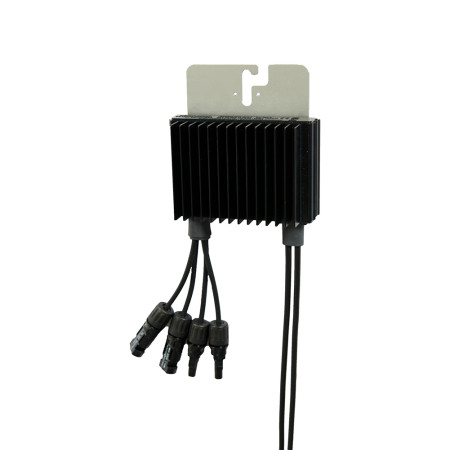

SolarEdge P950 950W Optimizer for 2 Modules
SolarEdge P950 power optimizer from the commercial series: a single device for two modules connected in series, with 950 W input power and maximum voltage of 125 Voc. It halves the number of optimizers, cables, and installation hours on medium- and large-scale systems. Compatible only with SolarEdge SE16K and higher three-phase inverters. 2,2 m output cable, MC4 connectors, 25-year warranty.
The SolarEdge P950-RM4MBY is a commercial series power optimizer designed with a different logic from S series residential optimizers: instead of one device for each module, a single P950 manages two photovoltaic modules connected in series. On a 200 kWp warehouse roof, this means halving the number of optimizers to install, with a direct impact on labor hours on the roof and on the balance of system cost.
The real constraint is not power: it is Voc
The datasheet states 950 W of nominal input power, but the parameter that determines whether the P950 can be used is the open-circuit voltage: the limit is 125 V total across the two modules in series, with a maximum short-circuit current of 12,5 A per input. Since a module's Voc increases as temperature decreases, the check must be performed at the site's minimum design temperature and not using STC values. With two modules rated at 50 V Voc at 25 °C, the limit can be approached on a January winter morning: the calculation determines feasibility and must be done before ordering, not on site.
The P950 was specifically developed for high-power modules and for vertically mounted bifacial modules, where the series pair remains within the operating window. For modules with high Voc, the correct choice is an optimizer with a different input window.
Compatibility: only commercial-size three-phase inverters
The P950 works exclusively with SolarEdge three-phase inverters SE16K and above, including Synergy units of equivalent power. It cannot be used with residential single-phase inverters. It should also be remembered that P series optimizers cannot be mixed in the same string with S series optimizers: a string can contain P800p, P850, P950 and P1100, but not a mix between the two families. This is the most common design error when expanding an existing system with materials purchased at different times.
Module-level safety and monitoring
Like all SolarEdge optimizers, the P950 integrates the SafeDC function: when the inverter is switched off or disconnects from the grid, the voltage of each optimizer drops to a safe value, reducing the risk for operators and firefighters in the event of work on the roof. Monitoring is per pair of modules, not per single module: a detail to consider when assessing the system's diagnostic capability, because a fault is located on the pair and not on the individual panel.
P950-RM4MBY technical specifications
| Nominal input power | 950 W |
| Connectable modules | 2 in series on a single input |
| Maximum input voltage | 125 Voc (absolute value) |
| Maximum short-circuit current | 12,5 A |
| Maximum efficiency | 99,5% |
| Maximum system voltage | 1000 Vdc |
| Compatible inverters | SolarEdge three-phase SE16K and above |
| String compatibility | Can only be mixed with P800p, P850, P950, P1100 |
| Connectors | MC4 |
| Output cable length | 2,2 m |
| Weight | 1.064 g |
| Safety | SafeDC, reduced voltage when inverter is off |
| Warranty | 25 years |
Frequently asked questions
How do I check whether my modules fall within the 125 V limit?
Take the module Voc under STC conditions from its datasheet, apply the temperature coefficient of the open-circuit voltage at the site's minimum design temperature, and multiply by two, because the modules are in series. The result must remain below 125 V with margin. The check must be performed using the actual minimum winter temperature of the location, not average values: that is when Voc reaches its peak.
Can I use the P950 with a single-phase inverter or with an SE10K?
No. The P950 is declared compatible only with SolarEdge three-phase inverters from SE16K upwards, including Synergy units of equivalent power. It must not be used on lower-power or single-phase inverters: the voltage window and permitted string lengths are different, and the system would not operate correctly. For residential systems, the correct choice is the S series.
Can I add P950 optimizers to a system that uses S series optimizers?
Not in the same string. SolarEdge allows mixing only among P800p, P850, P950 and P1100 commercial series optimizers. S series and P series cannot coexist in the same string. In an expansion, it is possible to dedicate separate strings to the two families, provided the minimum and maximum length constraints of each are respected: the design must be redone with SolarEdge Designer.
With one optimizer for every two modules, do I lose individual panel monitoring?
Yes, and this is the compromise accepted when choosing the commercial series. Monitoring and maximum power point tracking are performed per pair of modules: a drop in performance is reported on the pair, and identifying the responsible panel requires an on-site check. In return, the number of optimizers, connections and installation time is halved, which on commercial systems is almost always the economically dominant factor.
How many optimizers are needed per string?
Each optimizer model has a minimum and maximum number of units per string, depending on the paired inverter and the installed power. For commercial series models, the minimum number is typically in the order of ten units: the exact value for the specific configuration must always be obtained from SolarEdge Designer, which takes into account the inverter, module power and site conditions. It is not a parameter to estimate by eye.