


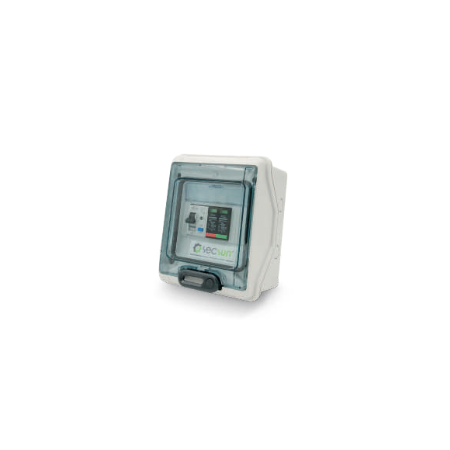

Single-Phase 5 kW PV AC Panel QIT5L
SecSun QIT5L: AC panel for PV systems with one single-phase inverter up to 5 kWp. It contains a 1P+N 25 A RCBO (6 kA, 300 mA type A) and a class II surge arrester rated 20 kA.
No interface protection: for use where the inverter's built-in protection is accepted, as in Italy below 11.08 kW. PVC enclosure IP65 class II, 164 x 200 x 116 mm, compliant with CEI EN 61439-1/2.
The SecSun QIT5L is the AC panel of the Light range, designed for residential PV systems with a single single-phase inverter up to 5 kWp. One IP65 box holds the two protections needed between the inverter output and the house distribution board: an RCBO (residual current circuit breaker with overcurrent protection) and a surge arrester.
The name says QIT, but there is no interface protection
This is the point to clear up before ordering. The QIT5L is an AC panel without interface protection: it contains no SPI relay and no interface device. In Italy, up to 11.08 kW the CEI 0-21 standard accepts the interface protection built into the inverter, so on a 3-5 kW single-phase system this panel is all you need. Other grid codes have similar rules (in Germany, for example, VDE-AR-N 4105 requires a central protection only above 30 kVA): check your local requirements. Where an external protection relay is required, you need an interface panel with test report, which is a different and more expensive product.
QIT5L technical specifications
| System power | 5 kWp |
| Inverter | 1 single-phase |
| RCBO | 1P+N 25 A, breaking capacity 6 kA, 300 mA type A |
| Surge arrester | Single-phase, class II, Imax 20 kA |
| Interface protection | Not included |
| Enclosure | Thermoplastic PVC, IP65, insulation class II |
| Conformity | CEI EN 61439-1/2 |
| Dimensions (W x H x D) | 164 x 200 x 116 mm |
| Weight | approx. 1.3 kg |
Why 25 A and why a type A residual current device
A 5 kW single-phase inverter at 230 V delivers about 22 A: the 25 A breaker covers the rated current with enough margin not to trip during peak summer production. For 6 kW inverters there is the QIT6L with a 32 A breaker; for 3 kW the QIT3L with 20 A. Choosing the right size avoids both nuisance tripping and protection that is oversized for the cable.
The residual current device is type A with a 300 mA threshold: it suits transformerless inverters whose manual states they cannot feed DC fault currents above 6 mA, which covers almost all current residential models. If the inverter manual requires a type B device or a lower threshold, that requirement takes precedence and the panel must be adapted.
Why a surge arrester on the AC side
The class II arrester protects the inverter from overvoltages coming from the grid, for example lightning on overhead lines or switching operations by the network operator. It is often overlooked because it is not always mandatory, but on an inverter worth several hundred euros, and in areas with overhead lines, it is the cheapest insurance you can install.
Frequently asked questions
Is this panel enough to connect a 5 kW system?
In Italy, in the typical configuration, yes: below 11.08 kW CEI 0-21 accepts the inverter's built-in interface protection, and the QIT5L adds line and surge protection. The inverter must be certified for the grid code of the country of installation.
Can it be used with a hybrid inverter with battery?
Yes, on the AC line towards the grid. If the inverter also has a backup (EPS) output, that line must be protected separately: the QIT5L has a single breaker and does not handle backup loads.
Does it also protect the DC side?
No, it works on the AC side only. The PV modules need a DC combiner box with switch-disconnector and DC surge protection, unless the inverter already integrates them.
Can it be installed outdoors?
Yes, the box is IP65 with class II insulation. A position sheltered from direct sun, close to the inverter, is still preferable, to keep the unprotected cable run short.
What is the difference from the QIT5 without the L?
The Light range is the essential version, with a PVC box and only the basic protections. The versions without L have more complete equipment and a higher price: for a standard residential system the Light version is usually sufficient.
