



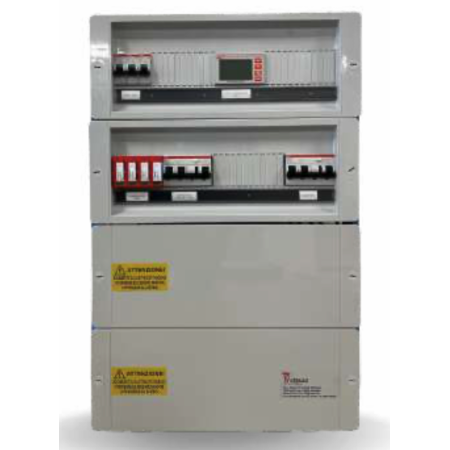

Interface Panel 30 kW 50A CEI 0-21 IP66
Three-phase interface panel from 26 to 30 kW, 50 A 400 V, compliant with CEI 0-21. Integrates a main device with 63 A Class A residual-current block, backup trip coil (DDR), 50 A AC-3 DDI contactor, SPI relay and 4P SPD surge arrester.
Fibreglass IP66 class II enclosure, 72 modules. Supplied with single-line diagram, declaration of conformity and SPI test report.
The QAC 26/30 kW interface panel marks a step up in category compared to the smaller sizes in the series: a fibreglass IP66 enclosure with 72 modules and, above all, a backup system integrated into the panel instead of delegated to external components.
The backup: the function that sets this size apart
CEI 0-21 requires that, if the Interface Device does not open when the SPI relay commands it — typically because the contactor contacts have stuck — a second device intervenes in its place. On the smaller sizes this backup has to be implemented on site, acting with an opening coil on the main upstream device.
Here the configuration integrates it: the Main Device is built with a 4x50 A circuit breaker and a 63 A 300 mA Class A residual-current block, and is equipped with a shunt trip coil serving as backup (DDR). This is a substantial difference at the design stage: it eliminates a component to be provided elsewhere and the related wiring logic.
QAC 26/30 kW technical specifications
| System power | From 26 to 30 kW, for 1 inverter |
| Grid type | Three-phase 400 V |
| Rated current | 50 A |
| Reference standard | CEI 0-21 |
| Main device (DG) | IMT 4x50 A 6 kA + 63 A 300 mA Class A residual-current block |
| Backup (DDR) | Shunt trip coil serving as backup |
| Inverter protection | IMT 4x50 A 6 kA |
| Interface device | Contactor (DDI) 50 A in AC-3 category |
| Overvoltages | SPD surge arrester 4P 440 Vac |
| Auxiliary circuits | 1P+N fuse holders for SPI power supply and general auxiliaries |
| Enclosure | Fibreglass box IP66 class II, 450 x 660 x 220 mm |
| Capacity | 72 DIN modules |
| Documentation | Single-line diagram, declaration of conformity, SPI test report |
The electrical characteristics are those declared by the official Icierre distribution for the ICR-QAC 26/30 kW 50A configuration.
Fibreglass and IP66: when they really matter
Sizes up to 25 kW use a polycarbonate IP65 enclosure. Here we move to fibreglass with IP66 rating, which adds resistance to powerful water jets and not just ordinary ones. Compared to polycarbonate, fibreglass withstands prolonged UV exposure better without yellowing or becoming brittle, and has greater dimensional stability under thermal excursions.
It is the right choice for outdoor industrial installations and agricultural environments, where the panel may be washed with a pressure washer or exposed to dust and ammonia. In a covered technical room the difference is less relevant and it still takes up more space.
Frequently asked questions
Do I need to provide other devices besides this panel to be compliant?
On the interface side this configuration is complete: main device, interface device, interface protection and backup are all present. What remains to be provided are the DC-side protections, with a combiner box for the strings, and coordination with the user's main distribution board.
Why is the residual-current device 300 mA and not 30 mA?
At 30 A operating current, the physiological leakage currents of the inverter's EMC filters and of the cables would make a 30 mA device subject to continuous tripping. The 300 mA Class A threshold protects against fire risk and solid faults, which is the function required at this level of the system.
Can I connect two 15 kW inverters to it?
The standard configuration provides a single protected line downstream of the interface device. With two inverters, two separate protections are needed to maintain selectivity: the solution is a version prepared for two lines, to be requested when ordering.
The panel is light for its size: is the figure correct?
The weight stated in the catalogue is being verified with the manufacturer: a 72-module fibreglass box with 50 A circuit breakers and a contactor realistically weighs more than reported. If the figure is decisive for your site logistics, ask us before ordering and we will confirm it.
Is the relay calibration suitable for any distributor?
The factory calibration follows the e-distribuzione standard thresholds. If the connection point is served by a local distributor with its own requirements, the specific calibration must be requested when ordering: redoing it on site requires a technician with a relay test box and a new report.