
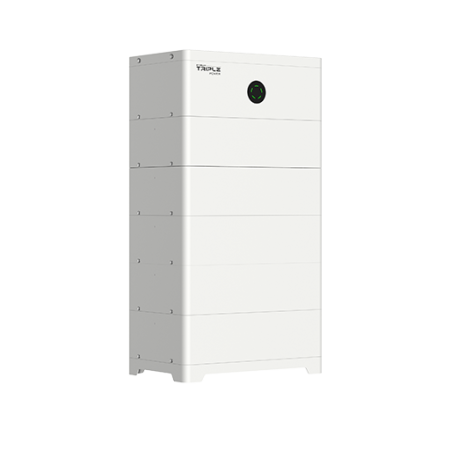

SolaX TB-HS51 Battery HV Module 5,1 kWh
The SolaX TB-HS51 is the 5.1 kWh high-voltage battery module of the TSYS-HS51 system: LiFePO4 cells, over 6,000 cycles at 90% DoD, integrated heating down to -30 °C, and IP66 rating. Stackable from 2 to 13 modules, from 10.2 to 66.5 kWh. Requires the TBMS-S51-8 BMS and a SolaX hybrid inverter compatible with HS series batteries.
The SolaX TB-HS51 is the 5,1 kWh high-voltage battery module of the TSYS-HS51 storage system. It is the stackable base element used to build the tower: LiFePO4 cells, over 6.000 cycles at 90% depth of discharge, and integrated heating to operate even at very low temperatures.
You are not only choosing capacity: you are also choosing power
In modular high-voltage systems, the number of modules determines not only the available kWh, but also the power the battery can deliver, because the modules are connected in series and the bank voltage increases with them. A 2-module tower (10,2 kWh) delivers approximately 6,1 kW nominal and 7,2 kW peak; a 7-module tower (35,8 kWh) reaches 21,5 kW nominal and 25,1 kW peak. This is why a battery that is "large enough" in kWh may still not be sufficient: if the installation has significant power demand peaks, the minimum number of modules is determined by power, not autonomy.
SolaX TB-HS51 technical specifications
| Nominal module capacity | 5,1 kWh |
| Chemistry | Lithium iron phosphate (LiFePO4) |
| Cycle life | over 6.000 cycles at 90% DoD |
| Depth of discharge | 90% |
| Nominal module voltage | 51,2 V |
| System configurations | from 2 to 13 modules, from 10,2 to 66,5 kWh |
| Charge and discharge current | 60 A nominal, 70 A maximum |
| Protection rating | IP66, indoor or outdoor installation |
| Operating temperature | -30 / +53 °C with integrated heating |
| Communication | CAN and RS485 (via BMS) |
| Dimensions / weight | 600 x 168 x 376 mm / 46 kg |
| Certifications | IEC 62619, IEC 62040, EN 62477, VDE 2510, UN 38.3 |
What is needed in addition to the module
The TB-HS51 does not work on its own. Each tower requires the BMS TBMS-S51-8, which manages from 2 to 8 modules and forms the base of the system. If the modules exceed eight and need to be divided across two towers, the Series Box TBHS51 is also required, while the TCBox-70 allows up to three towers to be connected in parallel. On the inverter side, a SolaX hybrid unit compatible with the high-voltage HS series batteries is required: on X3-ULTRA models, for example, the system requires at least three modules to start correctly.
Integrated heating and safety
Lithium iron phosphate cells lose capacity and do not accept charging below zero. The integrated heating of the TB-HS51 extends the operating range down to -30 °C, making installation possible in unheated rooms, garages, cellars or outdoors, even in mountain areas, where a battery without this function would remain unusable for months. The IP66 rating covers dust and water jets, and the TSYS-HS51 system integrates an aerosol fire extinguishing module for targeted intervention in the event of an initial fire outbreak.
Frequently asked questions
Can I buy just one TB-HS51 module?
A single module does not constitute a functioning system: the minimum configuration requires 2 modules plus the BMS TBMS-S51-8. The individual TB-HS51 is purchased instead to expand an already installed tower, within the limit of 8 modules per tower and 13 total system modules.
How many kWh can I reach?
From 10,2 kWh with two modules up to 66,5 kWh with thirteen. Up to eight modules remain on a single tower managed by the BMS; beyond that, the Series Box TBHS51 is required for the second tower. With the TCBox-70, up to three towers can be connected in parallel.
How much power does the battery deliver?
It depends on the number of modules, because the bank voltage increases with them: approximately 6,1 kW nominal with 2 modules, 12,3 kW with 4, 21,5 kW with 7, with peaks of 7,2, 14,3 and 25,1 kW respectively. The maximum system charge and discharge current is 70 A.
Does it work in the event of a blackout?
The system supports off-grid operation, but the ability to power loads during an outage depends on the hybrid inverter it is connected to and its backup output. The battery supplies the energy; the inverter manages the switchover and determines how much power is available to the loads.
Can it be installed outdoors?
Yes. The IP66 rating allows outdoor installation and the integrated heating extends operation down to -30 °C. Direct exposure to sunlight during the hottest hours should still be avoided, as the upper operating limit is 53 °C, and a stable base must be provided: each module weighs 46 kg and an eight-module tower exceeds 380 kg.