



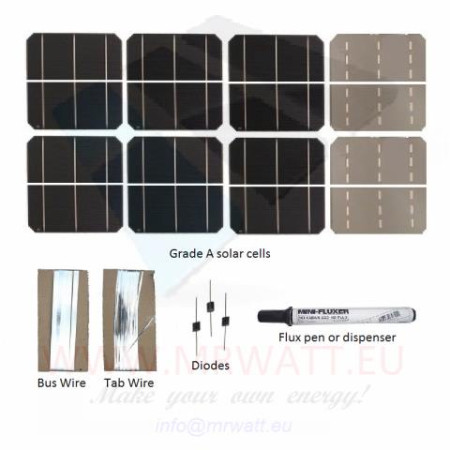


DIY Solar Panel Kit 160W – 72 Mono Cells 3x6
72 grade-A half-cut monocrystalline 3"x6" (78x156 mm) solar cells with tab and bus wire, flux and a Schottky diode to build 160 W of panels: one 24V nominal panel or two narrow 80 W 12V strips.
A kit designed by MR WATT, with spare cells included: for 24V systems on boats, work vehicles and campervans with little free roof space.
The MR WATT 160W DIY solar panel kit contains 72 grade-A half-cut monocrystalline 3"x6" (78x156 mm) solar cells plus the accessories to connect them. With 72 cells in series you build a 24V nominal panel; alternatively you get two 12V strips about 32 cm wide, to fit where a wide panel won't. We designed this kit in-house.
Designed for 24V systems
Many boats over 10 metres, trucks, construction vehicles and some larger campervans run on 24V. Charging a 24V battery takes 72 cells in series: this kit gives you about 38 V at maximum power with only 4 A of current. Low current means thin cables and low losses even when the controller sits far from the panel, as is often the case on board.
- Single 24V panel: 4 columns of 18 cells, a cell area of about 63x146 cm.
- Two 12V strips: 2 columns of 18 cells each, about 32x146 cm apiece, for example on either side of a skylight or along a boat's two gunwales.
K72MS3-AH technical specifications
| Number of cells | 72 half cells, plus a few spare cells |
| Technology | Monocrystalline silicon, half-cut cell |
| Quality | Grade A |
| Cell size | 3"x6" inches – 78x156 mm |
| Total kit power | 160 W (about 2.2 W per cell) |
| 72 cells in series | approx. 38 V at maximum power, approx. 45 V open-circuit, approx. 4 A (indicative values) |
| 2 x 36 cells in series | per panel approx. 19 V at maximum power, 22-23 V open-circuit, approx. 4 A (indicative values) |
| Included accessories | Tab wire and bus wire, flux, Schottky diode |
| Shipping weight | 0.5 kg |
Soldering and encapsulation
Half cells are soldered just like full cells: the ribbon runs from the front (negative) of one cell to the back (positive) of the next. You need a 60-80 W soldering iron with a flat tip, a smooth heat-insulating surface and an encapsulation method (EVA, clear silicone resin such as QSIL 216, or double glass), not included in the kit. The sizes given assume 3 mm between cells, frame excluded. Guides and videos are in the Learning Zone on mrwatt.eu and on our YouTube channel MRWattDIY.
What you can do with it every day
In Southern Europe 160 W produce on average about 0.6 kWh per day over the year, almost 0.7 kWh on summer days. On a moored 24V boat they keep the service batteries charged and run the fridge, lights and instruments; on a work vehicle they keep the batteries topped up during stops and power small loads such as site lights and trackers.
Frequently asked questions
What exactly is in the kit?
72 grade-A half-cut monocrystalline 78x156 mm solar cells, a few spare cells to make up for breakages during soldering or shipping, tab wire and bus wire, flux and a Schottky diode. The soldering iron, encapsulation materials, frames, junction boxes and charge controller are not included.
How does it differ from the 160W kit with 6x6 cells?
The power is the same. The 6x6 kit uses 36 full cells and gives a 12V panel with over 8 A; this kit uses 72 half cells and gives a 24V panel at about 4 A, or two narrow 12V panels. Choose according to your battery voltage and the shape of the space.
I have a 12V battery: can I still use it?
Yes, in two ways: build two 36-cell panels and wire them in parallel to a PWM or MPPT controller, or build a single 24V panel and connect it to an MPPT controller. Avoid the 24V panel with a PWM controller on a 12V battery: half of the power would be lost.
Which charge controller do I need?
A controller is always required, because connecting the panel straight to the battery overcharges it, with a risk of electrolysis and explosion. On a 24V battery a 10 A controller is enough; on a 12V battery you need at least 15 A.
How long does it take to build?
With 72 cells, allow a couple of afternoons. Solder an 18-cell string first, measure its voltage with a multimeter (about 9-10 V in sunlight), then carry on with the others. The spare cells included cover your first breakages.

- Power
- 160W
- Solar cells
- 72x Mono 3"x6" (78x156mm) 0.55V 4.05A
- Diodes
- 2x Schottky diode 5A 100V
- Flux
- 1x Dispenser 10ml Stannol flux x32-10i
- Tab wire
- 36m (120') 0.15x2mm
- Bus wire
- 2m (6') 0.2x5mm