



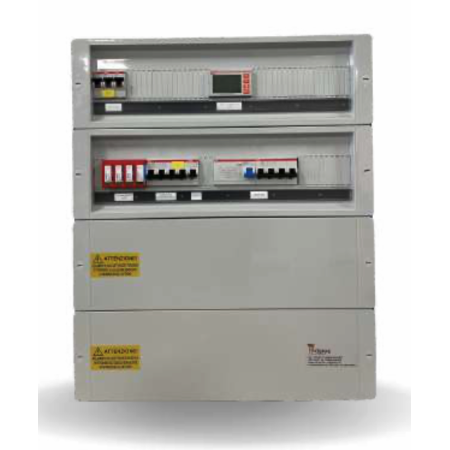

25 kW Interface Panel CEI 0-21 Test Report
Three-phase interface panel from 21 to 25 kW, compliant with CEI 0-21, with Interface Protection System (SPI) and test report included: mandatory above the 11,08 kW threshold, where the protections built into the inverter are no longer sufficient for the distributor.
IP65 enclosure in insulation class II, 36 DIN modules, 440 × 460 × 140 mm.
The QAC 21/25 kW interface panel is the CEI 0-21 compliant solution for three-phase photovoltaic systems in the range where photovoltaics stops being domestic and becomes a small commercial installation: workshops, farms, condominiums with a shared system.
Why this panel is required above 11,08 kW
CEI 0-21 allows the Interface Device and its protection to be integrated into the inverter only up to 11,08 kW. A 25 kW system far exceeds that threshold and therefore requires an external SPI with a dedicated, calibrated and tested relay, an Interface Device (DDI) contactor that physically opens the connection, and a backup system that intervenes if the DDI fails to open.
Without these three documented elements, the distributor does not issue the operating agreement and the system, however well built, cannot be connected in parallel with the grid.
QAC 21/25 kW technical specifications
| System power | From 21 to 25 kW |
| Grid type | Three-phase 400 V |
| Operating current | About 36 A at 25 kW (value calculated on 400 V three-phase) |
| Reference standard | CEI 0-21 |
| Interface protection | SPI relay compliant with CEI 0-21, with test report |
| Enclosure | IP65 box, class II, 440 x 460 x 140 mm |
| Capacity | 36 DIN modules |
| Weight | 5 kg |
Note on the data: the exact rating of the protection devices (main circuit breaker capacity, DDI contactor size) is not declared on the manufacturer's datasheet for this specific configuration. Before ordering, it is best to have it confirmed according to the actual current of your inverter, which depends on the set power factor.
Class II: the insulation that does not require earthing the enclosure
The box is in insulation class II, i.e. double insulated. This is not a formal detail: it means the enclosure does not require connection to the earthing system, because protection against indirect contact is guaranteed by the insulation itself. In practice it reduces wiring, eliminates a corrosion point typical of outdoor installations, and simplifies the continuity check during commissioning.
Frequently asked questions
Is the SPI test report included in the supply?
Yes. The relay is calibrated and tested at the factory with a relay test box according to CEI 0-21, and the report with the measured thresholds is delivered together with the panel. It is the document the distributor requires to complete the connection procedure.
If my system is connected in medium voltage, does the same standard apply?
No. CEI 0-21 applies to low-voltage connections; for medium voltage the reference is CEI 0-16, with different thresholds and architectures. The applicable standard depends on the connection point stated in the distributor's quotation, not on the system power.
Is the panel suitable for more than one inverter?
This configuration is designed around a single protected line. With two or more inverters, the correct version must be checked against the number of machines and their respective currents, so that each has its own dedicated protection and selectivity is maintained. When in doubt, send us the configuration before ordering.
What is the difference from the 16/20 kW model?
The protection logic is the same; what changes are the device ratings, sized on the operating current. Oversizing is not worthwhile: a circuit breaker larger than necessary protects the downstream cable less effectively, while undersizing causes nuisance tripping on days of maximum production.
Can I install it outdoors on the warehouse wall?
Yes, the IP65 rating allows it. A wall not exposed to the sun all day long is preferable: the internal temperature affects the life of the electronic components and the stability of the interface relay thresholds over time.