


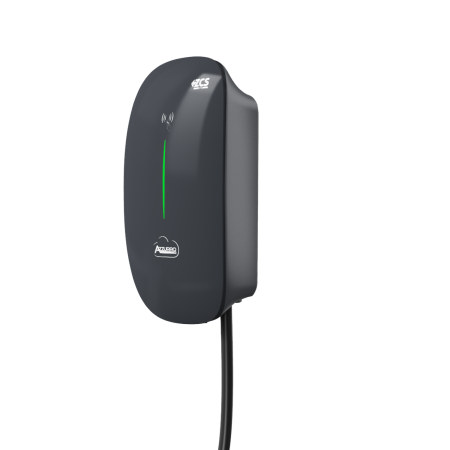

ZCS Azzurro Caro 7.4 kW Wallbox with Cable
ZCS Azzurro Caro: 7.4 kW single-phase charging station with a tethered 4-metre Type 2 cable, wall mounting and charge authorisation via RFID, app or Plug and Charge.
Integrates a 30 mA type A residual current device and DC fault detection down to 6 mA: in the intended configuration no separate type B RCD is required. Dynamic load balancing allows installation even on a 3 kW supply, with Wi-Fi, Ethernet and Bluetooth connectivity and integration with ZCS inverters and storage.
The ZCS Azzurro Caro is the single-phase 7.4 kW charging station in the version with a 4-metre Type 2 tethered cable. It mounts on the wall, unlocks via RFID, app or Plug and Charge, and integrates with ZCS solar inverters and storage systems.
The protections are already inside — that is where you save on the panel
This is what weighs most on the total cost of the installation. AC charging can produce DC fault currents, and wiring rules require them to be detected: the traditional answer is a dedicated type B RCD, several times the price of a type A.
This station integrates a 30 mA type A residual current device and DC fault current detection down to 6 mA, which is exactly what the standard asks for. In the manufacturer's intended configuration there is therefore no need to add a type B upstream. Welded-contact protection is also on board, tripping if a relay stays closed — the most insidious fault on a device that must be able to disconnect the vehicle.
The final decision still rests with the designer, who must confirm it on the schematic and in the declaration of conformity.
Tethered cable or socket: a choice you cannot reverse later
This version has a fixed 4-metre cable. Compared with the socket version the trade-off is clear and worth making before you buy:
- Tethered cable — no need to bring your own cable or keep one in the car, charging starts immediately. The natural choice for domestic or private use, where the vehicle is always the same.
- Socket — each user plugs in their own cable. Preferable in shared environments, because it reduces wear, damage and theft, and does not tie the station to one vehicle's connector.
Length matters too: four metres cover the parking bay if the station sits close to the charging port, but if the space is in-line or the car has to be parked the other way round they can fall short. Measure the actual cable route, not the straight-line distance.
Main features
| Power | 7.4 kW single-phase, adjustable from the app |
| Connection | Tethered 4-metre Type 2 cable |
| Charge authorisation | RFID, app or Plug and Charge |
| Connectivity | Wi-Fi, Ethernet, Bluetooth; 4G depending on configuration |
| Load management | Dynamic load balancing (DLM) |
| Residual current protection | 30 mA type A, integrated |
| DC fault currents | Detection down to 6 mA |
| Other protections | Welded contacts, overvoltage, overcurrent, short circuit, overtemperature |
| Status indication | RGB multicolour light ring |
| Installation | Wall-mounted; floor stand available as an option |
| Weight | 3.6 kg |
Load balancing matters more than it seems
On a domestic supply of 3 or 4.5 kW, charging at 7.4 kW alongside everything else is simply not sustainable: oven, induction hob and heat pump together would trip the limiter. Dynamic load balancing solves this at the root, reducing charging power while the rest of the house draws current and restoring it as loads switch off.
It is the function that lets you install a 7.4 kW wallbox without upgrading the meter, avoiding the higher standing charge on the bill. It does need to be configured correctly at commissioning, together with the measuring sensor on the main line.
Frequently asked questions
Do I need a dedicated type B RCD?
Not in the manufacturer's intended configuration. The station integrates a 30 mA type A device and DC fault detection down to 6 mA, which is the function a type B would otherwise provide. The designer must still record this on the installation schematic.
Can I install it with a 3 kW supply?
Yes, by enabling dynamic load balancing: the station reduces charging power according to household consumption, without tripping the meter. Charging will be slower at peak times and will speed up when the house draws little, typically overnight.
Does it work with a solar system?
Yes, and it is one of the main reasons it is chosen: it belongs to the ZCS Azzurro ecosystem and talks to inverters and storage systems of the same family, so charging can be prioritised when there is solar surplus. The exact setup depends on the inverter model and is worth checking before ordering.
Can it stay outdoors?
Yes. The Caro family is rated for both indoor and outdoor installation. As with any electronic device, a position sheltered from direct sun and driving rain extends its life — and the tethered cable benefits most, since it is the part that suffers UV exposure and thermal cycling.
Who can install it?
A qualified installer, who issues the declaration of conformity. The dedicated circuit cross-section, protection coordination and earthing all need checking. Note that installing a charging point together with a solar system may qualify for a reduced VAT rate: that assessment belongs to whoever issues the invoice.