
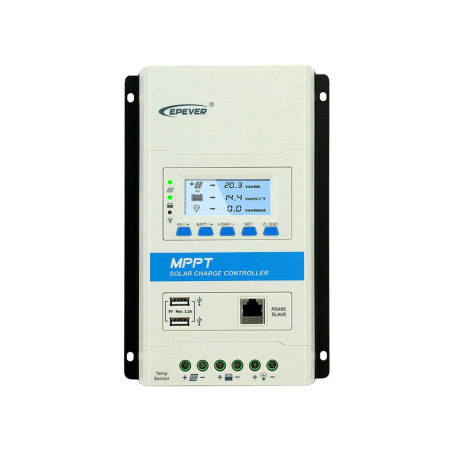


EPEVER TRIRON 2210N 20A MPPT Charge Controller 12/24V
EPEVER TRIRON 2210N 20A MPPT solar charge controller for 12/24V battery systems, with PV input up to 100V Voc and rated charging power of 260W at 12V or 520W at 24V.
The TRIRON2210N-2U version includes the DS2 display, UCS RS485 interface and two 5V USB outputs. Suitable for correctly configured lead-acid and lithium batteries; IP30 enclosure.
The EPEVER TRIRON 2210N-2U is a 20A MPPT charge controller for 12V or 24V stand-alone photovoltaic systems. Its MPPT algorithm tracks the solar array's maximum power point and converts the available energy toward the battery with a stated tracking efficiency of at least 99.5% and a maximum DC/DC conversion efficiency of 98%.
This configuration includes the DS2 display and the UCS interface module. The display shows the main PV, battery and load data, while UCS provides RS485 communication for monitoring and parameter adjustment plus two USB ports with a combined 5V / 2.2A output for small electronic devices.
Why use a 20A MPPT charge controller?
In an off-grid system, the controller manages the energy flow between the PV array and the battery and adapts voltage and current for controlled charging. Compared with PWM technology, MPPT can make better use of excess panel voltage, especially when the battery is discharged, ambient temperature is low or the PV operating voltage is well above the battery voltage. The actual gain still depends on the modules, wiring, temperature and battery condition.
What is included with TRIRON2210N-2U?
- EPEVER TRIRON 2210N 20A power module.
- DS2 LCD display with status indicators and navigation buttons.
- UCS interface module with RS485 communication.
- Two 5V USB outputs rated at 2.2A total, operating according to the load-output settings.
- Compatibility with the optional MT50 remote display.
EPEVER TRIRON 2210N technical specifications
| MR WATT reference | TRIRON2210N-2U |
| Charging technology | MPPT |
| Rated charge current | 20A |
| Rated load current | 20A |
| Rated battery voltage | 12/24VDC |
| Battery voltage range | 8-32VDC |
| Rated PV charging power | 260W at 12V; 520W at 24V |
| Maximum PV open-circuit voltage | 100V at the minimum operating temperature; 92V at 25°C |
| MPP operating range | Battery voltage + 2V up to 72V |
| MPPT tracking efficiency | At least 99.5% |
| Maximum conversion efficiency | 98% |
| Self-consumption | Up to 14mA at 12V; up to 15mA at 24V |
| Grounding | Common negative |
| Communication | RS485 through the UCS module |
| USB output | 5VDC, 2.2A total |
| Operating temperature with LCD | -25°C to +55°C |
| Ingress protection | IP30 |
| Main module dimensions | 216 x 150 x 56.7mm |
| Main module weight | 0.92kg; catalogue shipping weight 1.2kg |
| Recommended cable size | 6mm², to be verified for current, length and applicable rules |
How to size the solar array
With a 12V battery bank, the rated charging power is 260W; with a 24V bank, it increases to 520W. Panel quantity cannot be selected by wattage alone: the string open-circuit voltage must also be checked. At 25°C, the manual gives a 92V Voc limit for the TRIRON 2210N, while 100V is the limit at the minimum operating temperature. Because module Voc rises in cold weather, array design must use the module datasheet temperature coefficient and retain a suitable safety margin.
A power inverter should not be connected to the controller's load output. It must be connected directly to the battery through correctly sized cables and protection devices. The 20A load output is intended for compatible DC loads and the controller's programmable load modes.
Compatible batteries and setup
The TRIRON supports sealed lead-acid, AGM, GEL, flooded and user-defined lead-acid profiles, as well as lithium batteries such as LiFePO4 and lithium NMC when the charging settings match the battery manufacturer's instructions and BMS limits.
For lead-acid batteries, the controller can automatically identify a 12V or 24V system. With lithium batteries, system voltage must be configured correctly and must not be left to automatic detection. Temperature compensation and charging thresholds must also match the battery chemistry and BMS requirements.
Typical applications
- Off-grid photovoltaic systems for cabins, small buildings and stand-alone equipment.
- Camper vans, motorhomes and mobile 12/24V battery systems.
- Marine installations, provided the controller is mounted in a dry and ventilated compartment.
- Telecommunications, remote monitoring and stand-alone lighting systems.
- Small systems requiring local display and RS485 monitoring.
Installation and protection notes
The IP30 enclosure requires indoor or protected installation in a dry, clean and ventilated location. Leave adequate clearance for heat dissipation and never mount the controller in a sealed enclosure with flooded batteries. The manual requires suitable external fast-acting protection devices and correctly tightened connections.
During wiring, connect the battery first, then the optional DC load and finally the PV array; disconnect in the reverse order. Fuses, circuit breakers, cables and PV strings must be sized by a competent installer according to the actual system and applicable electrical requirements.
Frequently asked questions
Are the DS2 display and UCS interface included?
Yes. The TRIRON2210N-2U code identifies the version supplied with the DS2 display and UCS module. DS2 shows PV, battery and load data; UCS provides RS485 communication and two 5V USB outputs.
Can I use a LiFePO4 battery with this controller?
Yes, provided the charging voltage and thresholds are compatible with the battery and its BMS. With lithium batteries, the 12/24V system voltage must be configured manually rather than relying on automatic detection.
How many solar panels can I connect to the TRIRON 2210N?
It depends on total power, Voc and series-parallel configuration. The rated limit is 260W with a 12V battery or 520W with a 24V battery; string voltage must also remain below 92V Voc at 25°C and below the absolute 100V limit under the coldest expected conditions.
Can the charge controller be installed outdoors?
Not directly. IP30 does not protect against rain or water splashes, so the controller needs a covered, dry and ventilated enclosure with sufficient space for heat dissipation.
Can I connect an inverter to the LOAD output?
Not for a power inverter. The manufacturer's instructions require the inverter to be connected directly to the battery with suitable fusing, cable size and isolation; the LOAD output is intended for DC loads within the controller's rated limits.