
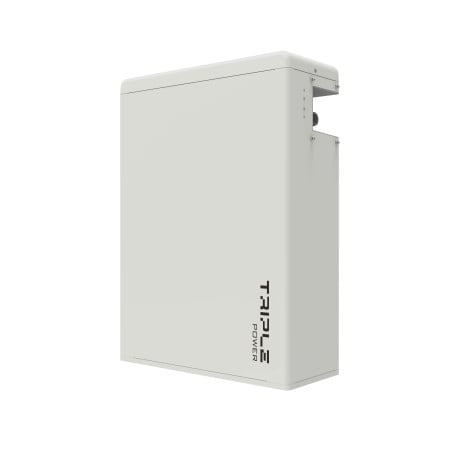

SolaX Triple Power HV11550 V3 Slave Battery 5,8 kWh HV
Slave expansion module with 5,8 kWh LFP for the SolaX Triple Power V3 high-voltage storage system. It does not include the BMS and does not work on its own: it must be connected to a T-BAT H 5.8 V3 master module, up to five slaves per tower (34,6 kWh total). 95% depth of discharge, over 6.000 cycles, 10-year warranty, IP66.
The SolaX HV11550 V3 is the slave module of the third-generation Triple Power high-voltage storage system: a lithium iron phosphate cell pack with 5,8 kWh that is stacked below or next to the master module to increase the system capacity. It is the right code when the tower already exists and only more energy is needed; it is not the right code for a new system.
Why it does not work on its own
The difference between this module and the T-BAT H 5.8 V3 master is not the capacity, which is identical, but the electronics: the HV11550 V3 contains only the cells, while the BMS that communicates with the hybrid inverter, measures the cell voltages and performs balancing is located exclusively in the master module. Without the master, the battery does not communicate, charge or discharge. The two units also have the same external dimensions (474 x 715 x 150 mm) and differ by just two kilograms: this is why they are often confused when ordering.
The configuration rule is simple: one mandatory master, up to five slaves, for a maximum of six modules and 34,6 kWh per cluster. On inverters equipped with a dual battery port, up to twelve total modules can be reached, equal to 69,1 kWh.
What you gain by adding a module
Expansion does not only increase stored energy but also the available power, because the modules work in series and the system voltage rises. Going from one to two modules takes you from 115,2 V to 230,4 V nominal, and the charging and discharging power doubles, from 2,9 kW to 5,8 kW nominal (from 4 to 8,1 kW peak). This is the most often overlooked aspect: anyone complaining about insufficient backup almost always has a power problem, not a capacity problem, and the solution is one more module.
HV11550 V3 technical specifications
| Role in the system | Slave module (cell pack only, without BMS) |
| Chemistry | Lithium iron phosphate (LFP) |
| Module energy | 5,8 kWh |
| Scalability | From 1 to 5 slaves per T-BAT H 5.8 V3 master |
| Maximum cluster capacity | 34,6 kWh (69,1 kWh on dual battery port inverter) |
| Depth of discharge | 95% |
| Recommended / maximum current | 25 A / 35 A |
| Service life | Over 6.000 cycles at 95% DoD |
| Warranty | 10 years |
| Charging temperature | 0 / +55 °C, or -30 / +55 °C with active heating |
| Discharging temperature | -20 / +55 °C, or -30 / +55 °C with active heating |
| Protection rating | IP66, indoor or outdoor installation |
| Installation | Wall-mounted or floor-mounted |
| Dimensions (W x H x D) | 474 x 715 x 150 mm |
| Weight | 59,5 kg (± 1 kg) |
| Certifications | IEC 62619, IEC 63056, IEC 60730, IEC 62040, EN 62477, VDE 2510, UN 38.3 |
Frequently asked questions
Can I use the HV11550 V3 as a single battery?
No. It is an expansion-only module, without BMS: it cannot communicate with the hybrid inverter or independently manage charging and discharging. For a new system, the T-BAT H 5.8 V3 master module must be ordered, as it contains the control electronics and also works on its own. The HV11550 V3 is purchased to expand an already existing tower.
How many slave modules can I add?
Up to five slaves for each master module, for a total of six modules and 34,6 kWh in a single cluster. If the hybrid inverter has two independent battery ports, two clusters can be managed, reaching twelve modules and 69,1 kWh overall. Before ordering, it is advisable to check the inverter datasheet to see how many battery ports it has and what maximum capacity it supports.
Does adding a module also increase power, or only capacity?
It increases both. The modules work in series, so the system voltage rises and so does the charging and discharging power: from 2,9 kW nominal with a single module to 5,8 kW with two, 8,6 kW with three, and so on, with peaks of 4, 8,1 and 12,1 kW respectively. This is the main reason why a single-module storage system struggles to support a complete home backup.
How can I distinguish the master from the slave when they arrive on site?
The dimensions are identical and the only obvious physical difference is the weight: approximately 61,5 kg for the master versus 59,5 kg for the slave. The reliable reference remains the product label, where the master shows the code T-BAT H 5.8 V3 and the slave shows the code HV11550 V3. Given their similarity, it is good practice to check the codes on the packages before starting to assemble the tower.
Can I add a V3 module to an older Triple Power tower?
This is not a configuration to be taken for granted. Triple Power generations differ in module capacity, depth of discharge and BMS firmware, so compatibility must be checked case by case with SolaX technical support, also verifying the firmware version of the hybrid inverter. If the existing tower uses previous-generation modules, the safe approach is to complete it with modules of the same generation.