



SES500-1G-M4M-RM
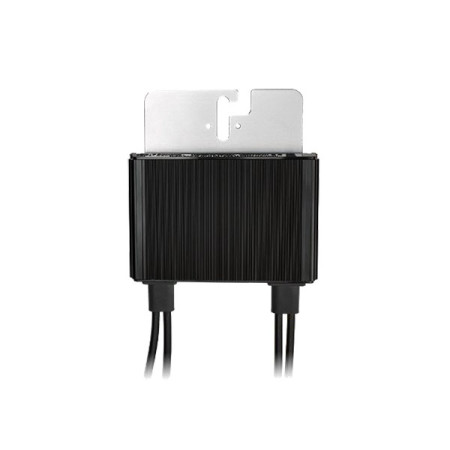
SolarEdge S500 power optimizer (SES500-1G-M4M-RM) for one photovoltaic module up to 500 W rated, increased to 550 W for installations after April 1, 2024.
Maximum efficiency 99.5%, maximum input voltage 60 Vdc, MPPT 8-60 V, MC4 connectors, IP68 rating and 1 V safety voltage according to VDE-AR-E 2100-712. 25-year warranty.
The SolarEdge S500 power optimizer (code SES500-1G-M4M-RM) is the DC/DC converter from the S series for photovoltaic modules up to 500 W nominal, increased to 550 W on systems installed after April 1, 2024. It is installed on the frame of each module with a single bolt and performs MPPT tracking independently from the rest of the string.
S500 or S500B? The difference is not the power
This is the most common misunderstanding about this range. The two models share the same nominal power of 500 W, but differ in their voltage window:
- S500 — absolute maximum input voltage 60 Vdc, MPPT 8-60 V, output up to 60 V
- S500B — absolute maximum input voltage 125 Vdc, MPPT 12,5-105 V, output up to 80 V
The choice is therefore based on the module Voc at the minimum design temperature, not on the nameplate power. A 500 W module in 132-cell format with Voc around 45-46 V at 25 °C can come dangerously close to 60 V at -10 °C: in that case, the S500 is not the right choice and the S500B is required. The S500 remains the correct and most cost-effective option for low-voltage modules in 108 or 144 half-cell format. There is also a less obvious design difference: the S500B allows minimum strings of 6 optimizers compared to 8 for the S500 on single-phase inverters, making it preferable for small or highly fragmented roof sections.
SolarEdge S500 technical specifications
| Nominal DC input power | 500 W (550 W for installations after 01/04/2024) |
| Absolute maximum input voltage (Voc) | 60 Vdc |
| MPPT operating range | 8 – 60 Vdc |
| Maximum continuous input current | 14,5 A (15 A for installations after 01/04/2024) |
| Maximum Isc of the connected module | 16,5 A with Home Hub inverter — 15 A with other SolarEdge inverters |
| Maximum / weighted efficiency | 99,5% / 98,6% |
| Maximum output current / voltage | 15 A / 60 Vdc |
| Standby safety voltage | 1 ± 0,1 Vdc per optimizer |
| Maximum system voltage | 1000 Vdc |
| Connectors and cables | MC4 — input 0,1 m, output (+) 2,3 m / (−) 0,1 m |
| Dimensions (W × H × D) | 129 × 155 × 30 mm |
| Weight | 720 g |
| Protection rating | IP68 — relative humidity 0-100% |
| Operating temperature | -40 °C / +85 °C (derating above +85 °C) |
| Compliance | IEC 62109-1 class II, IEC 61000-6-2/6-3, CISPR 11, EN 55011, UL 94 V-0, RoHS |
| Fire safety | VDE-AR-E 2100-712:2018-12 |
| Warranty | 25 years |
String design
With SolarEdge Home Wave or Home Hub single-phase inverters, the string ranges from 8 to 25 optimizers, with a maximum continuous power of 5.700 W per string. On Short String three-phase inverters the range is 9-20 optimizers, while on 230/400 V three-phase inverters it is 16-50 with a maximum of 11.250 W per string. Parallel strings of different lengths and orientations are allowed, making it possible to use roof sections with different exposures on the same input. Remember that in new installations mixing S series and P series in the same string is not permitted.
Frequently asked questions
What is the difference between SolarEdge S500 and S500B?
The nominal power is the same; the voltage window changes. The S500 accepts a maximum Voc of 60 V with MPPT 8-60 V; the S500B reaches 125 V with MPPT 12,5-105 V and output up to 80 V. The S500B also allows shorter minimum strings, 6 optimizers instead of 8 on single-phase inverters. The choice is made based on the module Voc at the minimum design temperature.
One optimizer for each module, or can I connect two?
The S500 is a single-input optimizer: one device for each photovoltaic module. Dual-input optimizers, which manage two modules in parallel, belong to the commercial and industrial range and are a different product. Connecting two modules in parallel on a single input would exceed the permitted current limits.
How much production gain can I expect compared to a string without optimizers?
It depends entirely on the mismatch between the modules. On a single-pitch roof, with no shading and with modules from the same batch, the gain is modest and often does not justify the extra cost. On roofs with recurring partial shading, multiple orientations or modules of different ages, the recovery can be significant because the worst-performing module no longer limits the entire string. Module-level monitoring and DC safety also make a real difference.
What happens to the string voltage when the inverter is switched off?
Each optimizer brings its output to 1 V ± 0,1 V. A string of 20 modules therefore drops to about 20 V instead of the several hundred volts of a traditional array. This is the SafeDC function, compliant with the German VDE-AR-E 2100-712 standard, designed for the safety of installers, maintenance technicians and fire brigade teams during work on the roof.
Do I need a SolarEdge inverter, or does it work with any inverter?
A SolarEdge inverter is mandatory. The architecture requires the inverter to keep the string voltage constant and communicate with the individual optimizers: without this counterpart, the system does not operate. This is the main limitation of the SolarEdge ecosystem and should be taken into account already at the quotation stage, together with the 25-year warranty on the optimizers and the shorter warranty on the inverter.