



SES440-1G-M4M-RM
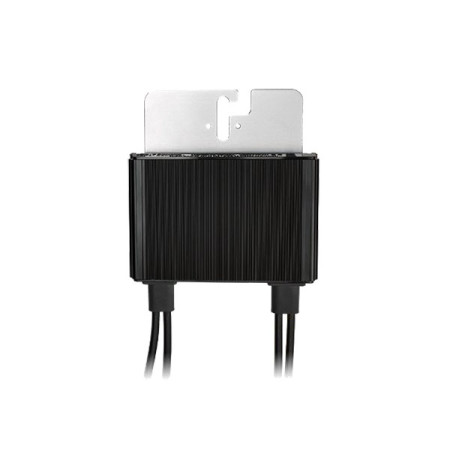
SolarEdge S440 power optimizer (SES440-1G-M4M-RM) for one photovoltaic module up to 440 W rated, increased to 490 W for installations after 1° April 2024.
MPPT at individual module level, maximum efficiency 99,5%, maximum input voltage 60 Vdc, MC4 connectors, IP68 rating, and automatic voltage shutdown to 1 V according to VDE-AR-E 2100-712. 25-year warranty.
The SolarEdge S440 power optimizer (code SES440-1G-M4M-RM) is the entry-level model of the S series, the DC/DC converter installed on the frame of a single photovoltaic module, tracking its maximum power point independently from the rest of the string. It replaces the old P series in new residential installations.
The real limit is not power, it is voltage
On paper, the S440 accepts modules up to 440 Wp (490 Wp for systems installed after 1° April 2024). In practice, however, the parameter that determines compatibility is another one: the absolute maximum input voltage of 60 Vdc, referring to the module Voc at the minimum design temperature, not at 25 °C. Many modern 430-440 W modules in 108-cell format have a rated Voc of around 37-38 V and are comfortably within the limit; modules with a rated Voc above 50 V, on the other hand, can exceed 60 V at -10 °C and must be paired with the S500B, which accepts up to 125 V. This is a check worth carrying out during the design phase, not on site.
S series and P series must not be mixed
In new installations, it is not permitted to install S series and P series optimizers in the same string. This is a SolarEdge requirement, not a recommendation, and it creates a recurring practical issue: if a component fails on an existing system with P optimizers, replacing it with an S440 on that string is not a correct solution. On mixed fields, it is advisable to check the availability of a replacement from the same family before ordering.
There is also the minimum string length constraint, often overlooked: with single-phase Home Wave/Hub inverters, at least 8 S440 optimizers are required, rising to 9 on three-phase Short String inverters and to 16 on three-phase 230/400 V inverters. Below that threshold, the string will not start.
SolarEdge S440 technical specifications
| Rated DC input power | 440 W (490 W for installations after 01/04/2024) |
| Absolute maximum input voltage (Voc) | 60 Vdc |
| MPPT operating range | 8 – 60 Vdc |
| Maximum continuous input current | 14,5 A (15 A for installations after 01/04/2024) |
| Maximum Isc of the connected module | 16,5 A with Home Hub inverter — 15 A with other SolarEdge inverters |
| Maximum / weighted efficiency | 99,5% / 98,6% |
| Maximum output current / voltage | 15 A / 60 Vdc |
| Standby safety voltage | 1 ± 0,1 Vdc per optimizer |
| Maximum system voltage | 1000 Vdc |
| Connectors and cables | MC4 — input 0,1 m, output (+) 2,3 m / (−) 0,1 m |
| Dimensions (L × H × D) | 129 × 155 × 30 mm |
| Weight | 720 g |
| Protection rating | IP68 — relative humidity 0-100% |
| Operating temperature | -40 °C / +85 °C (derating above +85 °C) |
| Compliance | IEC 62109-1 classe II, IEC 61000-6-2/6-3, CISPR 11, EN 55011, UL 94 V-0, RoHS |
| Fire safety | VDE-AR-E 2100-712:2018-12 |
| Warranty | 25 years |
Safety in the event of Fire Department intervention
When the inverter is switched off or the optimizer is disconnected, each S440 brings its output to 1 V. A string of 20 modules is therefore at around twenty volts instead of several hundred: this is the SafeDC function, compliant with VDE-AR-E 2100-712, which makes roof access safe for maintenance technicians and emergency teams. On compatible inverter models, detection of abnormal behavior of the photovoltaic connector is also added, designed to identify overheating that precedes an electric arc.
Frequently asked questions
Does the S440 optimizer work with inverters from other brands?
No. SolarEdge optimizers work exclusively with SolarEdge inverters, which keep the string voltage constant and communicate with the individual optimizers via the power line. With a traditional string inverter from another manufacturer, the system will not start: this is an architectural constraint, not a commercial limitation.
What is the minimum number of S440 optimizers required per string?
With SolarEdge Home Wave or Home Hub single-phase inverters, the minimum is 8 optimizers and the maximum is 25. On three-phase Short String inverters, the minimum rises to 9 with a maximum of 20, while on three-phase inverters for 230/400 V grids, at least 16 optimizers are required up to a maximum of 50. Parallel strings of different lengths and orientations are permitted.
Can I use the S440 with a 500 W module?
No, it is not the correct choice. The module STC power must not exceed the optimizer’s rated input power, i.e. 440 W (490 W for installations after 1° April 2024), with module power tolerance allowed up to +5%. For 500 W modules there is the S500, and for modules up to 650 W the S650B.
Can I replace an old P series optimizer with an S440?
In new installations, it is not permitted to mix S series and P series optimizers in the same string. On an existing system equipped with the P series, replacement of a single component must be carried out with an optimizer from the same family; otherwise, the entire string must be converted. Before ordering, check the model already installed by reading the label or the layout on the monitoring platform.
Is the S440 compatible with bifacial modules?
Yes, the S series is declared compatible with bifacial modules. However, the rear-side current gain must be taken into account: the module’s actual Isc, including the bifacial contribution, must remain within 16,5 A with Home Hub inverter and 15 A with other SolarEdge inverters. On high-reflectance installations, such as light-colored roofs or canopies, it is advisable to verify the data during sizing.