



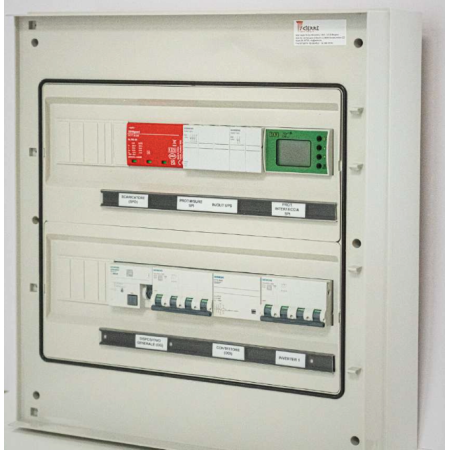

QAC 12/15 kW
Three-phase interface panel from 12 to 15 kW, 25 A 400 V, compliant with CEI 0-21 for one inverter. Integrates the Interface Protection System (SPI), the contactor interface device, the Class A residual-current circuit breaker with overcurrent protection, and the surge arrester.
36-module IP65 box, supplied with single-line diagram, declaration of conformity, and SPI test report: the three documents required by the distributor for connection.
The QAC 12/15 kW interface panel is the first in the series to feature a true external Interface Protection System. It is the component that makes it possible to connect a three-phase photovoltaic system to the grid once it has exceeded the threshold beyond which the protections built into the inverter are no longer sufficient.
The 11,08 kW threshold: what really changes
CEI 0-21 allows the Interface Device and the related protection system to be integrated into the inverter only up to 11,08 kW. Above that power level, the distributor requires three things that the inverter alone cannot provide: an external DDI, namely an AC-3 utilization category contactor that physically opens the connection to the grid, a dedicated SPI relay with overvoltage, undervoltage, overfrequency and underfrequency thresholds calibrated according to the regulatory annex, and a backup system that intervenes if the DDI does not open.
This is why an interface panel costs an order of magnitude more than a single-phase AC panel: it is not the enclosure, it is the calibrated relay and the contactor. Below 11,08 kW, buying an interface panel is an unnecessary expense; above it, it is a requirement with no alternative.
QAC 12/15 kW technical specifications
| System power | From 12 to 15 kW, for 1 inverter |
| Grid type | Three-phase 400 V |
| Rated current | 25 A |
| Reference standard | CEI 0-21 |
| Main protection | IMTD 4x25 A, 6 kA, 300 mA Class A |
| Inverter protection | IMT 4x25 A, 6 kA |
| Interface device | Contactor (DDI) in AC-3 category |
| Interface protection | SPI relay compliant with CEI 0-21 |
| Overvoltages | SPD surge arrester |
| Auxiliary circuits | 1P+N fuse holder (SPI power supply) and 3P+N (SPI measurement) |
| Provisions | External auxiliary power supply, in/out (DDI/M2), external trip |
| Enclosure | IP65 box with 36 modules, 450 x 480 x 195 mm |
| Documentation | Single-line diagram, declaration of conformity, SPI test report |
| Weight | 5 kg |
What the SPI test report contains and why it matters
The test report is the record of the factory test carried out with the relay test box: it lists the threshold values and trip times measured for overvoltage, undervoltage, overfrequency and underfrequency, with the serial number of the tested relay. Without this document, the distributor will not complete the connection procedure, and repeating it on site means calling a technician with the test box.
One point worth checking before ordering: the factory calibration follows the e-distribuzione standard. If your connection point is served by another distributor — Areti in Rome, Unareti in Milan, or one of the many local distribution companies — the thresholds may differ and the specific calibration must be requested.
The three provisions that simplify installation
- External auxiliary power supply: allows the SPI relay to be powered from an independent source, a requirement when protection must be guaranteed even in the absence of grid power
- In/out (DDI/M2): allows the panel to be inserted on the existing line without intermediate joints
- External trip: provides for remote opening control, useful for implementing the backup by acting on the main upstream device
Frequently asked questions
Does the panel arrive already calibrated and certified?
Yes. The interface relay is calibrated and tested at the factory with a relay test box according to CEI 0-21, and the test report documenting the measured thresholds is supplied together with the panel. On site, only the line wiring remains to be done.
Can I connect two 7,5 kW inverters to it?
This version is configured for a single inverter: there is only one dedicated protection downstream of the DDI. With two inverters, a version prepared for two separately protected lines is required; otherwise, selectivity between the two machines is missing.
What is the backup system and does this panel have it?
The backup is the second device that must open if the DDI remains stuck. CEI 0-21 requires it above 11,08 kW. This panel is prepared for external tripping: the backup is typically implemented by acting with an opening coil on the main upstream device, which must be included in the design.
How often must the SPI relay be retested?
The operating regulations require periodic verification of the interface protection system, at intervals specified by the distributor, typically every five years. The test is carried out with a relay test box and produces a new report to be kept together with the system documentation.
Is the DC-side string combiner box also needed?
They are independent protections. This panel operates on the AC side towards the grid; the string combiner box protects and disconnects the DC strings between the modules and the inverter. On a 15 kW system with multiple strings, both are required.