



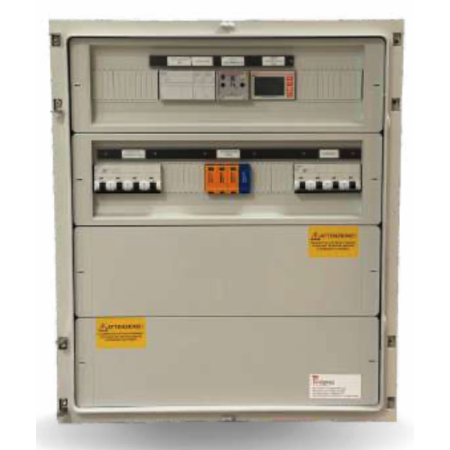

Interface Panel 55 kW 100A CEI 0-21 IP66
Three-phase interface panel from 45 to 55 kW, 100 A, compliant with CEI 0-21 for industrial photovoltaic systems connected in low voltage. SPI relay calibrated and tested at the factory, with SPI test report included.
IP66 class II enclosure with 96 DIN modules (540 × 640 × 240 mm): enough spare space for meters, monitoring auxiliaries and future expansions.
The QAC 45/55 kW interface panel is rated for 100 A at 400 V and is intended for industrial photovoltaic systems connected in low voltage: the range of production warehouses, greenhouses and logistics facilities where self-consumption covers a significant share of the company load.
100 A: the practical limit of low voltage
A 55 kW system draws about 79 A per phase at 400 V, and the 100 A protection covers this value with the necessary margin. Around this size, however, there is a design decision that must be made beforehand and not afterwards: the connection point.
Above a certain available power, the distributor prescribes connection in medium voltage, and in that case the applicable standard is no longer CEI 0-21 but CEI 0-16, with a completely different protection architecture, thresholds and devices. This panel complies with CEI 0-21 and is therefore correct only for LV connections: before ordering, the connection quotation must be read, not the power estimated.
QAC 45/55 kW technical specifications
| System power | From 45 to 55 kW |
| Grid type | Three-phase 400 V, low voltage |
| Rated current | 100 A |
| Reference standard | CEI 0-21 |
| Interface protection | SPI relay compliant with CEI 0-21, calibrated and tested at the factory |
| Enclosure | IP66 box, class II, 540 x 640 x 240 mm |
| Capacity | 96 DIN modules |
| Documentation | Single-line diagram, declaration of conformity, SPI test report |
Note on the data: the ratings and models of the individual installed devices (main circuit breaker, DDI contactor, surge arrester) are not published in detail by the manufacturer for this configuration. If you need them for the technical report or the executive design, request the single-line diagram from us before ordering.
Ninety-six modules: why spare space matters
On an industrial system the interface panel rarely stays as it was delivered. Over time it ends up housing the fiscal production meter, the auxiliaries for the monitoring system, the relays for the zero-export logic required by some distributors, the controls for a storage system possibly added later.
A 96-module enclosure with IP66 in class II leaves the margin for these additions without having to place a second panel alongside. It is an aspect rarely evaluated at the purchase stage and paid for dearly three years later.
Frequently asked questions
How do I know whether my system goes in LV or MV?
The distributor establishes it in the connection quotation, based on the requested power and the capacity of the local grid. It is not a designer's choice nor a fixed threshold that is the same everywhere. Until you have that document, purchasing an interface panel is premature.
Is a project signed by a professional required?
Yes. National regulations require the project to be drawn up by a registered professional for photovoltaic systems above 20 kW. At this size, the project, technical report and protection coordination checks are mandatory.
What cable cross-section is used to connect a 100 A panel?
The sizing must be calculated case by case according to the installation method, ambient temperature, grouping of circuits and length of the run. On industrial runs of a few tens of metres, cross-sections of 35 mm² and above are typically considered, but the value must be verified in the design and not assumed from a generic table.
Does the panel also manage the zero-export function?
No, limiting export to the grid is a function of the inverter combined with a bidirectional meter, not of the interface panel. The panel provides the modular space to house the components of that logic, but does not implement it.
Is periodic verification of the SPI relay mandatory at this size too?
Yes, and it is all the more relevant the larger the system. The operating regulations prescribe periodic verification with a relay test box and the retention of the reports: in the event of an inspection, the absence of the documentation can lead to suspension of the operating agreement itself.