
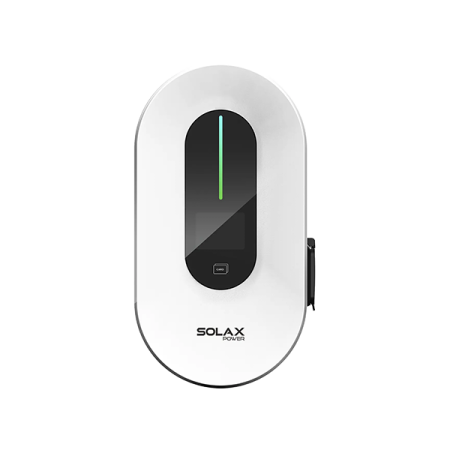

X1-HAC-7P
7.2 kW single-phase wallbox from the SolaX X1-HAC series, Type P version with integrated fixed Type 2 charging cable. Adjustable current from 6 to 32 A, IP65 and IK10 for indoor or outdoor installation, RFID and app authentication, OCPP 1.6 JSON protocol and dynamic load balancing with included CT. Integrated 30 mA AC + 6 mA DC residual current protection.
The SolaX X1-HAC-7P is a 7,2 kW single-phase wallbox with a Type 2 charging cable already connected, designed to be paired with a photovoltaic system and for everyday use in residential or small business settings. The code is not random: in the X1-HAC series, the letter P stands for plug, meaning a fixed 6,5-meter cable, while the S (socket) variant has only the socket and requires the user to bring their own cable. This is the difference that determines the user experience and is barely explained in price lists.
7,2 kW on an Italian single-phase connection: what to really expect
A 7,2 kW wallbox draws 32 A at 230 V. Most Italian domestic utilities, however, are 3 kW (about 13,6 A) or 4,5 kW: without a power increase, or without activating the dedicated tariff for electric vehicle charging, full power cannot be reached. This is not a product issue but a connection point issue, and it is the first check to carry out before the quotation.
For this reason, dynamic load balancing is the most important function of this wallbox and not an accessory: by reading household consumption via the included current transformer, the X1-HAC-7P automatically reduces the charging current when the oven, induction hob or heat pump starts operating, preventing the limiter from tripping. With an active photovoltaic system, you can also set the mode that draws only the surplus that would otherwise be fed into the grid.
The advantage in the electrical panel: type A RCD instead of type B
The X1-HAC-7P integrates fault current monitoring at 30 mA AC and 6 mA DC. This is a detail with an immediate economic impact: protection against DC fault currents, which CEI 64-8 requires for charging points, is already handled by the internal device, so upstream a type A residual-current circuit breaker is sufficient, rather than a type B, which is significantly more expensive and bulky. Verification of coordination naturally remains the responsibility of the system designer.
How long does it take to charge the car?
The calculation is simple: energy to be charged divided by the power actually delivered. However, the limit is almost never the wallbox, but the car's on-board charger: many vehicles in single-phase alternating current stop at 7,4 kW, several at 3,7 kW, and in that case the wallbox adapts. It is worth checking your vehicle's technical data sheet before purchasing.
| Energy to charge | At 7,2 kW | At 3,7 kW (limited car) |
| 20 kWh (about 120-150 km) | about 2 h 45 min | about 5 h 25 min |
| 40 kWh (small car from empty to full) | about 5 h 35 min | about 10 h 50 min |
| 60 kWh (SUV or electric sedan) | about 8 h 20 min | about 16 h 15 min |
The times are theoretical and do not take into account conversion losses, typically between 5 and 10%, nor the battery's natural slowdown above 80% charge.
X1-HAC-7P technical specifications
| Power supply | Single-phase 1/N/PE, 230 V, 50/60 Hz |
| Distribution systems | TN, TT, IT |
| Output current | 6 - 32 A adjustable |
| Charging power | 1,4 - 7,2 kW |
| Charging connector | Fixed Type 2 cable (IEC 62196-2), 6,5 m |
| Authentication | Plug and charge, RFID ISO 14443-A, SolaX app |
| Communication | Wi-Fi 2,4 GHz, Ethernet, RS485, optional 4G |
| Protocol | OCPP 1.6 (JSON), TLS encrypted communication |
| Residual-current protection | Integrated 30 mA AC + 6 mA DC |
| Protection rating | IP65, IK10 impact resistance (IK08 on the display) |
| Installation | Wall-mounted (optional pedestal), indoor or outdoor |
| Operating temperature | -30 °C / +50 °C |
| Other protections | Over/undervoltage, overload, short circuit, leakage, earth, surges, overtemperature |
| Standards | IEC 61851-1:2017, IEC 62196-2:2016, CE, LVD, EMC, RED |
| Dimensions and weight (P version) | 265 x 370 x 155 mm, about 10,5 kg |
| Supplied with | Mounting bracket, current transformer, RFID cards |
Frequently asked questions
What is the difference between the 7P version and the 7S version?
The 7P is the version with a fixed 6,5-meter Type 2 charging cable already mounted on the wallbox: you arrive, connect it to the car and go. The 7S, on the other hand, has a Type 2 socket and requires a portable cable, which the user must keep in the car. The 7P is more convenient for everyday use and is the typical choice for a garage or private parking space; the 7S is preferred when the unit is exposed to the public or when cables of different lengths need to be used.
Can I install it if I have a 3 kW meter?
Yes, but you will not charge at 7,2 kW. The wallbox must be configured with a maximum current compatible with the available power and, above all, the included current transformer must be connected to activate dynamic load balancing: in this way, charging is automatically reduced when other household appliances are drawing power, preventing the meter from disconnecting. To truly take advantage of 7,2 kW, the supply point power must be increased.
Is a type B residual-current circuit breaker required upstream?
No. The X1-HAC-7P integrates 6 mA DC fault current detection in addition to 30 mA AC protection, so the function normally assigned to a type B RCD is already performed internally, and a type A RCD dedicated to the charging line is sufficient. Line sizing and protection coordination remain the responsibility of the designer.
Does it only work with SolaX inverters?
No, the wallbox works as a normal charging point with any electrical system. The closest integration, with charging modes that make use of photovoltaic surplus, performs best in a complete SolaX ecosystem, but dynamic load balancing is based on the included current transformer and also works with inverters from other brands. OCPP 1.6 JSON support also allows it to be managed from third-party platforms.
Can it be installed outdoors, exposed to rain and sun?
Yes. The IP65 protection rating makes it suitable for outdoor installation and the IK10 mechanical resistance of the enclosure protects against accidental impacts, with the display certified IK08. The declared temperature range is from -30 to +50 °C. However, it remains good practice to avoid direct sun exposure throughout the day, as this makes the electronics operate at higher temperatures and may lead to a reduction in delivered power on the hottest days.