
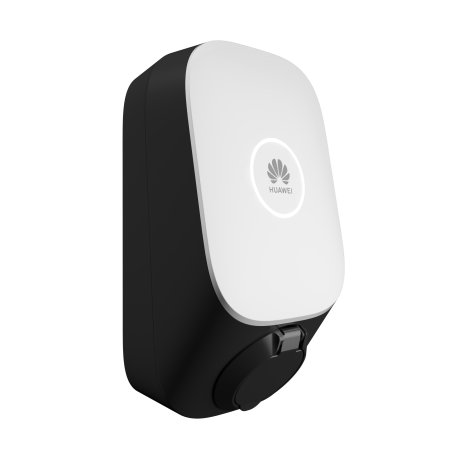

Huawei Wallbox 22 kW Three-Phase SCharger-22KT-S0
Huawei Smart Charger three-phase wallbox, power configurable from 1.4 to 22 kW at 400 V, Type 2 socket, IP54 and IK10.
PV-preferred charging, dynamic regulation to avoid tripping the supply, scheduled charging and Next Trip. Check your car first: most vehicles accept 11 kW AC, not 22.
The Huawei SCharger-22KT-S0 is the three-phase unit in the Smart Charger range: charging power configurable from 1.4 to 22 kW, Type 2 socket, IP54 and IK10. Compared with its 7.4 kW single-phase sister the connection changes (400 V three-phase) and so does the power ceiling, but the real difference only shows if the car can actually make use of it.
Careful: does your car really use 22 kW?
This is what causes most wrong purchases. AC charging power is limited by the vehicle's on-board charger, not by the wallbox. Most electric cars on the market have an 11 kW on-board charger: connected to this wallbox they will draw 11 kW, not 22. The cars that genuinely accept 22 kW AC are a minority, historically some Renault models.
This does not make the three-phase version pointless: even just moving from 7.4 to 11 kW almost halves the times, the load is spread more evenly across the three phases, and the wallbox stays ready for the next car. But if the home has a single-phase supply, the correct model is the 7KS-S0: this one needs a three-phase supply and an adequately sized connection.
How long does it take to charge my car?
Indicative times for a full charge with the car connected to this wallbox. The "real power" column is what the car accepts, and it is the value that governs:
| Car | Indicative battery | Real AC power | Time |
| Dacia Spring | ~27 kWh | ~6.6 kW | about 4 hours |
| Fiat 500e (large battery) | ~42 kWh | 11 kW | about 3 hours 50 |
| Renault 5 E-Tech | ~52 kWh | 11 kW | about 4 hours 45 |
| Jeep Avenger electric | ~54 kWh | 11 kW | about 4 hours 55 |
| Tesla Model 3 (base version) | ~58 kWh | 11 kW | about 5 hours 15 |
| Volkswagen ID.3 | ~58 kWh | 11 kW | about 5 hours 20 |
As you can see, the Dacia Spring takes the same time it would on a single-phase wallbox: its on-board charger goes no higher. Always check your own vehicle's data sheet for the maximum accepted AC power before choosing the size.
Solar charging and dynamic regulation
The PV Power Preferred mode makes the car draw primarily the energy the system is producing, modulating the current to the production curve. Dynamic regulation instead takes account of the rest of the building's consumption and reduces charging rather than tripping the meter. Add scheduled charging and Next Trip mode, which guarantees the required charge level by a set time while exploiting the cheaper hours.
SCharger-22KT-S0 technical specifications
| Charging power | Configurable from 1.4 to 22 kW |
| Nominal voltage | 400 V +/- 20% (three-phase) |
| Nominal current | Configurable 6 - 32 A (three-phase or single-phase) |
| Frequency | 50 / 60 Hz |
| Vehicle connection | Type 2 socket |
| Cable cross-section | Up to 10 mm2 |
| Network types | TN, TT |
| Protocols | Modbus TCP, OCPP 1.6 |
| Communication | Wi-Fi / Ethernet |
| Authentication | RFID (ISO-14443-A), app, Bluetooth |
| Working modes | Normal, scheduled, PV power preferred, Next Trip |
| Cable lock | E-Lock managed from the app |
| Protection rating | IP54, IK10 |
| Dimensions | 335 x 180 x 145 mm |
| Weight | 3.1 kg |
Frequently asked questions
Is it worth buying the 22 kW if my car only accepts 11?
It depends on what you foresee. With an 11 kW car the charging time will be identical to that of an 11 kW three-phase wallbox, so the extra cost brings no immediate benefit. It makes sense if you will change car, if several vehicles will use the same point, or in a business context where flexibility is worth more than the initial cost.
Can I use it on a single-phase system?
The current is configurable in single-phase too, but the model is designed for 400 V three-phase supply and that is its element. On a single-phase domestic supply the correct choice is the SCharger-7KS-S0, which costs less and offers the same smart features.
Is the charging cable included?
No, the wallbox has a Type 2 socket: you use the cable supplied with the vehicle or a Type 2 cable bought separately. To exploit 22 kW the cable must be three-phase rated at 32 A: a single-phase cable will limit charging regardless of wallbox and car.
Do I need a Huawei inverter?
For charging alone, no. For PV-preferred charging and dynamic regulation the system must know production and consumption: with a Huawei inverter the data comes from the inverter, otherwise you need the DTSU666-FE Smart Power Sensor installed at the board.
Can it be installed outdoors?
Yes: the IP54 rating protects against dust and splashing water from any direction, and the IK10 class ensures impact resistance. A position sheltered from driving rain and direct sun is still preferable, as it extends the product's life and makes everyday use more comfortable.