



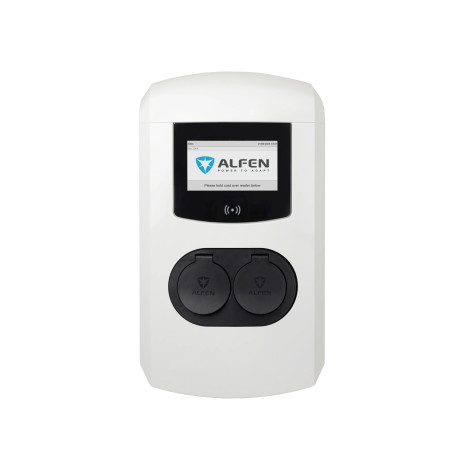

Alfen Eve Double Plus Three-Phase 2 Cables T2
Alfen Eve Double Plus three-phase: charging station with two independent charging points and two tethered Type 2 cables, 32 A per phase, with load balancing between the two vehicles.
RFID authorisation, multicolour LED indicators, RJ45 Ethernet port, DC fault current detection down to 6 mA — allowing a type A RCD instead of type B — IP54 and IK10. For company fleets and residential car parks: tethered cables remove the forgotten-cable problem.
The Alfen Eve Double Plus in its three-phase version is a charging station with two independent charging points and two tethered Type 2 cables, rated 32 A per phase. It is designed for company car parks, fleets and residential communal areas where two bays need to be served by a single unit.
Tethered cables: convenient for the user, wear for the operator
This is the substantial difference from the socket version, and it needs weighing up before purchase because it cannot be changed later. With cables already attached the driver arrives, plugs in and leaves: no need to carry a cable or keep one in the boot, and on a company fleet this removes the problem of forgotten or swapped cables.
The downside falls on whoever runs the installation. The cables stay exposed to weather, UV and passing vehicles, they wear and can be damaged, and in publicly accessible areas they can be stolen. In a residential car park with a few regular users the advantage prevails; in an area open to anyone, the socket version is usually the more robust choice.
Two points do not automatically mean double the power
This matters most when sizing the installation. For both points to deliver maximum power at the same time you would need 64 A per phase, a figure few supplies have available and which is often incompatible with the metered capacity.
That is why the station includes load balancing: when both cables are in use, the available power is shared between the two vehicles instead of tripping the protection. Two cars therefore receive roughly half the power each and take twice as long. This is not a product limitation but correct behaviour: the design decision is how much power to dedicate to charging, knowing the station adapts to that budget.
Technical specifications
| Charging points | 2, independent |
| Connection | 2 tethered Type 2 cables (feeder cable) |
| Supply | Three-phase |
| Maximum current | 32 A per phase |
| Power | Adjustable, with load balancing between the two points |
| Authorisation | RFID reader |
| User interface | Multicolour LED indicators |
| Connectivity | RJ45 Ethernet port |
| Electrical protection | DC fault current detection down to 6 mA |
| Protection rating | IP54, impact resistance IK10 |
DC fault detection saves money in the distribution board
This is the technical detail with the biggest effect on the overall quote. AC charging can generate DC fault currents, and wiring rules require them to be detected: the classic answer is a type B RCD for every charging point, several times the cost of a type A.
This station integrates DC fault current detection down to 6 mA, which is exactly the required function. In the manufacturer's intended configuration the circuit can therefore be protected with a type A RCD instead of type B — and on a dual station the saving doubles. The final assessment still rests with the designer, who must confirm it on the schematic and in the declaration of conformity.
IK10: why it matters in a car park
The IK10 rating indicates resistance to mechanical impact and is the highest class on the scale. On a station installed in a company or residential car park this is not a nameplate figure: it is the difference between an enclosure that takes the knock of a car door, a trolley or a bad manoeuvre and one that cracks. IP54 protects against dust and splashing water from any direction, which is sufficient for outdoor installation.
Frequently asked questions
How does it differ from the socket version?
This one has two cables already attached: the user does not need to bring their own. The socket version leaves each driver with their own cable, reducing wear, damage and theft. Tethered cables suit fleets and regular users; sockets suit areas open to the public.
How much power is needed to use both points at full output?
With 32 A per phase on two points the station needs 64 A per phase. If the line or the supply contract does not allow it, a lower limit is set and load balancing shares the power between the connected vehicles: charging time changes, functionality does not.
Do I need a type B RCD for each point?
The station integrates DC fault current detection down to 6 mA, which in the manufacturer's intended configuration allows a type A device to be used. That is a significant saving on a dual station, but the choice must be confirmed by the designer on the installation schematic.
How is access managed?
Through the RFID reader: authorised cards are enabled, so the station cannot be used by anyone who happens to pass by. In company or residential installations it is also the basis for attributing consumption to individual users, although that function depends on the configuration and on the management system adopted.
Can the cables be replaced if damaged?
Tethered cables are replaceable by the manufacturer or by authorised service, but this is not a do-it-yourself job: replacement involves a live connection and must be carried out by qualified personnel. It is also why, where the risk of damage is high, the socket version tends to cost less over time.
