
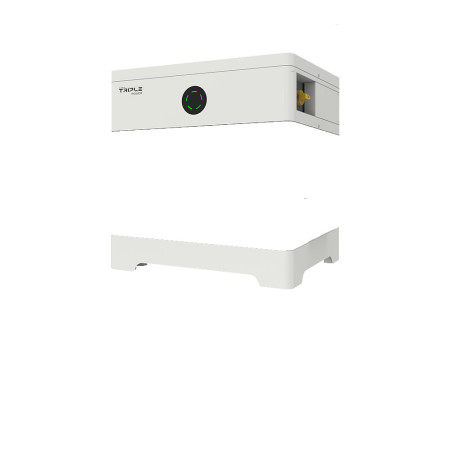

SolaX TBMS-MCS0800 Master BMS for T-BAT HV
The Solax TBMS-MCS0800 is the master BMS module for high voltage (HV) storage systems of the T-BAT Solax series. It coordinates communication, protections, and charge/discharge cycles of up to 13 HV battery modules S3.6 and S2.5, and is compatible with X3-Hybrid G4 and X3-Ultra inverters. Dimensions: 510 × 365 × 157 mm, weight: 10 kg.
The Solax TBMS-MCS0800 is the BMS master module (Battery Management System / Master Control System) for the high-voltage storage systems of the Solax Power T-BAT HV series. It is the component that coordinates and supervises the operation of the entire battery pack in photovoltaic systems with Solax X3-Hybrid G4 or X3-Ultra hybrid inverters.
What is the TBMS-MCS0800 used for?
In Solax high-voltage storage systems, the individual T-BAT HV batteries (slave modules) must be coordinated by a master unit that manages: communication with the inverter, balancing of charge and discharge cycles between modules, monitoring of the state of health (SOH) and remaining charge (SOC) of each module, and safety protections (overvoltage, overheating, short circuit). Without the TBMS-MCS0800, the HV battery modules cannot communicate properly with the Solax inverter.
Solax TBMS-MCS0800 technical specifications
| Type | BMS Master Control System |
| Battery compatibility | Solax T-BAT HV S3.6, HV S2.5 |
| Manageable battery modules | Up to 13 modules |
| Inverter compatibility | X3-Hybrid G4, X3-Ultra |
| Dimensions | 510 × 365 × 157 mm |
| Weight | 10 kg |
How many battery modules can it manage?
A single TBMS-MCS0800 can coordinate up to 13 HV battery modules, allowing the construction of large-capacity storage systems. Each T-BAT HV module has a capacity of about 3.6 kWh or 2.5 kWh depending on the version, allowing total capacities of up to about 47 kWh with a single BMS master.
Installation and wiring
The TBMS-MCS0800 is installed near the battery modules, usually in the same rack or storage cabinet. Communication with the inverter takes place via CAN or RS485 cable. The slave battery modules are connected to the BMS master via dedicated communication cables. The system does not require complex configuration: once properly wired and the address is set via DIP switch, the TBMS automatically detects the connected modules.
Frequently asked questions
Is the TBMS-MCS0800 necessary if I connect only one T-BAT HV battery?
It depends on the battery module version. With some versions of T-BAT HV modules, the BMS master is required from the very first unit to establish communication with the Solax inverter. With other versions, the first module can operate autonomously, but the TBMS becomes necessary when connecting multiple modules. Check the instructions for the specific battery model you have purchased.
Is the TBMS-MCS0800 compatible with the X3-IES?
No, the TBMS-MCS0800 is compatible with T-BAT HV batteries and X3-Hybrid G4 and X3-Ultra inverters. The X3-IES system uses a BMS integrated into its own structure, specific for the TP-HS50E batteries of the IES series. The two systems are separate and not interchangeable.
What is the maximum total storage capacity achievable with a TBMS-MCS0800?
With up to 13 T-BAT HV S3.6 modules (3.6 kWh each), the total capacity managed by a single TBMS-MCS0800 can reach about 47 kWh. With S2.5 modules (2.5 kWh each), the maximum capacity is about 32 kWh per BMS. For higher capacities with the X3-Ultra inverter, the Solax TB-PBOX system allows further expansion.
Does the TBMS-MCS0800 replace or work alongside the slave battery modules?
The TBMS-MCS0800 is an additional component that works alongside the slave battery modules: it does not contain energy cells and does not contribute to storage capacity. Its role is exclusively to coordinate the slave modules from an electronic and communication perspective. The T-BAT HV slave battery modules are purchased separately.
Is a TBMS needed for each battery rack or is one enough for the whole system?
A single TBMS-MCS0800 is sufficient to coordinate up to 13 battery modules. For systems with multiple racks exceeding this threshold, multiple BMS masters must be configured in coordination. The Solax technical documentation specifies the connection methods for multi-rack configurations.