
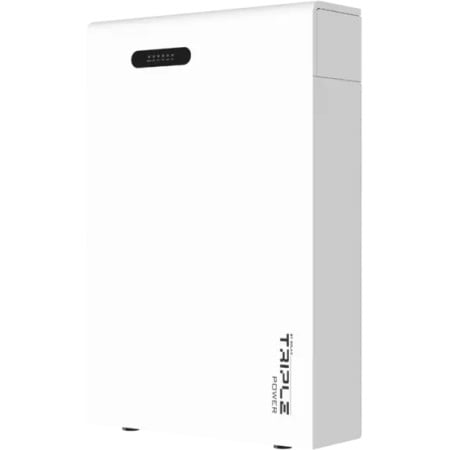

SolaX Triple Power T-BAT H 5.8 V3 Master Battery 5,8 kWh HV
Master module of the SolaX Triple Power V3 high-voltage storage system: 5.8 kWh nominal capacity with LFP technology and integrated BMS, the only module in the range that can operate on its own. 95% depth of discharge (5.5 kWh usable), over 6,000 cycles, 10-year warranty, IP66 for outdoor installation as well. Expandable up to 34.6 kWh with HV11550 V3 slave modules.
The SolaX T-BAT H 5.8 V3 is the master module of the third generation of the Triple Power high-voltage storage system. It is the component every installation must start from: inside it, in addition to the lithium iron phosphate cells, there is the BMS that manages the entire tower, communicates with the hybrid inverter and balances the cells. On its own, it already provides a complete 5,8 kWh system; with the HV11550 V3 slave modules, it can reach 34,6 kWh per cluster.
Master or slave: the distinction that causes ordering mistakes
In the Triple Power V3 catalogue there are two codes that look almost identical in appearance and dimensions, but are not interchangeable. The T-BAT H 5.8 V3 is the master and contains the control electronics; the HV11550 V3 is the slave, meaning only the cell pack, and cannot operate without a master to connect to. The two modules share the same external dimensions (474 x 715 x 150 mm) and differ by just 2 kg in weight: this is why they are often confused when ordering. The practical rule is simple: one master for each tower, then as many slaves as needed.
The real limit to know: power, not capacity
With a single module, the system operates at a nominal voltage of 115,2 V and provides 2,9 kW of nominal charge and discharge power, with a peak of 4 kW. This is a figure that must be carefully considered before designing a backup system: 2,9 kW is not enough to power an induction hob and a heat pump at the same time, and is below the power level of many Italian household utilities. With two modules (11,5 kWh), it rises to 5,8 kW nominal and 8,1 kW peak, which is the minimum sensible configuration when the goal is service continuity and not just self-consumption. Anyone installing a single module does so to shift energy over time, not to support significant loads.
What changes in the V3 generation
The V3 brings the depth of discharge to 95%: on 5,8 kWh nominal, this means 5,5 kWh actually usable, compared with 90% in the previous generation. The declared service life exceeds 6.000 cycles and the warranty is 10 years. It also adds two-level battery heating, which extends operation down to -30 °C and is why this battery makes sense in mountain areas or unheated rooms, and the aerosol fire suppression system integrated into the module. The IP66 rating allows wall or floor mounting even outdoors, a flexibility offered by few residential storage systems.
T-BAT H 5.8 V3 technical specifications
| Role in the system | Master module (BMS + cell pack) |
| Chemistry | Lithium iron phosphate (LFP) |
| Nominal energy | 5,8 kWh (5,5 kWh usable at 95% DoD) |
| Nominal voltage | 115,2 V (operating range 100 - 130 V) |
| Nominal charge / discharge power | 2,9 kW (maximum 4 kW) |
| Recommended / maximum current | 25 A / 35 A |
| Expandability | Up to 6 modules per cluster (34,6 kWh); up to 12 modules and 69,1 kWh on inverters with dual battery port |
| Service life | Over 6.000 cycles at 95% DoD |
| Warranty | 10 years |
| Charging temperature | 0 / +55 °C, or -30 / +55 °C with active heating |
| Discharging temperature | -20 / +55 °C, or -30 / +55 °C with active heating |
| Protection rating | IP66, indoor or outdoor installation |
| Installation | Wall-mounted or floor-mounted |
| Communication | CAN 2.0 + RS485 |
| Dimensions (W x H x D) | 474 x 715 x 150 mm |
| Weight | 61,5 kg (± 1 kg) |
| Certifications | IEC 62619, IEC 63056, IEC 60730, IEC 62040, EN 62477, VDE 2510, UN 38.3 |
Frequently asked questions
Can I buy only the HV11550 V3 slave module and save money?
No. The HV11550 V3 slave is only a cell pack: it does not contain the BMS and cannot communicate with the inverter or manage charging. Each Triple Power V3 tower must start from a T-BAT H 5.8 V3 master module, to which up to five slaves can be added. If you are building the first system, this is the code to order.
With 5,8 kWh, can I power the house during a blackout?
It depends on how much you consume, not on how much energy you have in the battery. A single module delivers 2,9 kW nominal and 4 kW peak: enough for lighting, refrigerator, router, TV and small appliances, but not to run an oven, induction hob or heat pump at the same time. If the goal is continuity for significant loads, at least a two-module configuration is needed, bringing power to 5,8 kW nominal and 8,1 kW peak. It must also be checked that the hybrid inverter has the backup function.
How much usable energy do I really have?
With a depth of discharge of 95%, the 5,8 kWh nominal becomes 5,5 kWh actually available. This is a high value compared with the market average, where 90% is still common, and over ten years of operation it makes a concrete difference in self-consumed energy. The usable capacity data declared by SolaX refer to charge and discharge at 0,2C with a temperature of 25 °C.
Can I install it in an unheated garage or outdoors?
Yes, the protection rating is IP66 and outdoor installation is provided for by the manufacturer, either wall-mounted or floor-mounted. With the heating function active, the temperature range extends down to -30 °C. However, it should be kept in mind that at extreme temperatures the charge and discharge current is automatically reduced to protect the cells, and that between -20 and 0 °C the battery can only discharge: in cold climates, a sheltered location is still advisable.
Can I place V3 modules alongside previous-generation Triple Power modules?
This is not a configuration to be taken for granted. Triple Power generations differ in module capacity, depth of discharge, BMS firmware and mechanical structure, so before adding a V3 module to an existing tower, compatibility with SolaX technical support must be verified and the firmware version of the hybrid inverter must be checked. When in doubt, the safe choice is to complete the tower with modules of the same generation.