
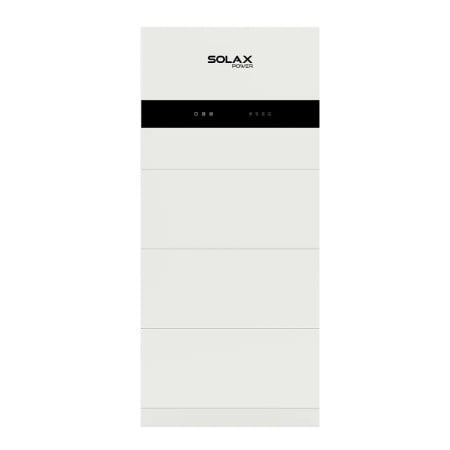

SolaX TP-HS50E 5.1 kWh High Voltage Battery
High-voltage 5.1 kWh battery module (about 4.6 kWh usable at 90% DoD) with cobalt-free LiFePO4 cells, for the SolaX X1-IES (1–4 modules, up to 20.4 kWh) and X3-IES (2–6 modules, up to 30.6 kWh) storage systems.
Charge and discharge up to 50 A, over 6,000 cycles, IP66, 10-year warranty. The BMS is not integrated: it must be paired with the TBMS-MCS0800E, which manages up to 4 modules.
The SolaX TP-HS50E is the high-voltage 5.1 kWh battery module with cobalt-free LiFePO4 cells of the integrated X1-IES and X3-IES storage system. It stacks in a column under the inverter, is rated IP66 and handles charge and discharge currents up to 50 A.
The module alone does not work: you need the BMS
This is the detail missing from almost every listing in circulation, and the one that causes incomplete deliveries: the TP-HS50E has no integrated BMS. The battery management system is a separate component, the TBMS-MCS0800E, which governs up to 4 modules and includes the column base. If the configuration exceeds 4 modules and therefore needs two columns, a Series Box THS50E is required as well. The minimum shopping list for a working storage system is therefore: IES inverter + TP-HS50E modules + BMS.
The low-voltage T-BAT-SYS-LV D53 series is different, with the BMS inside each module: these are two distinct architectures and the accessories are not interchangeable.
TP-HS50E technical specifications
| Nominal capacity | 5.1 kWh per module |
| Usable capacity | About 4.6 kWh (90% depth of discharge) |
| Technology | Cobalt-free lithium iron phosphate (LiFePO4) |
| Architecture | High voltage, stackable modules |
| BMS | Not integrated — requires separate TBMS-MCS0800E |
| Max charge / discharge current | 50 A |
| Max power | 5.1 kW |
| On X1-IES (single-phase) | 1 to 4 modules, 5.1–20.4 kWh |
| On X3-IES (three-phase) | 2 to 6 modules, 10.2–30.6 kWh |
| Cycle life | Over 6,000 |
| Protection rating | IP66 |
| Max operating altitude | 3,000 m |
| Dimensions (H×W×D) / weight | 730 × 318 × 150 mm / 47 kg |
| Warranty | 10 years |
How to size the capacity
The practical rule for a home: the battery covers the consumption that shifts from day to evening, not the entire demand. For a household with annual consumption around 3,500 kWh, two modules (10.2 kWh nominal, about 9.2 usable) are usually the balance point between cost and benefit. Going to three or four makes sense with a heat pump, an electric-car charge, very high evening consumption, or to increase coverage during a grid outage.
It is also worth starting with the BMS of the final configuration: the TBMS-MCS0800E covers up to 4 modules, so anyone planning to expand within that limit does not have to replace it.
Frequently asked questions
Does the TP-HS50E have an integrated BMS?
No. It must be paired with the external BMS TBMS-MCS0800E, which manages up to 4 modules and includes the base. It is the most frequent ordering error on this family: the battery alone cannot be commissioned.
Which inverters is it compatible with?
It is designed for the X1-IES (single-phase, 1–4 modules) and X3-IES (three-phase, 2–6 modules) systems. It can also be used with X1-Hybrid G4 and X3-Hybrid G4 inverters, but then the BMS version specified by SolaX for those inverters is required: compatibility must be checked on the exact model before ordering.
How much energy can I really use from a module?
About 4.6 kWh out of the 5.1 nominal, corresponding to a 90% depth of discharge. This is the figure to use in autonomy calculations: two modules give about 9.2 usable kWh, not 10.2.
Can I add modules later?
Yes, within the limits of the inverter configuration and the installed BMS. Bear in mind that the modules of the same column should have similar age and state of health: adding a new module to a column that has worked for years pulls performance down to the lowest — behaviour common to all modular systems.
Can it be installed outdoors?
The IP66 rating allows it and the maximum operating altitude is 3,000 m. As with any lithium battery, though, temperature is the factor that determines lifespan: a sheltered, ventilated position out of direct sun is worth more than any nameplate spec.