
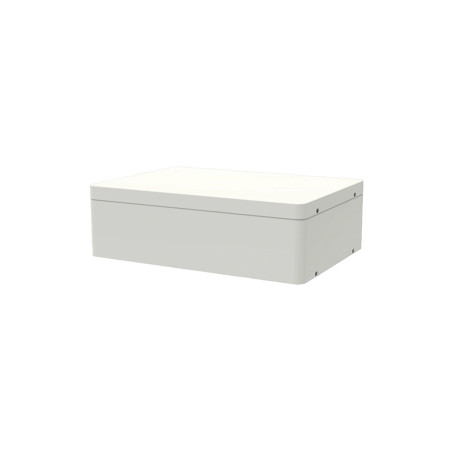

Series Box TBHS51
Series Box TBHS51 for SolaX Triple Power HS51 storage systems: it is the accessory that connects two battery towers when one is no longer enough.
Required for configurations beyond the 8 TB-HS51 modules of a single tower, it allows you to reach up to 13 modules, equal to 66,5 kWh, managed by a single BMS. To be ordered together with the BMS, battery modules and base module.
The Series Box TBHS51 is the component that allows you to expand a SolaX Triple Power TSYS-HS51 storage system beyond a single battery tower. Without the Series Box, the system remains limited to one tower with 2 to 8 modules; with the Series Box, two towers managed by the same BMS can be connected, up to a total of 13 TB-HS51 modules and 66,5 kWh nominal.
When is the Series Box needed?
This is the most common question when placing an order. The practical rule is simple: up to 8 battery modules it is not needed, because they all fit into a single tower together with the BMS and base module. From the ninth module onward, it is mandatory, because the capacity must be distributed over two side-by-side towers and the Series Box is the element that connects them in series and makes the system see them as a single bank.
| Up to 8 TB-HS51 modules (max 40,9 kWh) | Single tower: BMS + modules + base. Series Box not required |
| From 9 to 13 TB-HS51 modules (46,0 - 66,5 kWh) | Two towers: BMS + modules + base + Series Box |
How an HS51 tower is composed
The TSYS-HS51 system is modular and always consists of the same elements, to be ordered separately:
- BMS TBMS-S51 - the control unit that manages the entire battery bank
- TB-HS51 battery modules - blocks of 5,1 kWh nominal each, with a depth of discharge of 90% (4,59 kWh usable per module)
- Base module - the base on which the column rests
- Series Box TBHS51 - this product, required only for the two-tower configuration
The modules are stacked and connected to each other without external wiring: it is a plug-in assembly, designed to be carried out even by a single installer.
Series Box TBHS51 technical specifications
| Function | Series connection of two HS51 battery towers |
| Compatible system | SolaX Triple Power TSYS-HS51 (TB-HS51 modules, BMS TBMS-S51) |
| Required configuration | From 9 to 13 total battery modules |
| Maximum system capacity | 66,5 kWh nominal with 13 modules |
| Maximum system current | 70 A charging and discharging |
| Cell chemistry | LiFePO4 (LFP) |
| Weight | 15 kg |
| Dimensions | 225 x 600 x 376 mm |
Frequently asked questions
Is the Series Box TBHS51 a battery?
No. The Series Box does not contain cells and does not add storage capacity. It is a connection component: it connects two towers of TB-HS51 modules in series so that the BMS manages them as a single bank. Capacity is added by purchasing TB-HS51 battery modules.
I have 6 TB-HS51 modules: do I also need to buy the Series Box?
No. With 6 modules you remain in a single tower, where the limit is 8 modules. The Series Box becomes necessary only from the ninth module, when a second tower is required. However, if you plan to exceed 8 modules in the future, you can add it later without redoing the system.
How much usable capacity do I get with 13 modules?
Thirteen TB-HS51 modules provide 66,5 kWh nominal. With a depth of discharge of 90%, the actually usable energy is approximately 59,7 kWh, i.e. 4,59 kWh per module. This is a typical size for commercial installations or large residential users.
Is a second BMS needed for the second tower?
No: the two-tower configuration connected with the Series Box is managed by a single BMS TBMS-S51. A second BMS is instead needed when creating two separate battery banks, typically on commercial systems with large-capacity inverters.
Which inverters is the HS51 system compatible with?
The Triple Power HS51 bank is high-voltage and works with compatible SolaX hybrid inverters, both single-phase and three-phase, and with commercial solutions from the X3-AELIO series. Always check the inverter manual for the maximum number of modules and towers allowed before sizing the storage system.