



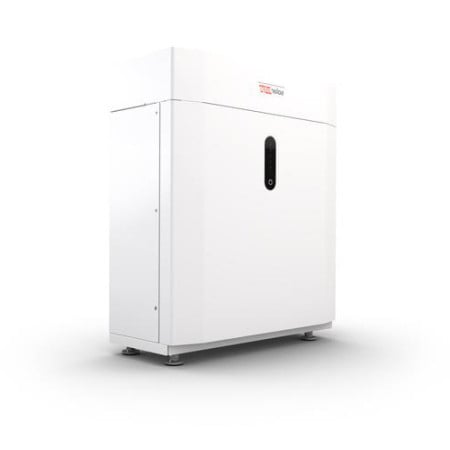

SE-BAT-05K48M0B-02
SolarEdge Home 48V BAT-05K48M0B-02 Battery: lithium storage module LFP with 4,6 kWh fully usable (100% DoD), DC-coupled to SolarEdge Home Hub and StorEdge three-phase inverters.
Discharge power up to 4.096 W per single module, cycle efficiency over 95%, IP65 rating for indoor or outdoor installation and noise level below 25 dBA. Stackable up to 5 modules (23 kWh). 10-year warranty.
The SolarEdge Home 48V battery (manufacturer code BAT-05K48M0B-02, BAT-05K48 series) is a 4,6 kWh LFP lithium storage module designed to work in direct DC coupling with SolarEdge inverters. Unlike many AC-coupled retrofit systems, the energy produced by the photovoltaic array reaches the cells without double DC-AC-DC conversion: the overall round-trip efficiency exceeds 95,4%.
Compatible only with SolarEdge three-phase inverters: check before ordering
This is the point that should be made clear, because it is the most common cause of incorrect orders. The 48V battery is the storage solution for SolarEdge Home Hub three-phase and StorEdge three-phase inverters. It is not the battery for the single-phase inverters in the Home range, which instead use the 400 V high-voltage architecture, and it cannot be used with inverters from other manufacturers: there is no "generic" 48 V mode, because the BMS communicates via CAN bus directly with the SolarEdge inverter. Before ordering, check the inverter model on the SolarEdge compatibility matrix.
The declared 4,6 kWh are real 4,6 kWh
The nameplate figure is expressed as usable energy with 100% depth of discharge, not as gross nominal capacity. This is a substantial difference when comparing products: many competing storage systems declare the nominal capacity and then make 80-90% of the energy available. Here, the 4.600 Wh are the ones that can actually be cycled. On new installations with Home Hub three-phase, the usable energy increases to 4.850 Wh via firmware configuration.
However, the asymmetry between charging and discharging on a single module should be read carefully: 2.825 W charging versus 4.096 W discharging. With a single module, the battery delivers more than it can absorb, so a system with significant photovoltaic surplus at midday will not be able to store it all. With two or more modules, the limit rises to 5.000 W in both directions.
BAT-05K48M0B-02 technical specifications
| Usable energy (100% DoD) | 4.600 Wh (4.850 Wh on new Home Hub three-phase installations) |
| Cell chemistry | Lithium iron phosphate (LFP), 16S1P |
| Continuous charging / discharging power (1 module) | 2.825 W / 4.096 W |
| Continuous charging / discharging power (multiple modules) | 5.000 W / 5.000 W |
| Peak cycle efficiency | > 95,4% |
| Voltage range | 44,8 – 56,5 Vdc |
| Modules per inverter | Up to 5 in parallel (up to 23 kWh with two towers) |
| Communication | RS485 between modules, CAN bus to the inverter |
| Dimensions (W × H × D) | 540 × 500 × 240 mm |
| Weight | 54,7 kg |
| Protection rating | IP65 / NEMA 3R — indoor and outdoor |
| Operating temperature | -10 °C / +50 °C (with derating above 40 °C and below 15 °C) |
| Noise level at 1 m | < 25 dBA (natural convection cooling) |
| Safety | IEC 62619, IEC 63056, IEC 62040-1, UN38.3, UL9540A, VDE-AR-E 2510-50 |
| Warranty | 10 years |
What is not included with the module
The battery module is sold individually. To complete a tower, separate accessories are required, and this is the item most often missed in quotations:
- Top cover (IAC-RBAT-5KMTOP-01) — one per tower, mandatory
- Floor base (IAC-RBAT-5KFSTD-01) — one per tower for floor-mounted installations
- Battery-inverter cable set — different code for Home Hub three-phase and StorEdge three-phase
- Module-module cable set — one for each module added after the first
With the base, a 1-module tower with cover is 670 mm high; 1.170 mm with two modules and 1.670 mm with three. Without the base, the heights are respectively 620, 1.120 and 1.620 mm.
What you can really do with 4,6 kWh
To give a practical measure: 4,6 kWh roughly covers the nighttime consumption of a family of three with a refrigerator always running, LED lighting, TV for a few hours and a delayed dishwasher cycle. In a home with annual consumption of around 3.500 kWh and a 4-5 kWp system, a single module typically increases self-consumption from 30-35% to 55-65%. To also cover a heat pump or electric car charging, you need to move up to two or three modules.
Frequently asked questions
Does the SolarEdge Home 48V battery work with single-phase inverters?
No. The BAT-05K48 is designed for SolarEdge Home Hub three-phase and StorEdge three-phase inverters. The single-phase inverters in the SolarEdge Home range use the 400 V high-voltage storage architecture, which is a different and non-interchangeable product. Always check the exact inverter model on the manufacturer's compatibility matrix before ordering.
How many modules can I connect to the same inverter?
Up to 5 modules in parallel per inverter, for a maximum of about 23 kWh usable by connecting two towers in direct parallel. Each tower requires its own top cover and, for floor-mounted installations, its own base. Modules can also be added later to a system that is already in operation.
Can it be installed outdoors?
Yes, the protection rating is IP65 / NEMA 3R, so outdoor installation is permitted. However, the operating range from -10 °C to +50 °C and derating must be considered: below an internal temperature of 15 °C, charging power is reduced and the battery activates heating that consumes part of the charge itself. In cold climates, a sheltered location performs much better.
Does it make noise? Can I put it in a basement room or in the garage under the house?
Cooling is by natural convection, with no fans: the declared noise level at one meter is below 25 dBA, i.e. below the perception threshold in a normal domestic environment. It can therefore be installed in technical rooms, garages and basement rooms without acoustic issues, while complying with the fire safety and ventilation requirements specified in the project.
Why LFP cells and not NMC?
Lithium iron phosphate chemistry has intrinsically higher thermal stability than NMC: the onset temperature for degradation is much higher and the risk of thermal runaway is drastically reduced. In return, the energy density is lower, which explains the 54,7 kg for 4,6 kWh. For fixed residential storage, where weight is irrelevant, the compromise is almost always in favor of LFP.