


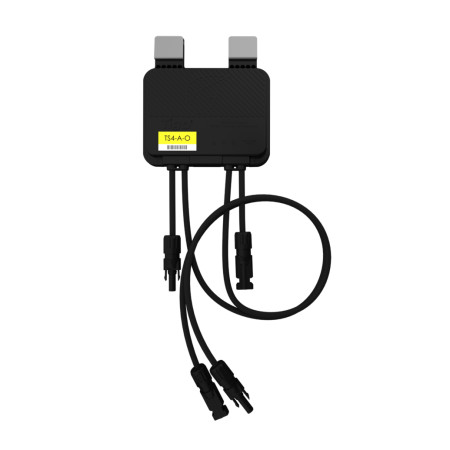

Tigo TS4-A-O 700W Optimizer with Module Shutdown
Tigo TS4-A-O power optimizer for PV modules up to 700 Wp. An add-on unit that fits an already installed module and adds optimization, module-level monitoring and shutdown.
15 A maximum current, 16-80 V range, IP68 rating, MC4/EVO2 connectors. Clips onto the module frame — even on a single shaded panel.
The Tigo TS4-A-O is the add-on power optimizer of the Flex MLPE platform, designed for PV modules up to 700 Wp. Unlike integrated optimizers it attaches to a module that is already installed, so it can be used to upgrade an existing array or to optimize only the panels that actually need it, without equipping the whole string.
Why fit an optimizer to a PV array?
In a conventional string the current is dictated by the weakest module: a chimney, an aerial or a tree canopy is enough to drag down the entire row. The TS4-A-O decouples the individual module from the string and recovers its output, cutting losses from partial shading, soiling, mismatch and uneven degradation. It also allows design with unequal string lengths and mixed roof orientations — freedom a system without MLPE does not offer.
TS4-A-O 700W technical specifications
| Maximum module power | 700 W |
| Maximum current | 15 A |
| Maximum input voltage | 80 V (Voc at lowest temperature) |
| Voltage range | 16 - 80 V |
| Recommended fuse rating | 30 A |
| Connectors | MC4 / EVO2 |
| Cable length (in/out) | 0.12 / 1.2 m |
| Ingress protection | IP68 |
| Operating temperature | -40 °C to +70 °C |
| Maximum elevation | 2000 m |
| Dimensions | 138.4 × 139.7 × 22.9 mm |
| Weight | 520 g |
| Communication | Wireless (TAP required) |
Selective optimization: how many are really needed
The TS4-A-O does not have to go on every module. Where only part of the roof suffers from shading, only the affected modules are equipped and the rest stay conventionally wired. That is the key difference from optimizers that are mandatory on every panel, and it feeds straight into system cost. Module-level monitoring and the shutdown function, on the other hand, require the dedicated communication accessories.
What is needed for full functionality
- One TS4-A-O per module to be optimized (tool-free clip mounting on the frame; clips can be removed for rail mounting).
- Tigo TAP — the wireless access point placed in the middle of the array, required for module-level shutdown.
- Tigo CCA (Cloud Connect Advanced) — the data logger that enables monitoring on the Tigo Energy Intelligence platform.
Without TAP and CCA the optimizer still works (a so-called blind deployment): it recovers production, but per-module data is not visible and shutdown cannot be commanded.
Frequently asked questions
Can the TS4-A-O be fitted to an array already in service?
Yes — that is precisely what the add-on version is designed for. It is inserted between module and string using the existing MC4 connectors, with no need to replace panels or inverter. The work must be done safely, with the string isolated, by qualified personnel.
Does it go on every panel or only the shaded ones?
For yield recovery alone, only the modules genuinely penalised by shade or mismatch need one — that is the benefit of selective optimization. If the goal is module-level shutdown across the whole array, then every panel needs its own device.
Does it work with any string inverter?
Yes. The TS4-A-O works on the module side and does not tie you to a specific inverter: it is compatible with common string inverters, provided the string design respects the device limits of 80 V maximum voltage and 15 A current.
Is my 700 W module compatible?
The stated limits are 700 W power, 15 A current and 80 V open-circuit voltage at the site's minimum temperature. All three parameters must be checked on the panel datasheet: a 700 W module drawing more than 15 A falls outside the specification.
Do I need the CCA if I only want more yield?
No. Optimization is active from the moment it is installed, with no configuration. CCA and TAP are for viewing per-module data on the Tigo portal and for managing module-level shutdown: a functional addition, not a requirement for energy recovery.