
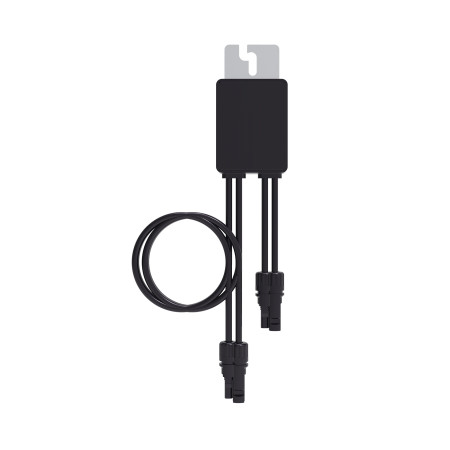

Huawei SUN2000-450W-P2 Optimizer 450 W MC4
Huawei SUN2000-450W-P2 power optimizer for systems with Huawei SUN2000 inverters: it makes every panel work at its own maximum power point, independently of the others.
450 W input, MC4 connectors, 99.5% peak efficiency. Drops output to 0 V when the inverter shuts down (rapid shutdown) and enables module-level monitoring in FusionSolar.
The Huawei SUN2000-450W-P2 is a power optimizer (Smart PV Optimizer) installed on an individual PV module to manage its operating point independently. In a conventional string the worst module dictates the behaviour of all the others; with optimizers that constraint disappears and every panel produces as much as it can.
When an optimizer really makes a difference
It is not needed on every system. It pays off where there is mismatch between modules, and the typical causes are three:
- Partial shading - a chimney, an aerial, a tree, a nearby building. In a system without optimizers, shade on a single panel penalises the whole string.
- Roof planes with different orientation or tilt - it lets you put modules on the same string that would otherwise have to be separated, using the entire available roof area.
- Soiling, leaves, uneven ageing - the degradation of one module stays confined to that module.
A concrete case: on a residential system where two panels out of twelve sit in shade for a couple of hours every afternoon, without optimizers the loss propagates across the whole string. With optimizers on the affected modules the loss stays limited to those two panels. Huawei states a yield increase that, depending on the situation, ranges from 5% to 30%.
Safety: 0 V rapid shutdown
When the inverter is switched off or disconnected, the optimizer brings its own output down to 0 V. The array therefore stops carrying voltage along the strings, a tangible benefit for fire brigade intervention, rooftop maintenance or works on the building. It is why optimizers are frequently specified even on systems with no shading issue at all.
SUN2000-450W-P2 technical specifications
| Rated input power | 450 W |
| Maximum input voltage | 80 V |
| MPPT voltage range | 8 - 80 V |
| Max short-circuit current (Isc) | 13 A |
| Maximum efficiency | 99.5% |
| Weighted efficiency | 99.0% |
| Maximum output voltage | 80 V |
| Maximum output current | 15 A |
| Output voltage with inverter off | 0 V (rapid shutdown) |
| Output bypass | Yes, a failed optimizer is bypassed |
| Connectors | MC4 |
| Safety | IEC 62109-1, class II |
| Weight (cables included) | 0.55 kg |
| Mounting | On module frame or aluminium profile, portrait and landscape modules |
Frequently asked questions
Do I need an optimizer on every panel?
Not necessarily. The Huawei system allows partial optimization: you fit optimizers only on the critical modules, typically those subject to shading or on a differently oriented roof plane. The rest of the string goes without. If instead you want panel-by-panel monitoring across the whole system, then one optimizer per module is required.
Does it work with other brands of inverter?
No. The SUN2000-450W-P2 communicates with the inverter over a proprietary Huawei protocol and must be paired with compatible Huawei SUN2000 inverters. It cannot be used with other manufacturers' inverters, nor is it interchangeable with other brands of optimizer.
Which panels can I connect to this optimizer?
Modules whose STC power does not exceed the 450 W input, with open-circuit voltage within 80 V and short-circuit current within 13 A. Modules with up to +5% power tolerance are allowed. For larger panels there is the 600 W version.
How much extra energy will I actually get?
It depends entirely on how uneven the array is. On a clear, well-oriented, unshaded roof the gain is marginal and the investment is hard to justify. On systems with recurring shading or multiple roof planes the recovery stated by Huawei reaches 30%. The assessment has to be made case by case at design stage.
What happens if an optimizer fails?
The failed optimizer is bypassed automatically and the string keeps running: the system does not stop. Module-level monitoring in FusionSolar flags which unit is affected, making the fault immediately identifiable instead of requiring a diagnosis on the roof.