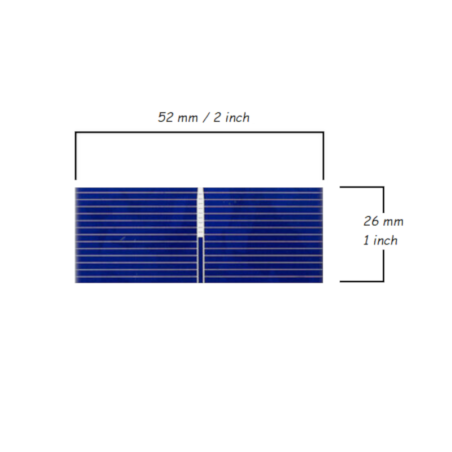


Polycrystalline solar cell 1"x2" or 26x52mm of 1BB
26x52 mm (1x2 inch) polycrystalline solar cell rated about 0.25 Wp with 1 busbar. Nominal values: Vmp 0.544 V, Imp 0.45 A, Voc 0.64 V and 18.7% efficiency.
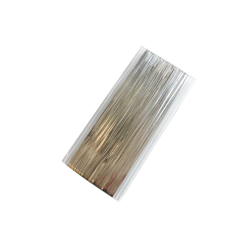
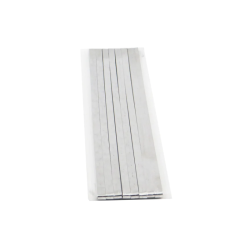
A very compact format for micro modules, models, small sensors, prototypes and STEM labs. This is a bare cell and requires ribbon, soldering, support and encapsulation.
The 26x52 mm 1BB polycrystalline solar cell produces approximately 0.25 Wp and is the smallest format in this cell family, suitable for micro modules, models, sensors and educational demonstrators. At maximum power it supplies a nominal 0.544 V and 0.45 A.
It is not a ready-to-use panel. A reliable string requires ribbon compatible with the single busbar, controlled soldering, support, insulation and encapsulation.
What projects suit the 26x52 mm format?
The small dimensions allow integration into compact objects, educational vehicles, fans, sensors and models where space is limited. Several cells may be distributed along narrow surfaces and connected in series to obtain the required voltage.
Power is limited, so the cell should not be selected to drive substantial loads directly. Start from the device's actual consumption and consider available light, storage and any required converter.
SC1P1-26x52 technical specifications
| Reference | SC1P1-26x52 |
| Technology | Polycrystalline silicon |
| Rated power Pmax | About 0.25 Wp |
| Vmp | 0.544 V |
| Imp | 0.45 A |
| Voc | 0.64 V |
| Isc | 0.49 A |
| Efficiency | 18.7% |
| Busbar | 1BB |
| Dimensions | 26x52 mm, about 1x2 inches |
| Thickness | 170 ± 20 µm |
| Weight | About 2 g |
What do 12, 24 or 36 cells produce?
Series connection adds voltage while current remains about 0.45 A. Values are theoretical before temperature, mismatch, soldering and encapsulation losses.
| Cells | Vmp | Voc | Approximate power |
| 12 | 6.53 V | 7.68 V | 3 Wp |
| 24 | 13.06 V | 15.36 V | 6 Wp |
| 36 | 19.58 V | 23.04 V | 9 Wp |
To increase current, connect only complete matched strings in parallel. Size the load, controller, wiring and protection from real operating values.
STEM projects and educational photovoltaic kits
The small format is ideal for quick experiments: voltage and current measurements, miniature solar vehicles, shading effects and comparison of one or more cells in series.
Discover The Sun in the Classroom and MR WATT educational photovoltaic kits
How to solder a micro solar cell
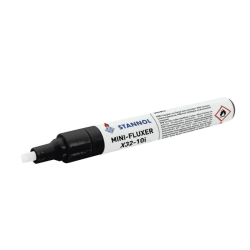
Small size does not remove wafer fragility. Use compatible ribbon and flux, a clean tip, controlled temperature and short contact times. Support the cell flat and check continuity, polarity and voltage.
Read the MR WATT solar-cell soldering guide
Frequently asked questions
Is this a complete solar panel?
No. It is one approximately 0.25 Wp cell requiring interconnections, support, insulation and encapsulation.
Can it power a small motor?
It depends on voltage, starting current and light. Multiple cells and sometimes a capacitor, battery or management circuit are normally required.
How many cells provide about 6 V?
Twelve cells in series provide approximately 6.53 V nominal Vmp before losses and environmental variation.
Is it suitable for school projects?
Yes. Its small size supports compact strings and clear demonstrations of electrical connections.
Can it be used outdoors without protection?
No. It must be encapsulated and protected from moisture, impact and bending.