



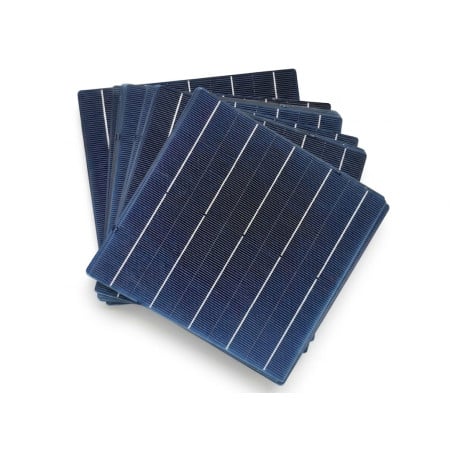


Bifacial monocrystalline solar cell 5BB 5.4Wp
Bifacial monocrystalline solar cell in M2 format, 156.75 x 156.75 mm, 200 µm thick, with 5 silver busbars on the front and a contact grid on the rear: it generates power from both faces.
Front side up to 5.40 Wp and 22.1% efficiency at STC; the manufacturer states a rear-side gain of 5-20% with a suitable installation. Solderable with standard ribbon, designed for glass-glass modules or transparent backsheets.
The bifacial monocrystalline solar cell measuring 156.75 x 156.75 mm (M2 format, 210 mm diagonal) collects light on both faces: the front receives direct irradiance, the rear the light reflected by the ground and diffuse light. Unlike a monofacial cell of the same format, the rear is not closed by a continuous aluminium layer but by a contact grid that lets light through. According to the manufacturer's datasheet, with a suitable installation the rear adds 5 to 20% to the power measured on the front.
The front has 5 silver busbars 0.7 mm wide and a silicon nitride anti-reflection coating; the rear carries silver soldering pads 1.75 mm wide. It is therefore interconnected with conventional front-to-back ribbon, just like the busbar monocrystalline cells you already know: no conductive backsheet or special equipment required.
Bifacial does not automatically mean more energy
This is the point most competitor listings leave out. The rear gain only exists if light actually reaches the rear, and it depends on three factors:
- The module must be transparent at the back: glass-glass or a transparent backsheet. Laminated with an opaque white or black backsheet, a bifacial cell works exactly like a monofacial one and the price premium is wasted.
- Ground albedo, i.e. how much light the surface under the module reflects: grass reflects roughly 15-26%, concrete and light gravel more, a white membrane or snow much more.
- Height and clearance: a module laid flat on a roof has its rear in the dark. Pergolas, canopies, vertical fences, balustrades and elevated ground mounts are where the rear side works.
That is why the stated range is so wide: 5% in modest conditions, 20% over very bright surfaces with the module well raised.
Technical specifications
| Technology | Monocrystalline silicon, bifacial cell |
| Format | 156.75 x 156.75 mm (M2), diagonal 210 ±0.25 mm |
| Thickness | 200 ±20 µm |
| Front (- pole) | 5 silver busbars 0.7 ±0.1 mm, silicon nitride anti-reflection coating |
| Rear (+ pole) | Silver soldering pads 1.75 ±0.1 mm, gridded aluminium back surface field (BSF) |
| Front power (STC) | 5.20 to 5.40 Wp depending on bin |
| Front efficiency | 21.3% to 22.1% |
| Rear-side gain | 5-20% with suitable installation (manufacturer data) |
| Bifaciality factor | Not stated in the datasheet |
| Temperature coeff. Pmax | -0.41 %/°C |
| Temperature coeff. Voc | -0.32 %/°C |
| Temperature coeff. Isc | +0.04 %/°C |
| Test conditions | STC: 1000 W/m² on the front, AM1.5, 25 °C |
Power bins (front side, STC)
| Pmax | Vmp | Imp | Voc | Isc | Efficiency |
| 5.20 W | 0.564 V | 9.22 A | 0.669 V | 9.73 A | 21.3% |
| 5.28 W | 0.568 V | 9.29 A | 0.672 V | 9.78 A | 21.6% |
| 5.30 W | 0.569 V | 9.32 A | 0.673 V | 9.80 A | 21.7% |
| 5.35 W | 0.572 V | 9.35 A | 0.675 V | 9.83 A | 21.9% |
| 5.40 W | 0.574 V | 9.40 A | 0.677 V | 9.87 A | 22.1% |
The efficiencies check out against the geometry: the pseudo-square cell has a usable area of about 244 cm², and 5.40 W over 244 cm² at 1000 W/m² gives 22.1%. When sizing a module always use the front-side values; the rear contribution is an extra margin that depends on the site, not a guaranteed nameplate power.
How much the rear really adds: a worked example
The measurement standard for bifacial devices (IEC TS 60904-1-2) uses 135 W/m² on the rear together with 1000 W/m² on the front as reference, a condition representative of a raised module over ground of average albedo. The bifaciality of this model is not stated: assuming 70%, typical of p-type bifacial cells with an aluminium rear grid, the 5.40 Wp cell reaches about 5.9 W equivalent, roughly +9%. This is a calculation assumption, not a nameplate figure: it shows the order of magnitude.
Heat matters too. At -0.41 %/°C, a cell running at 65 °C in summer loses about 16% compared with the 25 °C test temperature: the 5.40 Wp cell then delivers about 4.5 W from the front. Well-ventilated bifacial installations such as pergolas and fences help here as well, because the module stays cooler.
Who it is for and where to use it
- Custom glass-glass modules for pergolas, canopies, carports and verandas, where the light filtering between cells is also an architectural feature
- Vertical modules for east-west facing fences and balustrades, producing from both faces in the morning and afternoon
- Prototyping and laboratories: bifaciality measurements, front/rear comparisons, teaching cell architectures
- DIY builds: at 200 µm with front busbars, this cell can be hand-soldered with ribbon, flux and a temperature-controlled iron
It is not the right choice for a panel laminated with an opaque backsheet or bonded to a solid surface: there a monofacial monocrystalline cell costs less and performs the same. MR WATT designs and manufactures custom PV modules: if you need a finished glass-glass module with these cells, we can take care of stringing and lamination.
Frequently asked questions
Does a bifacial cell always produce more than a standard cell?
No. The rear only produces if it receives light: in a module with an opaque backsheet, or one laid on a roof with no space underneath, a bifacial cell performs like a monofacial one. The stated 5-20% gain is achieved with glass-glass or transparent-backsheet modules mounted raised above bright surfaces.
Can it be hand-soldered like conventional busbar cells?
Yes. The front has 5 silver busbars 0.7 mm wide and the rear has 1.75 mm silver soldering pads, so cells are connected in series with tinned front-to-back ribbon. You need no-clean flux and a temperature-controlled soldering iron. The 200 µm thickness makes it more forgiving to handle than the thinner latest-generation cells.
How many cells do I need to charge a 12 V battery?
With a maximum power point voltage of about 0.57 V per cell, you need 36 cells in series: about 20.5 V at 25 °C, dropping towards 18 V with hot cells in summer, still enough for a charge controller to charge a 12 V battery properly. 36 cells of 5.4 W give a module of about 190 W from the front side alone, before lamination losses.
What is the bifaciality factor and why is it not stated?
It is the ratio between the power produced by the rear and by the front under the same light, measured according to IEC TS 60904-1-2. The datasheet of this model does not report it; p-type bifacial cells with an aluminium rear grid typically sit between 65 and 80%, while n-type cells such as TOPCon and heterojunction reach 80-95%.
Does the stated power include the rear contribution?
No. The 5.20 to 5.40 Wp bins are measured at STC with light on the front only. The rear contribution comes on top depending on the installation and must not be used to size strings and charge controllers: design on the front-side values and treat the rear as a production margin.