
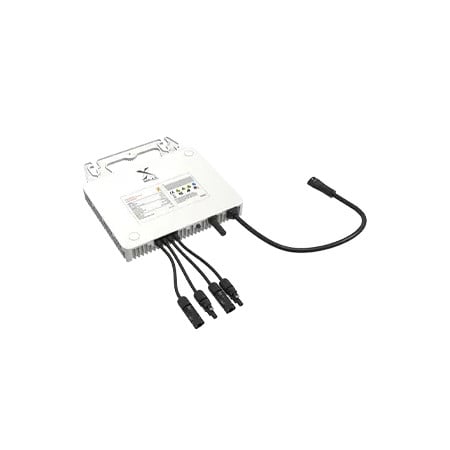

SolaX X1-Micro 1000 W Microinverter 2 MPPT
SolaX X1-Micro 1000: 1,000 W single-phase microinverter with two independent MPP trackers, built-in Wi-Fi and IP67 rating, mounted behind the modules.
Each module works at its own maximum point, so shading on one panel does not drag down the other. Conversion happens on the roof: the only cable running through the building is at 230 V AC, with no high-voltage DC section. 96.5% efficiency, per-module monitoring on SolaX Cloud.
The SolaX X1-Micro 1000 is a 1,000 W single-phase microinverter with two independent MPP trackers, built-in Wi-Fi and an IP67 rating. It mounts directly behind the modules and converts to 230 V right there, at panel level.
Two trackers for two modules: shading stops being contagious
This is the real reason to choose a microinverter. In a string, all modules are wired in series: a chimney shadow, a leaf or a soiled panel drags down the whole string, because the current is set by the weakest module.
Here each module has its own MPP tracker. If one panel is shaded, the other keeps working at its own maximum. On roofs with dormers, aerials, chimneys or trees nearby — and on installations split across faces with different orientations — that is not a marginal gain: it is the difference between an array that yields what was calculated and one that disappoints from the first autumn.
No high-voltage DC on the roof
A string system carries several hundred volts of direct current from the roof down to the inverter. A microinverter converts on the spot: the only cable running through the building is at 230 V AC, the same as any household circuit. There is no high-voltage DC section, and therefore none of the DC-side risks that string systems are designed around.
It also simplifies expansion: adding a module means adding a microinverter, without recalculating string voltage or worrying about the inverter's input limits.
Technical specifications
| Rated output power | 1,000 W single-phase, 230 V |
| MPP trackers | 2, independent (one per module) |
| Maximum efficiency | 96.5% |
| Monitoring | Built-in Wi-Fi, SolaX Cloud portal and app |
| Protection rating | IP67, outdoor installation behind the modules |
| Installation | Directly on the module support structure |
Where a microinverter earns its price
A microinverter costs more per watt than a string inverter, so it is worth being clear about when it pays back. It makes sense on small arrays of two to six modules, on irregular or shaded roofs, on installations spread across several orientations, and wherever per-module monitoring matters — a failing panel is identified immediately, not months later from an unexplained drop in output.
On a clean, unshaded south-facing roof with ten or more modules, a string inverter remains the more economical choice and gives away very little.
Frequently asked questions
How many modules can I connect?
This model has two independent trackers, so it serves two modules. Larger arrays use several microinverters wired in parallel on the AC side, which is exactly how the system scales.
Does it need a separate monitoring device?
No. Wi-Fi is built in and data goes to the SolaX Cloud portal and app, with per-module readings. That granularity is one of the main practical advantages: an underperforming panel shows up straight away.
Can it be installed outdoors under the modules?
Yes, that is exactly where it belongs. The IP67 rating covers dust and temporary immersion. Even so, avoid positions with standing water and leave room for air circulation: heat is what ages power electronics.
Does it need approval from the grid operator?
Yes, like any generator connected to the grid. The connection procedure and the paperwork depend on the total installed power and on national rules, and the work must be carried out by a qualified installer who issues the declaration of conformity.
What happens if one microinverter fails?
Only the modules connected to it stop producing; the rest of the array carries on. It is the opposite of a string system, where an inverter failure shuts everything down. Replacement, on the other hand, means working on the roof — which is worth bearing in mind when the array is on a difficult pitch.