


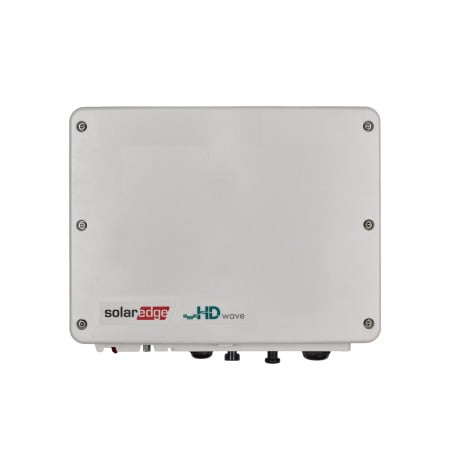

SolarEdge SE4000H Single-Phase Inverter 4 kW HD-Wave
4.000 VA single-phase photovoltaic inverter with HD-Wave technology and maximum efficiency of 99,2%. Accepts up to 8.000 W of DC power, i.e. double the output power, to make the most of large roofs on limited connections. Only 7,8 kg, IP65, under 25 dBA without fans. 12-year warranty extendable to 25. Requires SolarEdge optimizers on each module.
The SolarEdge SE4000H-RW000BEN4 is a 4.000 VA single-phase inverter with HD-Wave technology. It is the highest size in the single-phase HD-Wave family that still makes sense for an Italian home user upgraded to 4,5 or 6 kW, and it accepts up to 8.000 W of photovoltaic input power: twice the rated output power.
8 kWp of modules on a 4 kW inverter
DC oversizing up to 200% is the feature that makes this size interesting in Italy. Those with a large roof but limited connection power can install a photovoltaic array much larger than the inverter nameplate suggests: peak production is clipped during the few central hours of clear days, but mornings, evenings, winters and cloudy days yield much more. With storage or significant daytime loads, such as a heat pump or a wallbox, the excess energy is not wasted but shifted where it is needed.
Why an optimizer is needed on every module
The SE4000H is not a traditional string inverter: it requires a SolarEdge power optimizer on each module. This is an operating requirement, not an optional improvement, and must be included in the budget from the initial quote. In return, the string voltage remains fixed at 380 V: there is no MPPT window to comply with, no need to calculate Voc at the minimum temperature on the inverter, and strings of different lengths can coexist. On an Italian roof with small roof sections and mixed orientations, it is often the difference between installing 20 modules and installing 14.
Installation, noise, safety
It weighs 7,8 kg and measures 280 x 370 x 142 mm: it can be wall-mounted independently. Cooling is by natural convection, without fans, with noise below 25 dBA, so placement in a living environment does not create problems; the IP65 rating also allows outdoor installation. DC arc fault protection is integrated and SafeDC reduces the voltage along the strings when the inverter is switched off, an aspect that matters in fire risk assessments on roofs. 12-year warranty, extendable to 20 or 25.
SE4000H-RW000BEN4 technical specifications
| Rated AC power | 4.000 VA (single-phase) |
| AC output voltage | 220 / 230 Vca (range 184 - 264,5 Vca) |
| Frequency | 50 / 60 ± 5 Hz |
| Maximum continuous output current | 18,5 A |
| Harmonic distortion (THD) | < 3% |
| Power factor | 1, adjustable from -0,9 to 0,9 |
| Maximum DC input power | 8.000 W (oversizing up to 200%) |
| Maximum input voltage | 480 Vcc |
| Nominal DC voltage | 380 Vcc (constant) |
| Maximum efficiency | 99,2% |
| Topology | Transformerless, ungrounded |
| Communication | RS485 and Ethernet as standard; Wi-Fi, cellular network and ZigBee optional |
| Commissioning | SolarEdge SetApp app (no onboard display) |
| Protection rating | IP65, indoor or outdoor installation |
| Cooling and noise | Natural convection, < 25 dBA |
| Dimensions (H x W x D) | 280 x 370 x 142 mm |
| Weight | 7,8 kg |
| Safety | Integrated arc fault protection, SafeDC |
| Connection standards | CEI 0-21, IEC 61727, IEC 62116, EN 50438 and others |
| Warranty | 12 years, extendable to 20 or 25 |
Frequently asked questions
How many modules can I connect to an SE4000H?
The limit is 8.000 W of installed DC power, i.e. twice the 4.000 VA output. With 450 W modules, this means about 17-18 panels. However, the minimum and maximum number of optimizers per string depends on the model selected and must be checked with SolarEdge Designer, which also takes into account the module power and site conditions.
Does it make sense to oversize the photovoltaic array this much?
It makes sense when the connection power is the constraint and the roof is not, which is the case for the vast majority of Italian homes. Maximum power is reached only for a few hours on clear summer days: during the rest of the year, a larger array produces more with the same inverter. The benefit increases if there is storage or if there are daytime loads such as a heat pump or car charging.
Can I use it with modules and optimizers from other brands?
The modules can be of any brand, provided they are compatible with the chosen optimizer in terms of power, open-circuit voltage and current. The optimizers, however, must be SolarEdge: the architecture is based on proprietary communication between inverter and optimizers, and devices from other manufacturers cannot be used.
What is the difference between SE3500H and SE4000H?
The differences are the output power, 3.500 versus 4.000 VA, the maximum continuous current, 16 versus 18,5 A, and above all the DC input power accepted, 7.000 versus 8.000 W. Dimensions, weight, efficiency, noise and protection rating are identical. The choice is therefore based on the size of the photovoltaic array and the available connection power.
What happens to the system in the event of a blackout?
Like any grid-connected inverter, the SE4000H disconnects for the anti-islanding protection required by CEI 0-21: without the grid it does not produce. To have energy during an outage, storage and an inverter from the Home Hub line with the relevant backup interface are required. The SE4000H is a pure photovoltaic inverter, without battery management.