



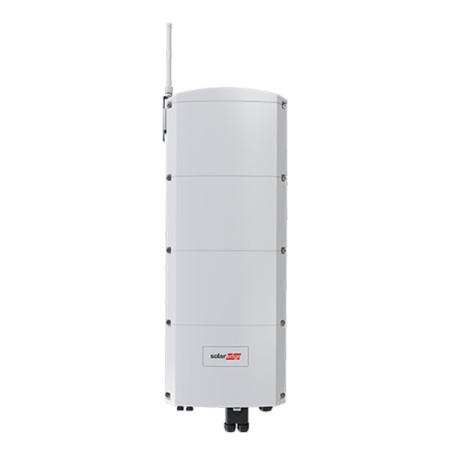

SolarEdge SE10K Three-Phase Hybrid Inverter 10 kW
10 kW three-phase hybrid inverter from the SolarEdge Home Hub line, with DC coupling and DC oversizing up to 200%. It is the last size below the 11,08 kW threshold of CEI 0-21, so it does not require an external interface panel. SolarEdge Home 48V battery up to 5 modules (23 kWh), 5.000 W charging and discharging. IP65, 37 kg. Backup interface not included.
The SolarEdge SE10K-RWB48BFN4 is a 10 kW three-phase hybrid inverter from the SolarEdge Home Hub line: a single device for photovoltaic production, storage management and, with the dedicated hardware, operation during a grid outage. It is the largest size in the residential three-phase family, above SE5K and SE8K.
10 kW: the last size below the CEI 0-21 threshold
This is the most important point for those designing systems in Italy, and one that no price list highlights. CEI 0-21 sets the threshold at 11,08 kW, beyond which the interface protection integrated into the inverter is no longer sufficient and an external interface panel with calibrated SPI relay, interface device and test report are required. With 10 kW you stay below this limit: you can access the simplified procedure and avoid a cost item that, for interface panels, starts from several hundred euros, plus the related calibration. Anyone considering moving up in size should also budget for that step, not just the price difference between two inverters.
DC coupling
The architecture is DC-coupled: excess photovoltaic energy is stored directly in the battery without the double DC-AC-DC conversion of AC-coupled systems. Together with DC oversizing up to 200%, this is why this platform is chosen for residential systems with storage: a photovoltaic array much larger than the inverter nameplate rating can be installed without wasting excess production.
Backup and battery power: two limits to know
The SE10K is backup-ready, not equipped for backup: to power loads when the grid is unavailable, the battery and the SolarEdge Home BI-NEUNU-3P-01 three-phase backup interface, purchased separately, are required. The second limit is more subtle: the maximum battery charge and discharge power is 5.000 W, compared with the inverter’s 10 kW. In off-grid operation, therefore, a maximum of 5 kW can be drawn from storage regardless of how many battery modules are installed: the essential loads panel must be sized based on that figure.
In practical terms, the inverter is fan-cooled, with declared noise level below 50 dBA: suitable for a technical room, garage or outdoor installation, less so for a wall adjoining a bedroom area. With 37 kg and 907 x 317 x 192 mm, installation should be carried out by two people.
SE10K-RWB48BFN4 technical specifications
| Type | SolarEdge Home Hub three-phase hybrid inverter |
| Nominal AC power | 10.000 W |
| Storage architecture | DC coupling (DC-coupled) |
| Supported batteries | SolarEdge Home Battery 48V BAT-05K48, up to 5 modules (23 kWh) |
| Max charge / discharge power | 5.000 W |
| Backup function | Ready; requires BI-NEUNU-3P-01 three-phase interface (not included) |
| DC photovoltaic input | 2 pairs of MC4 connectors |
| DC oversizing | Up to 200% |
| AC output - cable gland | Diameter 15 - 21 mm, cross-section 2,5 - 16 mm² |
| DC battery - cable | Cross-section 35 mm² |
| Recommended external residual current device | Type A 100 mA (minimum non-tripping 70 mA) |
| Cooling and noise level | Fan-cooled, < 50 dBA |
| Operating temperature | -40 °C / +60 °C |
| Protection rating | IP65, indoor or outdoor installation |
| Dimensions (H x W x D) | 907 x 317 x 192 mm |
| Weight | 37 kg |
| Commissioning | SolarEdge SetApp app (no onboard display) |
| Monitoring | At individual module level via optimizers |
Frequently asked questions
With 10 kW, is an external interface panel required?
No, and this is the main advantage of stopping at this size. The CEI 0-21 threshold for the simplified procedure is 11,08 kW: with 10 kW, the interface protection integrated into the inverter is sufficient and the manufacturer’s declaration is enough. Above that value, an external panel with calibrated SPI relay, interface device and test report would be required, with the related supply and calibration cost.
What is the difference between SE8K and SE10K?
The nominal output power changes, 8 versus 10 kW. Enclosure, weight, protection rating, cooling, battery management and storage charge and discharge power are identical. The choice is therefore based on the connection power agreed with the distributor and on the size of the photovoltaic array, not on functional differences.
How much battery capacity can I connect?
Up to five SolarEdge Home 48V BAT-05K48 battery modules per inverter, for a total capacity of around 23 kWh. Increasing the number of modules increases stored energy, not power: charging and discharging remain limited to 5.000 W. The correct cabling accessory between battery and inverter is also required, which for the Home Hub line is the IAC-RBAT-5KCINV-01 set.
Is whole-home backup included?
No. The inverter is ready for backup, but the battery and the SolarEdge Home BI-NEUNU-3P-01 three-phase backup interface, sold separately, are required. It must also be verified that off-grid operation is permitted by local regulations. This should be clarified at the quotation stage, because continuity during blackouts is often assumed by looking only at the inverter code.
Are SolarEdge optimizers also required with this inverter?
Yes. Like the entire SolarEdge platform, the SE10K works exclusively with SolarEdge power optimizers installed on the photovoltaic modules: they keep the string voltage constant and enable monitoring at individual panel level. Their cost must always be included when comparing with a traditional three-phase hybrid inverter.