



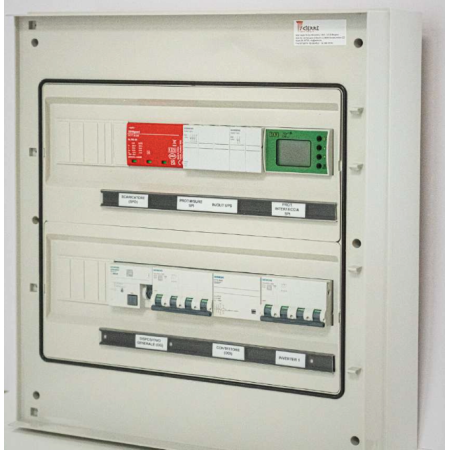

Three-Phase Photovoltaic AC Protection Panel QAC 8/11 kW
Three-phase AC panel 8/11 kW with IMTD 4x20 A class A 300 mA, IMT input/output switch-disconnector and class II SPD surge arrester 4P 400 V - 15 kA in an IP65 18-module box, with single-line diagram and Di.co. It is the last size in the series that remains below the 11,08 kW threshold of the simplified CEI 0-21 procedure: it does not include an SPI or DDI contactor, because at this power level the inverter interface protection is sufficient.
The Icierre QAC 8/11 kW AC panel protects the alternating current line of a three-phase photovoltaic system up to 11 kW, with a rated current of 20 A at 400 V. Compared to the smaller size, it adds an IMT disconnector in in/out configuration, allowing the panel to be inserted on an existing backbone without permanently interrupting it. All in an IP65 box with 18 DIN modules, with single-line diagram and declaration of conformity Di.co.
The last size before 11.08 kW
CEI 0-21 divides low-voltage connected systems into three ranges. Up to 11.08 kW, the simplified procedure applies: reduced documentation and interface protection integrated in the certified inverter, with no external SPI relay. Above 11.08 kW, the standard applies in full, with dedicated SPI and interface device. Above 20 kW, the obligation for remote monitoring and remote management by the distributor is added.
The QAC 8/11 kW is built exactly for the first range and does not contain SPI, DDI contactor or test report: at 11 kW these would be unnecessary and costly components. If the project is close to the threshold - for example 11.5 kWp of modules on a 10 kW inverter - the power that counts for CEI 0-21 is that of the inverter, but it is advisable to check this with the distributor before ordering, because moving up to the next range means changing the panel, not just adding a component.
Why the in/out disconnector makes the difference
The 4x20 A in/out IMT allows the panel to be disconnected without removing power from the rest of the line to which it is connected. In practice, this means being able to perform maintenance on the inverter, replace a depleted surge arrester or check the residual current device without taking the entire user system out of service. On small commercial systems, where the photovoltaic system coexists with loads that cannot stop, it is the difference between a ten-minute intervention and a scheduled shutdown.
QAC 8/11 kW technical specifications
| System power | 8 - 11 kW three-phase |
| Rated current | 20 A |
| Operating voltage | 400 V three-phase + neutral |
| Main protection | IMTD 4x20 A, class A, 300 mA |
| Disconnection | IMT in in/out configuration |
| Surge arrester | SPD class II, 4P, 400 V, 15 kA |
| Enclosure | IP65 box with 18 DIN modules (115 x 260 x 340 mm) |
| Interface protection (SPI) | Not present - assigned to the inverter |
| Included documentation | Single-line diagram, declaration of conformity Di.co |
| Manufacturer | Icierre - Italian construction |
Frequently asked questions
What is the difference between the QAC 8/11 kW and the QAC 6/8 kW?
Two concrete differences: the rated current increases from 16 A to 20 A, suitable for 11 kW systems that draw about 15.9 A per phase, and the IMT disconnector in in/out configuration is added, which is absent on the smaller size. The box and IP65 protection rating are identical, as is the absence of the SPI.
Does the panel include SPI interface protection and the test report?
No. Up to 11.08 kW, CEI 0-21 accepts the interface protection integrated in the certified inverter, so the panel contains only the line protections. If a panel with SPI, DDI contactor and test report is required, it is necessary to move up to the QAC 12/15 kW size or higher.
What does in/out configuration mean?
It means that the line enters the panel and exits it, continuing towards other users, instead of terminating inside it. The IMT disconnector makes it possible to isolate only the panel branch for maintenance, while keeping the rest of the backbone powered. This is the typical configuration when the photovoltaic system is connected to an already existing distribution system.
Is the 300 mA residual current device sufficient or is a 30 mA one needed?
At 300 mA, the function is protection against indirect contact and fire risk on the production line, not the protection of people against direct contact, which remains the task of the 30 mA residual current devices on the terminal circuits of the user system. Class A, on the other hand, is mandatory because inverters can generate pulsating unidirectional fault currents that an AC-type residual current device would not detect.
Can the panel be installed outdoors?
The IP65 rating makes it suitable for outdoor installation protected from dust and water jets. However, direct and prolonged exposure to the sun should be avoided: internal heating reduces the capacity of the modular devices and accelerates the ageing of the surge arrester. A shaded position or a canopy is the correct solution.