



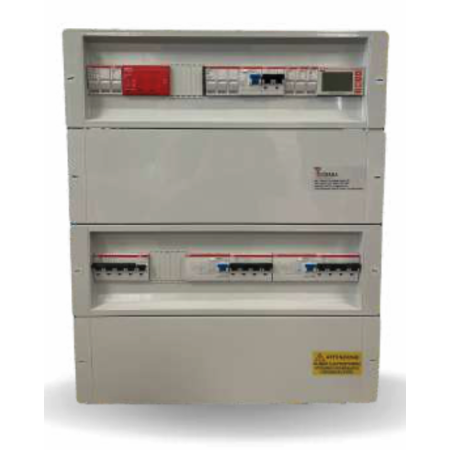

QAC 36/44 kW
Three-phase QAC 36/44 kW interface cabinet for PV systems from 36 to 44 kW, compliant with the Italian standard CEI 0-21.
54-module enclosure, 480x540x220 mm, IP66 class II: it integrates main device, interface device, interface protection and surge arrester in a single pre-wired, factory-tested unit. Supplied with wiring diagram, declaration of conformity and SPI test report.
The QAC 36/44 kW is a pre-wired three-phase interface cabinet for photovoltaic systems from 36 to 44 kW, compliant with the Italian grid code CEI 0-21. It is the typical size for installations on industrial buildings, farms, apartment blocks and commercial premises, where power is well beyond the threshold that makes an external interface mandatory.
Why an interface cabinet is required
CEI 0-21 requires an interface protection system external to the inverter for all systems connected to the low-voltage grid with a power above 11.08 kW. Its job is to disconnect the system from the grid when voltage or frequency go out of limits, preventing the generator from feeding a faulty line or one under maintenance.
The cabinet brings together in one enclosure the main device (DG), interface device (DDI), interface protection system (SPI) and surge arrester (SPD), already coordinated with each other and factory tested.
What changes compared with the smaller sizes
Going up in power does not only change the rated current of the protective devices. The QAC 36/44 kW uses a 54-module enclosure against the 36 of the sizes up to 20 kW, and above all an IP66 rather than IP65 protection rating, which makes sense on industrial installations or in environments more exposed to dust and water jets. The larger size also accommodates the dedicated protections needed when the system is split across several inverters, as is almost always the case at these power levels.
QAC 36/44 kW technical specifications
| System power | 36 - 44 kW |
| Voltage | 400 V three-phase |
| Enclosure | 54 modules, 480 x 540 x 220 mm |
| Protection rating | IP66, class II |
| Integrated functions | DG, DDI, SPI, SPD |
| Interface relay (SPI) | CEI 0-21 compliant, calibrated with a relay test set |
| Terminal blocks | Cable entry and exit |
| Reference standard | CEI 0-21 |
| Weight | 10 kg |
What is included
- Pre-wired and tested cabinet, ready to install
- Single-line diagram of the assembly
- Declaration of conformity (Di.co)
- SPI test report - the factory calibration record of the interface protection
Frequently asked questions
Does the cabinet arrive pre-wired?
Yes, it arrives fully wired and factory tested, with the interface protection already calibrated. What remains for the installer is fixing the enclosure, connecting the power cables to the terminal blocks and making the auxiliary connections shown on the supplied single-line diagram.
What is the difference between IP65 and IP66?
Both ratings guarantee complete protection against dust. What changes is water resistance: IP65 is tested against water jets, IP66 against powerful water jets. On an industrial installation, in an agricultural setting or anywhere exposed, IP66 gives extra margin.
Does CEI 0-21 or CEI 0-16 apply to a 44 kW system?
It depends on the connection point, not on power as such. CEI 0-21 covers low-voltage connections, CEI 0-16 medium-voltage ones. A 44 kW system connected in LV falls under CEI 0-21, which is what this cabinet is designed for. If the meter is on medium voltage, a CEI 0-16 compliant cabinet is required instead.
Can I use it with several inverters?
At these power levels the system is almost always split across several inverters. The cabinet configuration must however be verified case by case against the number of inverters and their currents, because the number of dedicated protections changes. It is best to send us the intended layout before ordering.
Is the test report enough to complete the connection application?
The SPI test report is one of the required documents, not the only one. The application also needs the system single-line diagram, the installer's declaration of conformity and the component certificates. Having it in the supply does however avoid arranging an on-site relay test after installation.