



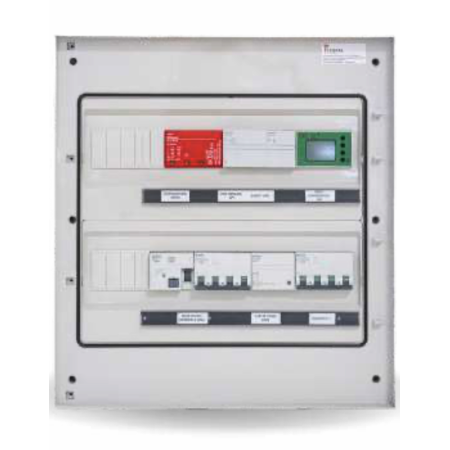

QAC 16/20 kW
Three-phase QAC 16/20 kW interface cabinet for PV systems from 16 to 20 kW, 32 A at 400 V, compliant with the Italian standard CEI 0-21.
Pre-wired and factory tested: it houses the main breaker, interface device, interface protection system and surge arrester in a 36-module IP65 class II enclosure. Supplied with wiring diagram, declaration of conformity and SPI test report.
The QAC 16/20 kW is a pre-wired three-phase interface cabinet for photovoltaic systems from 16 to 20 kW, rated 32 A at 400 V and compliant with the Italian grid code CEI 0-21. It is designed for the installer who wants to arrive on site with a unit that is ready, tested and accompanied by the paperwork the DSO asks for.
When an interface cabinet is mandatory
CEI 0-21 requires systems connected to the low-voltage grid with a power above 11.08 kW to be fitted with an interface protection system external to the inverter. Below that threshold the inverter's internal protection is sufficient, provided it is compliant. A 16 or 20 kW system therefore falls squarely within the obligation, and without an interface cabinet the grid connection application cannot be completed.
The cabinet integrates in a single enclosure the four functions required by the standard: main device (DG), interface device (DDI), interface protection system (SPI) and surge protection (SPD).
QAC 16/20 kW technical specifications
| System power | 16 - 20 kW |
| Rated current | 32 A |
| Voltage | 400 V three-phase |
| Main breaker (DG) | 4x32 A - 6 kA |
| RCBO (DDG) | 4x32 A - 6 kA - 300 mA class A |
| Contactor (DDI) | 4P, 230 V coil, AC3 category |
| Surge arrester (SPD) | Three-phase class II, 4P |
| Interface relay (SPI) | CEI 0-21 compliant |
| Auxiliary protection | 1P+N fuse holders (SPI supply) and 3P+N (SPI measurement) |
| Provisions | External auxiliary supply, loop in/out (DDI/M2), external trip |
| Terminal blocks | Cable entry/exit up to 16 mm2 |
| Enclosure | 36-module box, IP65 class II |
| Reference standard | CEI 0-21 |
What is included
- Pre-wired and tested cabinet, ready to install
- Single-line diagram of the assembly
- Declaration of conformity (Di.co)
- SPI test report - the calibration record of the interface protection system, performed in the factory with a relay test set
The test report is what makes the difference at application stage: without it the test must be carried out on site by a qualified technician, at additional cost and delay. Here it comes already done.
Frequently asked questions
Does the cabinet arrive pre-wired or do I have to assemble it?
It arrives fully wired and factory tested. What remains for the installer is fixing the enclosure, connecting incoming and outgoing power cables to the terminal blocks, and making the auxiliary connections shown on the supplied single-line diagram.
What is the SPI test report and why does it matter?
It is the record documenting calibration and verification of the interface protection system to CEI 0-21, carried out with a dedicated relay test set. The distribution operator requires it as part of the connection application: having it supplied with the cabinet avoids arranging an on-site test after installation.
Is this cabinet suitable for two inverters?
The base configuration of the 16/20 kW size provides dedicated protection for one inverter. If the system uses two or more, the correct cabinet version must be checked against the number of inverters and their respective currents. When in doubt, send us the configuration before ordering.
Do I need it for a 12 kW system?
Above 11.08 kW the external interface is mandatory, so a 12 kW system does need one, but the right size is the QAC 12/15 kW rated 25 A. The QAC 16/20 kW is oversized for that power and the protections would not be properly coordinated.
Which documents are needed for the connection application?
Typically the system single-line diagram, the installer's declaration of conformity, component certificates and the SPI test report. The documents relating to the cabinet are included in the supply; the rest of the application remains with the installer, who completes it with the site-specific data.