



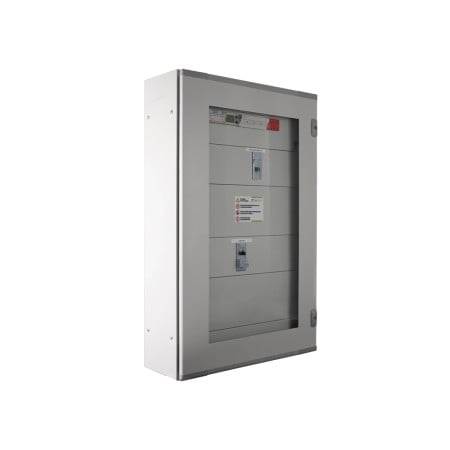

Interface Panel 100kW 1 Inverter CEI 0-21
100kW three-phase interface panel for 1 inverter, compliant with CEI 0-21 and CEI EN 61439-1/2. Protection rating IP65 class II, complete with certified SPI test report and declaration of conformity Di.co included in the supply. Ideal for industrial and commercial photovoltaic systems with LV connection and rated power up to 100kW.
The QIT100-1 is Secsun’s 100kW three-phase interface panel for 1 inverter, designed for photovoltaic systems that require full compliance with the CEI 0-21 standard. Mandatory for systems with power above 11.08 kW connected to the LV grid, it includes the Interface Protection System (SPI) with CEI 0-21-compliant relay and certified test report—essential documents for the grid connection application with the local distributor.
Why is the interface panel mandatory?
The CEI 0-21 standard requires a certified interface device (DDI) and an Interface Protection System (SPI) for all LV photovoltaic systems with power above 11.08 kW. The panel ensures automatic disconnection of the system from the grid in the event of voltage or frequency anomalies, protecting both the system and the distributor’s grid. The SPI test report, bench-tested by the manufacturer, is the document required by GSE and ENEL Distribuzione for the connection authorization.
QIT100-1 technical specifications
| Rated power | 100 kWp |
| Number of three-phase inverters | N.1 |
| Main disconnect switch | 4x160A with 230V shunt trip coil |
| Inverter protection (IMD) | 4x160A 16kA adjustable |
| DDI contactor | 4P 160A AC-3 (interface device) |
| Surge arrester | Three-phase class II, Imax 20kA |
| Interface relay | CEI 0-21 compliant (SPI) |
| Protection rating | IP65 class II |
| Certification | CEI EN 61439-1/2 |
| Dimensions (WxHxD) | 705 x 1095 x 230 mm |
| Weight | 80 kg |
| Terminal block | Numbered cable input/output |
When is it mandatory to install the interface panel?
The CEI 0-21 interface panel is mandatory for any photovoltaic system with power above 11.08 kW connected to the local distributor’s LV grid (ENEL Distribuzione, A2A Reti Elettriche, Areti, etc.). For 100 kWp systems with a single three-phase inverter, the QIT100-1 provides the protection required by the standard and complete documentation for the GSE application. It is used in industrial, agricultural, and commercial systems.
What is included in the supply?
- Wired and tested electrical panel, ready for installation
- Certified CEI 0-21 SPI test report (bench-tested — required by GSE and the distributor)
- Declaration of conformity CEI EN 61439-1/2 (Di.co)
- Single-line diagram of the panel
- Numbered input/output terminal block for easier on-site wiring
Frequently asked questions
Is the QIT100-1 supplied already wired and tested?
Yes. The QIT100-1 is delivered fully wired, assembled, and factory-tested. The SPI test report is bench-tested before shipment, so the panel can be installed immediately without additional settings or on-site testing.
What is the SPI test report and why is it essential?
The SPI test report (Interface Protection System) is the document that certifies the correct operation of the interface relay according to the CEI 0-21 standard. It is mandatory to obtain the connection authorization from the local distributor (e.g., ENEL Distribuzione) and to complete the GSE application for systems above 11.08 kW. Without this document, system commissioning cannot be completed.
Is the QIT100-1 compatible with any 100kW three-phase inverter?
Yes. The QIT100-1 works with any 100kW three-phase inverter of any brand (Huawei SUN2000, SolarEdge, SMA Sunny Tripower, Sungrow, Fronius, etc.). The inverter protection is an adjustable IMD 4x160A 16kA, sized for the maximum current of 100kW LV three-phase inverters.
Which documents are needed for the GSE application with the QIT100-1?
For the GSE application and the one with the local distributor, the following are normally required: CEI 0-21-compliant SPI test report (included), CEI EN 61439-1/2 declaration of conformity (included), panel single-line diagram (included), and the inverter declaration of conformity. The QIT100-1 already includes all panel-specific documents.
What is the difference between QIT100-1 and QIT100-2?
The main difference concerns the number of inverters: the QIT100-1 is set up for 1 100kW three-phase inverter, while the QIT100-2 manages 2 three-phase inverters (typically 2 x 50kW each). The QIT100-2 has larger dimensions (955x1095x230mm vs 705x1095x230mm). For a single 100kW inverter, the QIT100-1 is sufficient; for redundancy with 2 x 50kW inverters, the QIT100-2 is required.
