
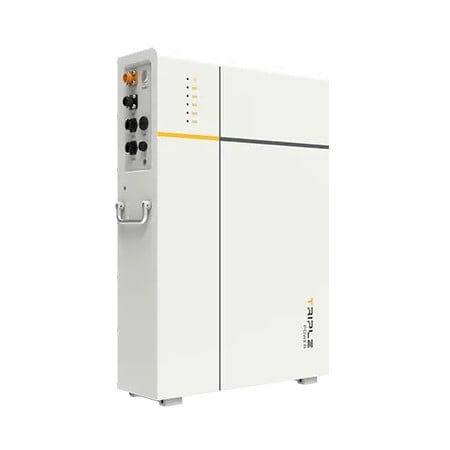

SolaX T-BAT LD53 5.3 kWh 48V battery with BMS
5.3 kWh battery module (5.03 usable at 95% DoD) with cobalt-free LiFePO4 cells and integrated BMS, part of the SolaX T-BAT-SYS-LV D53 low-voltage system. Nominal voltage 51.2 V, wall or floor mounting.
Expandable up to 16 modules in parallel (85.1 kWh), output current 100 A with 200 A peaks for 10 s, over 5,000 cycles, IP65, 10-year warranty.
The SolaX T-BAT LD53 is the base module of the low-voltage T-BAT-SYS-LV D53 storage system: 5.3 kWh nominal, cobalt-free LiFePO4 cells, integrated BMS and a nominal voltage of 51.2 V. It mounts on the wall or floor and is the battery to pair with SolaX single-phase hybrid inverters in the low-voltage line.
Low voltage: when it is the right choice
48–51.2 V systems have a reputation as outdated technology, but not with this module. The practical advantage is twofold: the BMS is inside each module, so no external manager is needed as in high-voltage architectures, and scalability reaches 16 units in parallel, that is 85.1 kWh — a ceiling residential HV families do not reach. In addition, if a module faults, the adaptive algorithm isolates it and the others keep working.
The downside is current: at low voltage, for the same power, currents are higher and cable cross-sections grow. The module delivers 100 A continuous (120 A from 8 modules up) with peaks of 200 A for 10 seconds — values to respect when sizing conductors and DC protections.
T-BAT LD53 technical specifications
| Nominal capacity | 5.3 kWh per module |
| Usable capacity | 5.03 kWh (95% depth of discharge) |
| Technology | Cobalt-free lithium iron phosphate (LiFePO4) |
| Nominal voltage / range | 51.2 V / 45–58 V |
| BMS | Integrated in every module |
| Max output current | 100 A (120 A from 8 modules up) |
| Peak discharge current | 200 A for 10 seconds |
| Max charge / discharge power | 5.12 kW / 6.14 kW |
| Battery efficiency | 95% (at 0.2 C) |
| Expandability | Up to 16 modules in parallel, 85.1 kWh nominal (80.48 usable) |
| Communication | CAN / RS485 |
| Cycle life | Over 5,000 at 95% DoD (80% residual capacity, 10 years) |
| Protection / cooling | IP65 / natural, fanless |
| Operating temperature | 0–53 °C charging, -20/+53 °C discharging |
| Max altitude | 3,000 m |
| Mounting | Wall or floor |
| Dimensions (W×D×H) / weight | 645 × 150 × 430 mm / 48.5 kg |
| Certifications | IEC 62619, IEC 62040, CE, UN 38.3 |
| Warranty | 10 years or total delivered energy, whichever comes first |
How the system grows
Each added module brings 5.3 kWh nominal and 5.03 usable. System sizes have their own code: LD106 with 2 modules (10.6 kWh), LD159 with 3, LD212 with 4, and so on up to LD848 with 16 modules and 85.1 kWh. From 2 modules onward the TP-LD53 accessory kit is required, containing original cables and connectors for the interconnection.
One figure makes this series interesting beyond residential use: 5.03 usable kWh out of 5.3 nominal means 95% depth of discharge, against the 90% typical of high-voltage batteries. For the same declared capacity, you use more of it.
Frequently asked questions
Does the T-BAT LD53 have an integrated BMS?
Yes, every module integrates its own management system, with remote fault diagnosis and over-the-air updates. This is the main difference from the high-voltage TP-HS50E series, which instead requires an external BMS bought separately.
Is it compatible with high-voltage Triple Power batteries?
No. The LV D53 series works at 51.2 V, the HV series at voltages an order of magnitude higher: connectors, BMS, cables and accessories are completely different and not interchangeable. The battery must be chosen based on the inverter already installed or planned, never the other way round.
How many modules can I put in parallel?
Up to 16, for 85.1 kWh nominal and 80.48 usable. The inverter limit must be checked, though: the maximum manageable capacity depends on the model and is usually well below the battery system's maximum.
How long does it last?
The datasheet declares over 5,000 cycles at 95% depth of discharge, with 80% residual capacity at end of life, and a 10-year warranty. The warranty ends at the first of the two: time or total delivered energy. In domestic use with one cycle a day, time is the limiting factor.
Can it be installed in a garage or outdoors?
The protection rating is IP65 and cooling is natural, fanless. Mind the charging limit: below 0 °C the module does not accept charge, while it discharges down to -20 °C. In an unheated northern garage, January mornings can therefore delay charging.