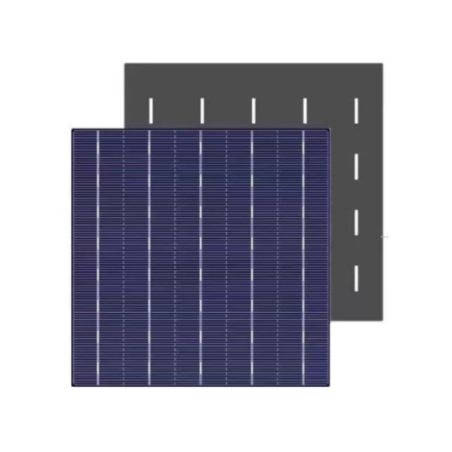


Polycrystalline Solar Cell 6"x6" or 156x156mm of 5BB
156x156 mm (6x6 inch) polycrystalline solar cell rated 4.55-4.67 Wp with 5 busbars. Nominal values: Vmp 0.544 V, Imp 8.44 A, Voc 0.64 V and 18.7% efficiency.
A high-current format for DIY photovoltaic panels, compatible repairs, prototypes and STEM labs. This is a bare cell and requires ribbon, soldering, support and encapsulation.
The 156x156 mm 5BB polycrystalline solar cell is a full-size cell rated 4.55-4.67 Wp for DIY photovoltaic modules, prototypes and educational demonstrators. The 6x6 inch format delivers a high nominal current of 8.44 A at maximum power, while one cell produces approximately 0.544 V.
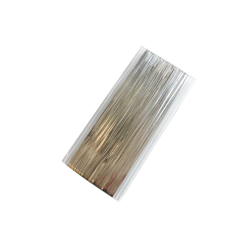
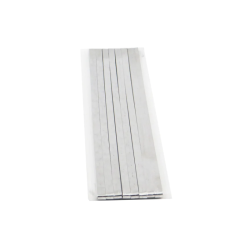
It is not a ready-to-use panel. A reliable module requires compatible tabbing ribbon, mechanical support, electrical insulation, a transparent front layer, backsheet and encapsulation against moisture and impact.
Why choose a 156x156 mm cell with 5BB?
This is the highest-power format in this MR WATT cell family. Five busbars provide five main current-collection lines and require a matching ribbon layout. It is suitable for high-current modules, full-cell testing and repairs or reproductions specifically designed around 5BB geometry.
Before replacing a cell in an existing panel, verify technology, size, busbar count, current, thickness and polarity. A mechanically or electrically different cell may create mismatch and hot spots.
SC1P5-156x156 technical specifications
| Reference | SC1P5-156x156 |
| Technology | Polycrystalline silicon |
| Rated power Pmax | 4.55-4.67 Wp |
| Maximum-power voltage Vmp | 0.544 V |
| Maximum-power current Imp | 8.44 A |
| Open-circuit voltage Voc | 0.64 V |
| Short-circuit current Isc | 8.98 A |
| Nominal efficiency | 18.7% |
| Busbars | 5BB |
| Nominal dimensions | 156x156 mm, about 6x6 inches |
| Thickness | 170 ± 20 µm |
| Cell weight | About 14 g |
What do 12, 24 or 36 cells produce?
Series connection adds voltage while current remains that of one cell. The following are theoretical nominal values before temperature, mismatch, ribbon and encapsulation losses.
| Cells in series | Nominal Vmp | Nominal Voc | Approximate power |
| 12 | About 6.53 V | About 7.68 V | 54.6-56.0 Wp |
| 24 | About 13.06 V | About 15.36 V | 109.2-112.1 Wp |
| 36 | About 19.58 V | About 23.04 V | 163.8-168.1 Wp |
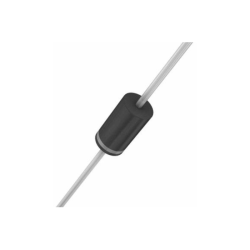
To increase current, complete and electrically matched strings may be connected in parallel. System design must include the charge controller, bypass or blocking diodes where required, cable size, protection and the real operating voltage of the load.
STEM projects and educational photovoltaic kits
A full-size cell makes it easy to observe how voltage and current change with light level, angle, temperature and shading. STEM activities can compare series and parallel circuits, measure current-voltage behaviour and study mismatch between cells.
Discover The Sun in the Classroom and MR WATT educational photovoltaic kits
How to solder solar cells without breaking them
The wafer is thin and fragile. Use compatible tabbing ribbon and flux, a clean soldering tip, controlled temperature and short contact times. Do not press on the cell or lift it by one corner. After each string, check continuity, polarity and voltage before encapsulation.
Read the MR WATT guide to soldering solar cells
Handling, protection and encapsulation
A bare solar cell is not waterproof and cannot withstand impact, twisting or hail by itself. Outdoor use requires a module structure that protects the interconnections, keeps the cells flat and prevents moisture ingress. Small dimensional differences may occur between selected or cut-cell batches.
Frequently asked questions
Is this a complete solar panel?
No. It is one 4.55-4.67 Wp cell. A complete panel requires multiple cells, electrical interconnections, protection, mechanical support and encapsulation.
What is the difference between 5BB and 3BB?
The number identifies the main current-collection busbars. A 5BB layout uses five lines and must be soldered with compatible ribbon geometry; it is not an automatic replacement for a 3BB cell.
How many cells are needed for a nominal 12V panel?
Small modules often use 24 or 36 cells in series, but the correct number depends on the required voltage, charge controller and operating conditions. With 36 cells, nominal Vmp is about 19.58 V.
Can I use it to repair a solar panel?
Only when dimensions, technology, current, busbars and electrical characteristics match the original cells. A mismatched replacement can reduce power or create hot spots.
Can it operate outdoors without glass or resin?
No. The bare cell must be encapsulated and protected from moisture, impact and mechanical stress.