



Off-Grid Solar Kit 250 Wp 12V EUREKA M
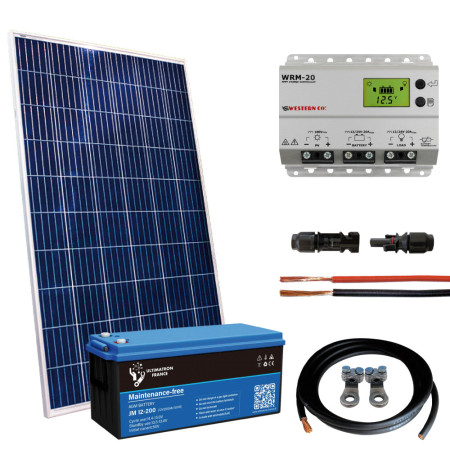
EUREKA M 12 V off-grid solar kit: panel of at least 250 Wp, Western Co. WRM20 20 A MPPT charge controller designed in Italy, 100 Ah deep-cycle lead battery (about 600 Wh usable) and wiring.
Designed for cabins, sheds and country houses used at weekends: the panel recharges during the week, you use the energy when you are there.
EUREKA M is a 12 V off-grid solar kit for people who use their cabin, shed or country house mainly at weekends. It combines a panel of at least 250 Wp, the Western Co. WRM20 MPPT charge controller, a 100 Ah deep-cycle lead battery and the cables to connect them.
What makes this kit work is the ratio between panel and storage: the battery is generous compared with the module output, so while you are away the sun has time to fill it, and when you arrive the energy is ready. Below you will find realistic figures, the controller's limits and the path to expand the system.
How the EUREKA M kit works
The panel feeds the WRM20 MPPT controller, which tracks the module's maximum power point and charges the battery with the correct lead-acid profile, automatically detecting whether the system runs at 12 or 24 V. Unlike a PWM controller, MPPT does not force you to use 36-cell panels: it accepts mono or polycrystalline modules from 36 to 144 cells, as long as they respect the input voltage and power limits. An internal blocking diode prevents the battery from discharging back into the panel at night.
The stored energy powers 12 V DC loads directly or, through an inverter bought separately, 230 V appliances. The system is stand-alone and must not be connected to the public grid or to the household wiring.
EUREKA M technical specifications
| PV power | At least 250 Wp, monocrystalline module (brand depending on availability) |
| System voltage | 12 V |
| Charge controller | Western Co. WRM20, 20 A step-down MPPT, automatic 12/24 V detection |
| Maximum panel power on the WRM20 | 310 W with 12 V battery, 620 W with 24 V battery |
| Maximum panel input voltage | 100 V (module Voc at -10 °C) |
| Minimum module Vmp | Above 15 V at 25 °C with 12 V battery, above 30 V with 24 V battery |
| Batteries supported by the controller | Sealed/GEL lead, flooded lead, lithium and LiFePO4 only with built-in BMS |
| Battery supplied | 12 V 100 Ah deep-cycle lead battery |
| Nominal storage energy | About 1,200 Wh |
| Recommended usable energy | About 600 Wh at 50% depth of discharge |
| PV cable | 40 m in total: 20 m red and 20 m black |
| Controller-battery cable | 4 m, 16 mm² cross-section |
| Connections | MC4 connectors on the panel side, 2 power terminals on the battery side |
| Reference | EUREKA-M |
Why it suits weekend use
A 12 V 100 Ah lead battery holds about 1,200 Wh, but to make it last you should use roughly half of it: 600 Wh usable. To bring it back from 50% to 100%, the 250 Wp panel needs, allowing for charging losses, about 3-4 equivalent full-sun hours. On a good summer day that means recovering in one day what you used in the evening; in midwinter, with few useful sun hours, a full recharge can take two or three days.
That is why EUREKA M performs best where consumption is concentrated: you arrive on Friday with a full battery, run lights, router and charging over the weekend, and during the week the panel restores everything. If you need energy every day, especially in winter, a kit with more panel power is the better choice.
What you can run on 600 Wh
The figures below allow for about 10% losses in cables and conversion and are indicative: they depend on the actual consumption of your appliances.
| Load | Indicative runtime on 600 Wh |
| Four 8 W LED lights (32 W) | About 17 hours |
| 12 V security camera, 5 W | More than 4 days non-stop |
| 4G router, 10 W | About 2 days non-stop |
| 12 V LED TV, 40 W | About 13 hours |
| 12 V submersible pump, 120 W | About 4.5 hours |
| Smartphone charge (about 15 Wh) | More than 30 charges |
Compressor fridges, power tools and pumps with high inrush current need an inverter sized for the surge power. Hair dryers, heaters, kettles and hot plates are not compatible with this storage.
What is included and what is not
- 1 monocrystalline PV panel of at least 250 Wp
- 1 Western Co. WRM20 MPPT charge controller
- 1 12 V 100 Ah deep-cycle lead battery
- MC4 connectors for the panel
- 40 m of PV cable (20 m red and 20 m black)
- 4 m of 16 mm² battery cable
- 2 power terminals
Inverter, panel mounting structure, fuses and isolators are not included. A fuse on the battery cable, fitted as close as possible to the positive terminal, should always be installed, as required by the WRM20 manual.
How to expand the system later
The WRM20 accepts a maximum of 310 W of panel with a 12 V battery: with a 250 Wp module there is no room for a second panel while staying at 12 V. The same controller also works at 24 V, where the limit rises to 620 W. The natural upgrade path is therefore to add a second identical battery in series and a second panel, moving to 24 V, with modules wired to exceed 30 V Vmp and an inverter suited to that voltage. The two batteries must be the same model and ideally the same age.
Frequently asked questions
How long does the 250 Wp panel take to recharge the EUREKA M battery?
To bring the 100 Ah battery from 50% to 100%, recovering about 600 Wh, you need roughly 3-4 equivalent full-sun hours including charging losses. In summer one clear day is usually enough; in winter, with fewer useful sun hours, a full recharge can take two or three days.
Can I use EUREKA M every day in winter too?
It works all year round, but in winter a 250 Wp panel produces only a few hundred watt-hours per day, less than the battery's 600 Wh usable capacity. For steady daily consumption in the cold months a kit with more PV power is better; EUREKA M is at its best with weekend use or very low daily loads.
Does the Western WRM20 controller work with a lithium battery?
Yes, the WRM20 handles sealed, GEL and flooded lead batteries as well as lithium and LiFePO4 batteries, but only if they have a built-in BMS. The manufacturer forbids connecting lithium batteries without a BMS. If you later replace the lead battery with a lithium one, check compatibility and set the controller to the correct profile.
What is the advantage of an MPPT controller over PWM in such a small kit?
A PWM controller forces you to use 36-cell panels with a voltage close to the battery's and wastes the voltage difference. The WRM20 MPPT converts panel voltage into charging current, makes better use of the module especially in cold weather and changing skies, and lets you use 60-cell or larger panels, which are more common and cheaper.
Which inverter should I pair with it to run 230 V appliances?
You need a 12 V inverter, preferably pure sine wave, sized for the continuous and surge power of your appliances. With a single 100 Ah lead battery it is wise to keep continuous loads modest, in the range of a few hundred watts: very high currents at 12 V drain the battery quickly and shorten its life.