
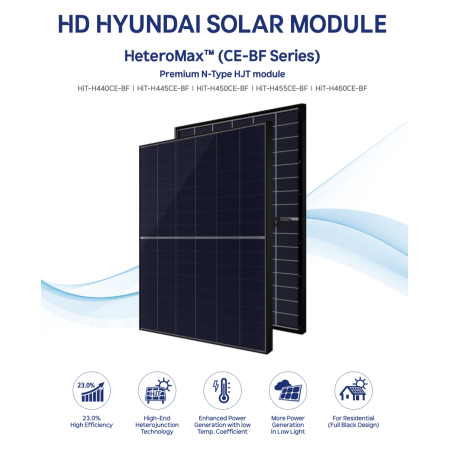

HIT-H455CE-BF
Hyundai Heteromax HIT-H455CE-BF 455 Wp photovoltaic module with HJT N-Type bifacial heterojunction technology and glass-glass double-glass structure. 23% efficiency, an outstanding temperature coefficient of just -0.24%/°C and a bifacial gain of up to 30%. Ideal for high-yield residential and commercial systems and for repowering old installations.
The Hyundai Heteromax HIT-H455CE-BF photovoltaic module is a next-generation 455 Wp panel featuring N-Type heterojunction (HJT) technology, bifacial cells and a double-glass structure. It combines N-Type monocrystalline silicon with amorphous silicon layers to minimise recombination losses and maximise output, delivering 23% efficiency and excellent performance even in low-light and high-temperature conditions. Certified to IEC 61215 and IEC 61730.
Why choose a bifacial HJT module?
Heterojunction technology has a symmetrical structure that naturally favours bifaciality: the cells capture energy from both the front and the rear side (via reflection), boosting total system output by up to 20-30% depending on the surface beneath. The very low temperature coefficient of -0.24%/°C means the panel loses very little power in hot weather, a decisive advantage over PERC or TOPCon modules during hot summers.
HIT-H455CE-BF technical specifications
| Rated power | 455 Wp |
| Cell technology | HJT N-Type, 96 monocrystalline half-cells |
| Module type | Bifacial, double glass (glass-glass) |
| Module efficiency | 23.0% |
| Open circuit voltage (Voc) | 37.05 V |
| Short circuit current (Isc) | 17.66 A |
| Voltage at Pmax (Vmpp) | 31.16 V |
| Current at Pmax (Impp) | 16.56 A |
| Temperature coefficient (Pmax) | -0.24 %/°C |
| Dimensions | 1762 × 1134 × 30 mm |
| Weight | 21.8 kg |
| Mechanical load | 5400 Pa (snow) / 2400 Pa (wind) |
| Connectors | MC4 / MC4-Evo2 |
| Warranty | 30 years (product and power) |
| Certifications | IEC 61215, IEC 61730 |
What do these panels actually produce?
A system with 6 HIT-H455CE-BF panels (2.73 kWp) installed on a well-exposed roof in southern Europe produces on average 3,700-4,100 kWh per year, enough to cover 70% up to 100% of the consumption of a 3-4 person household. With 12 panels (5.46 kWp) you reach around 7,500-8,000 kWh/year, the typical size for a house with a heat pump or an electric car. Thanks to their bifacial yield and excellent high-temperature behaviour, these modules keep producing strongly even in the hottest summers, when conventional panels lose more.
Perfect for repowering too
With its compact 1762 × 1134 mm footprint, the HIT-H455CE-BF is the perfect candidate for repowering projects: it replaces old, less efficient panels with a last-generation technology that almost doubles output on the same available surface.
Frequently asked questions
How much energy do these panels produce in a year?
It depends on orientation and location. In a sunny climate, 6 well-oriented HIT-H455CE-BF panels (2.73 kWp) produce around 3,700-4,100 kWh per year, enough to cover most of the consumption of a 3-4 person family. Yields are slightly lower in northern latitudes and higher in the south.
What does bifacial mean and how much extra energy do I get?
A bifacial module generates energy from both the front and the rear side, using light reflected off the surface underneath. The real gain ranges from 5-10% on a dark roof up to 20-30% on highly reflective surfaces such as light gravel, white roofs or snow.
What is the difference between HJT technology and PERC or TOPCon panels?
Heterojunction (HJT) technology combines crystalline and amorphous silicon, reducing recombination losses. Compared with PERC and TOPCon it offers higher efficiency, a better temperature coefficient (-0.24%/°C) and slower degradation: after 30 years it still retains about 90% of its initial power.
How many panels do I need for a 3 or 6 kW system?
With 455 Wp modules you need about 7 panels for a 3 kWp system (3.18 kWp actual) and about 13 panels for a 6 kWp system (5.91 kWp actual). The exact number depends on the available space and the inverter you choose.
Does the 30-year warranty also cover the drop in output?
Yes. The Hyundai warranty covers both the product and performance for 30 years: the manufacturer guarantees the panel retains over 90% of its rated power in year 30, one of the best degradation curves on the market.