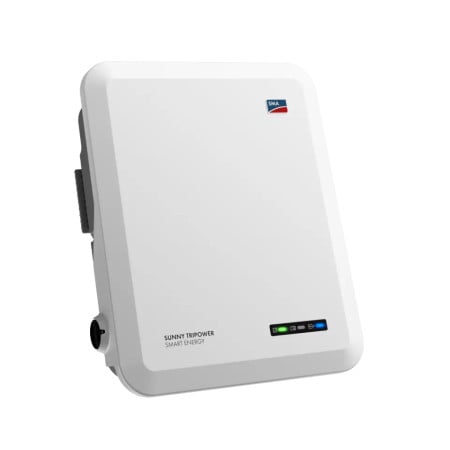

SMA Three-Phase 8 kW Hybrid Inverter with Backup
8 kW three-phase hybrid inverter SMA Sunny Tripower Smart Energy: photovoltaic inverter and battery manager in a single device, with 2 MPPT, up to 12 kWp generator and high-voltage 150-600 V DC-coupled battery.
Integrated backup function: up to 13.800 W with grid present, 8.000 W three-phase in island mode, adjustable switchover from 30 ms to 10 s. 98,2% efficiency, IP65, 5+5-year warranty with SMA registration.
The SMA Sunny Tripower Smart Energy STP 8.0-3SE is an 8 kW three-phase hybrid inverter that combines the photovoltaic inverter and high-voltage battery manager in a single device, with an automatic backup function in the event of a blackout. It is the inverter around which an SMA Energy System Home is built: DC-coupled storage, load management and power continuity, without additional cabinets.
DC coupling: why it matters
The battery connects directly to the DC side of the inverter (150-600 V, MC4 connectors with 3 m cable included). The energy from the modules goes into the battery without going through DC/AC conversion twice, as happens with AC-side retrofits: this gains a few percentage points of efficiency on the charging cycle and saves a second inverter. It is the right choice when the system is designed from scratch with storage already planned; on an existing photovoltaic system, however, an AC-side battery inverter avoids having to rework the DC array.
STP 8.0-3SE technical specifications
| Rated AC power (230 V, 50 Hz) | 8.000 W |
| Maximum AC apparent power | 8.000 VA |
| Maximum PV generator power | 12.000 Wp |
| Usable power per input A / B | 7.200 W / 7.200 W |
| Maximum input voltage | 1.000 V |
| MPPT range / rated voltage | 330-800 V / 600 V |
| Independent MPPTs / strings per MPPT | 2 / 1 per input |
| Usable current per input / short-circuit current | 12,5 A / 20 A |
| Rated / maximum output current | 3 x 11,6 A / 3 x 12,1 A |
| Battery | High-voltage lithium, 150-600 V, 30 A max charging and discharging, 1 connectable battery |
| Backup with grid present | Up to 13.800 W connectable, 3 x 20 A |
| Island backup (230 V, 50 Hz) | 2.660 W single-phase / 8.000 W three-phase |
| Backup switchover time | From 30 ms to 10 s, adjustable |
| Maximum / European efficiency | 98,2% / 97,8% |
| Protection devices | DC disconnect switch, grid and ground fault monitoring, all-current sensitive RCMU, type II DC and AC surge arresters |
| Degree of protection | IP65, climatic class 4K26, -25 °C / +60 °C |
| Noise level / nighttime consumption | 30 dB(A) typical / 44 W |
| Interfaces | 1 Wi-Fi, 2 Ethernet, 1 BAT-CAN, 5 digital inputs and 1 digital output, Modbus SMA and SunSpec, Speedwire |
| Dimensions (W x H x D) / weight | 500 x 598 x 173 mm / 30 kg |
| Warranty | 5 years, extendable to 10 free of charge by registering the product on the SMA portal |
| Certifications | Internal and external CEI 0-21, EN 50549-1, IEC 62109-1/-2, CE |
Pay attention to the MPPT: it starts at 330 V
The MPPT window of the 8 kW starts at 330 V, the highest value in the entire Smart Energy family — even higher than the 10 kW. Long strings are required, approximately from 11-12 modules upward, and each input accepts only one string with 12,5 A usable. In practice, the photovoltaic array is designed with two strings of similar length: on fragmented roofs this model is the least flexible in the series, and it is worth comparing it with the 10.0-3SE, which has an input for 2 strings and 25 A.
What really happens during a blackout
When the grid is present, loads can reach 13.800 W through the backup distribution board. When the grid is down, the inverter switches to island mode in a time adjustable between 30 ms and 10 seconds and the available power drops to the rated values: 8.000 W distributed across the three phases, or 2.660 W if only one phase is used. This is the number that matters when sizing the priority loads board: refrigerator, freezer, lights, router and a pump fit comfortably; an induction hob or a 3 kW oven on a single phase do not.
What is needed to complete the system
- Compatible high-voltage battery (SMA Home Storage or BYD Battery-Box), with dedicated communication cable
- SMA Energy Meter for the basic system, or Sunny Home Manager 2.0 for predictive management of loads, heat pump and EV charging
- Priority loads distribution board for the backup function, with separation from the main line
- Interface panel with SPI if the total system power exceeds the 11,08 kW required by CEI 0-21
Frequently asked questions
Which batteries are compatible with the STP 8.0-3SE?
High-voltage lithium batteries with a 150-600 V window included in the SMA list of approved batteries: typically SMA Home Storage and BYD Battery-Box. Only one battery (understood as a tower of modules) connects per inverter, and the capacity must be selected together with the current, because the actual charging and discharging power depends on the connected battery.
Can I power the whole house during a blackout?
No, and it is not advisable. In island mode, the inverter delivers 8.000 W across the three phases (2.660 W on a single phase), so it powers a priority loads board selected during the design phase. Switchover takes place in a time adjustable between 30 ms and 10 seconds, fast enough to prevent refrigerators and routers from restarting.
Can I add the battery at a later stage?
Yes. The inverter also works solely as a photovoltaic inverter and the battery can be added later by connecting it to the dedicated MC4 inputs and to the communication cable. This is the typical approach for those who want to stagger the investment, while bearing in mind that the inverter costs more than an equivalent-power model without a hybrid function.
How much does it consume at night?
About 44 W, a significantly higher value than pure photovoltaic inverters (below 5 W): the battery management electronics and the backup function remain active. Over the year this is approximately 190 kWh, to be taken into account when calculating savings.
What is the difference from the Sunny Tripower X series?
The X series consists of pure photovoltaic inverters, without battery input and without backup, but with 3 MPPTs and sizes up to 25 kW. The Smart Energy has 2 MPPTs and stops at 10 kW, but in exchange it integrates the battery manager and emergency power supply. They are designed for two different systems; it is not a matter of high-end or low-end range.