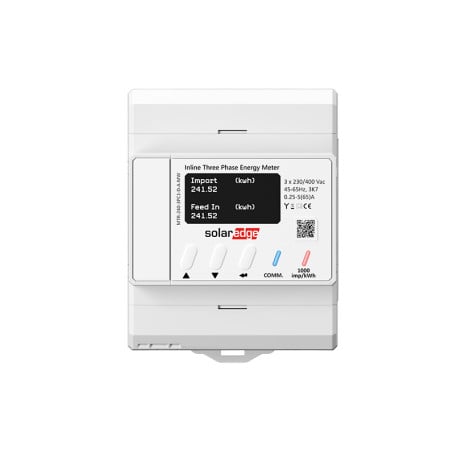
SolarEdge Three-Phase Inline Energy Meter 65 A | MR WATT
zoom_out_map
chevron_left chevron_right
Out-of-Stock

SolarEdge Three-Phase Inline Energy Meter 65 A

SolarEdge SE-MTR-240-3PC1-DAMW: inline energy meter for three-phase 230/400 V and single-phase networks, up to 65 A per phase, with built-in current transformers and wireless Energy Net communication to the inverter.

Class B accuracy (EN 50470), self-consumption under 2 W, automatic detection and setup via SetApp, IP51 panel mounting. 5-year warranty. Check that your inverter supports Energy Net.

€279.72 Tax escl.
block Out-of-Stock

The SolarEdge SE-MTR-240-3PC1-DAMW is the inline energy meter of the SolarEdge Home family in the version that covers both three-phase and single-phase networks: it measures production, consumption, import and export with built-in current transformers and talks to the inverter without cables, over the SolarEdge Energy Net.

One part number for both networks

This is the practical difference from the single-phase version. This model supports the 3 x 230/400 V wye network with L1, L2, L3 and neutral, but it also works on a single-phase supply: an installer working across several sites can keep one part number in stock instead of two. The single-phase version costs less and is the right choice when the installation will certainly stay on one phase, but it does not cover the opposite case.

Built-in CTs up to 65 A per phase

The line passes directly through the meter, which integrates the current transformers: no CTs to clamp around cables, no secondaries to wire, no wrong-direction mistakes. The limit is 65 A per phase, which on a three-phase supply corresponds to roughly 45 kW — ample for residential use and for much of the light commercial sector. Above that, an energy meter with external CTs is required.

Technical specifications

Part numberMTR-240-3PC1-D-A-MW (model MTR EU3)
Rated voltage3 x 230/400 Vac wye (L1/L2/L3/N), single-phase networks also supported
Voltage range320 - 460 V phase to phase, 184 - 264.5 V phase to neutral
Maximum current (Imax)65 A per phase, direct connection without external CTs
Characteristic currentsIref 5 A, Itr 0.5 A, Imin 0.25 A, starting current 20 mA
Accuracy classEN 50470 class B, IEC 62053-21 class 1 (about 1% on active power)
Frequency45 - 65 Hz
CommunicationSolarEdge Energy Net wireless (RS485 optional)
Self-consumptionUnder 2.0 W wireless, under 1.8 W over RS485
CommissioningAutomatic detection by the inverter, setup via SetApp
Protection ratingIP51 (panel mounting, not outdoor)
External antennaOptional, SE-ANT-ENET-HB-01 kit sold separately
Warranty5 years

The check to run on the inverter part number

Wireless communication only works if the inverter supports the Energy Net. On SolarEdge units the part number says it: codes containing BE indicate an inverter that is already prepared and only needs the ENET-HBNP-01 plug-in module; codes containing BN indicate one that is not prepared and requires the kit with the ENET-HBCL-01 communication board. Inverters with a display have dedicated kits per family. Checking before ordering takes five minutes; discovering it after installation costs a second visit.

Why measurement at the delivery point changes the system

Without a meter the inverter produces but has no idea what is happening in the building. With one installed, export limitation becomes possible when the grid operator requires it, battery management can follow real consumption instead of an estimate, loads can be started during surplus, and production and consumption are separated in monitoring. On a three-phase system it is also the only way to see which phase is loaded and which is not.

Frequently asked questions

Can I use it on a single-phase installation?

Yes, this version supports both configurations: on a single-phase connection one phase and the neutral are used, following the wiring diagram in the installation manual. That is why many installers keep only this part number in stock.

What happens above 65 A per phase?

The meter cannot be used: the connection is direct and the limit is absolute. Higher currents require an energy meter with external current transformers sized for the line. On a three-phase supply, 65 A per phase corresponds to about 45 kW, so most installations stay well below.

Do I need the external antenna?

Not normally. It becomes useful when the enclosure is metallic and closed, when the inverter sits in a distant room, or when there are reinforced concrete walls in between. The kit is the SE-ANT-ENET-HB-01 and is purchased separately. Alternatively, the meter supports wired RS485.

How accurate is it?

Class B under EN 50470 and class 1 under IEC 62053-21, with a deviation of about 1% on active power in the normal working range. That is the accuracy required for system management and monitoring; for fiscal metering the specific requirements of the grid operator and, where applicable, of the tax authority apply.

Can it be installed outdoors?

No, the protection rating is IP51: it must be installed inside an enclosure. If the enclosure is outdoors, weather protection must come from the enclosure itself. The work involves the main supply line and must be carried out by a qualified installer.

Solaredge
3f67a782-bf56-11ea-a13a-42010a9c0053