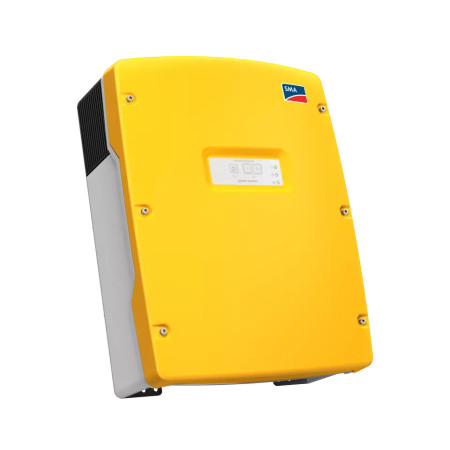

SMA Sunny Island 48V Off-Grid Battery Inverter
Single-phase 48 V battery inverter SMA Sunny Island: forms the grid from the battery, for truly off-grid systems or for full backup of a connected system.
6.000 W continuous rated power, with overload up to 8.000 W for 30 minutes and a peak of 11.000 W for starting motors and pumps. Compatible with lithium, lead-acid, and nickel-cadmium batteries; charging up to 140 A. IP54 (sheltered installation), 63 kg, 96,5% efficiency.
The SMA Sunny Island SI8.0H-13 is a single-phase 48 V battery inverter: it does not convert the energy from the panels, but forms the grid from the battery. It is the component that makes a truly off-grid system possible — cabins, mountain huts, isolated farms, construction sites — or a grid-connected system with full backup in the event of an outage. More than 120.000 units installed worldwide make it the benchmark in its category.
The "8.0" figure in the name is not the rated power
This is the most common misunderstanding about this product, and it is worth clarifying it first. The continuous rated power is 6.000 W. The 8.000 W refers to the overload power for 30 minutes; it then rises to 9.100 W for 5 minutes and to a peak of 11.000 W for 3 seconds. This overload capacity is exactly what is needed off-grid to start an electric motor, a pump or a compressor, but the power to use when sizing continuous loads remains 6 kW.
SI8.0H-13 technical specifications
| Type | Single-phase battery inverter, on-grid and off-grid |
| Continuous rated power | 6.000 W |
| Overload | 8.000 W for 30 min - 9.100 W for 5 min - 11.000 W peak for 3 s |
| Battery voltage | 48 V nominal, range 41-63 V |
| Maximum charge / discharge current | Up to 140 A / 136 A, depending on the connected battery |
| Supported battery types | Lithium (LiFePO4 and SMA-approved models), lead-acid FLA and VRLA, nickel-cadmium |
| Maximum AC input current and power | 50 A / 11,5 kW |
| Maximum efficiency | 96,5% |
| Parallel operation | Up to 3 units for a three-phase system; multiple clusters for systems from 2 to 300 kW |
| Communication | Ethernet and Speedwire, integrated web interface, Sunny Portal; WLAN depending on version |
| Protection rating | IP54 — indoor installation or installation in a protected room |
| Operating temperature / cooling | -25 °C / +60 °C, thermally controlled fan |
| Dimensions (W x H x D) / weight | 467 x 612 x 242 mm / 63 kg |
| Warranty | 5 years as standard, with extensions available |
IP54 means sheltered, not outdoors
This needs to be stated clearly because it is a common source of errors on site: IP54 is not a protection rating for outdoor installation. It protects against dust in non-harmful quantities and water splashes, but not against driving rain or jets of water. The Sunny Island must be wall-mounted in a technical room, garage or sheltered enclosure, ventilated and accessible, with the fan free to operate. With its 63 kg, installation requires two people and a structurally suitable wall.
Off-grid or backup: two different uses
- Pure off-grid system: the Sunny Island creates the 230 V grid, the string photovoltaic inverters connect on the AC side and the battery acts as a buffer. A diesel generator can be added for the winter season, which the inverter starts and manages autonomously
- Grid-connected system with backup: the system normally operates in parallel with the grid and, when the grid fails, the Sunny Island supplies the essential loads panel. It is the “heavy-duty” alternative to hybrid inverters, chosen when high starting power and freedom in battery selection are required
Compatibility with lead-acid as well as lithium is another reason why this product remains in the catalogue: in existing isolated systems, or where the budget cannot support lithium, it is one of the few professional solutions still available.
Frequently asked questions
Does the Sunny Island produce energy from the panels?
No. It is a battery inverter: it converts between the 48 V battery and the 230 V grid, and in off-grid operation it generates the grid itself. Photovoltaics require a dedicated inverter, connected on the AC side. This is a substantial difference compared with a hybrid inverter, which integrates both functions.
How much power can I really draw?
6.000 W continuously. The overload — 8.000 W for half an hour, 11.000 W for 3 seconds — is used for motor and pump starting currents, not to power permanent loads. Sizing based on 8 kW leads to a system that regularly goes into protection mode.
Can I use it in a three-phase system?
Yes, by installing three units in a cluster: one for each phase. The Sunny Island system scales by cluster up to systems in the hundreds of kW range, and the three-phase configuration is typical for isolated farms.
Which batteries does it work with?
With 48 V lithium batteries (SMA-approved models, with BMS communication), lead-acid batteries in FLA and VRLA variants, and nickel-cadmium batteries. For lithium, communication with the BMS is essential: the list of approved models must be checked before purchase, as it determines the charging profiles.
Is an interface panel with SPI required?
It depends on the configuration. In a truly off-grid system, with no connection to the public grid, CEI 0-21 does not apply. In a grid-connected system, the 11,08 kW threshold is assessed based on the total generation power of the system, not on this single device.