
SCharger-7KS-S0
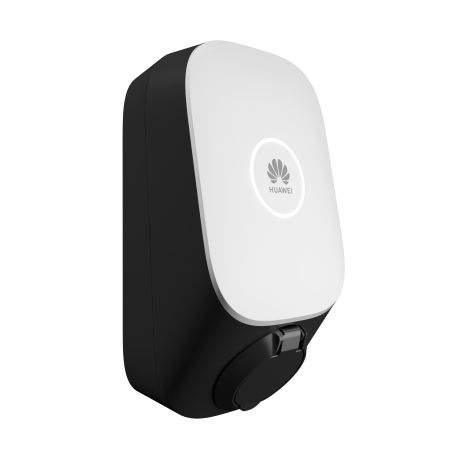
Huawei Smart Charger single-phase wallbox, power configurable from 1.4 to 7.4 kW, Type 2 socket, IP54 and IK10.
PV-preferred charging, dynamic regulation to avoid tripping the supply, scheduled charging and Next Trip mode. Managed from the FusionSolar app, with RFID, app or Bluetooth authentication. Installation stated at 15 minutes.
The Huawei SCharger-7KS-S0 is the single-phase unit in the Smart Charger range: charging power configurable from 1.4 to 7.4 kW, Type 2 socket, IP54 protection and IK10 impact resistance. It is designed for the home, where charging happens overnight or during sunlight hours and smart energy management matters more than raw power.
The real reason to buy it: charging from your own solar
The PV Power Preferred mode makes the car draw primarily the energy the system is producing at that moment, rather than pulling it from the grid. The charger modulates charging current to follow the production curve: when a cloud cuts output, charging slows down instead of drawing from the meter.
Just as important is dynamic power regulation: the charger takes account of what the rest of the house is consuming and reduces charging instead of tripping the main breaker. That is the feature that makes a 7.4 kW charger viable on a typical domestic supply.
How long does it take to charge my car?
With a 7.4 kW single-phase charger, charging time depends almost entirely on battery capacity. Indicative figures for a full charge:
| Car | Indicative battery | Time at 7.4 kW |
| Dacia Spring | ~27 kWh | about 4 hours |
| Fiat 500e (large battery) | ~42 kWh | about 5 hours 40 |
| Renault 5 E-Tech | ~52 kWh | about 7 hours |
| Jeep Avenger electric | ~54 kWh | about 7 hours 20 |
| Tesla Model 3 (base version) | ~58 kWh | about 7 hours 45 |
| Volkswagen ID.3 | ~58 kWh | about 7 hours 50 |
These are 0 to 100% figures, a situation that hardly ever occurs in real use: starting from 30% remaining cuts the times by roughly a third. In practice any car on this list charges fully overnight. Always check your own vehicle's data sheet for actual capacity and maximum accepted AC power.
SCharger-7KS-S0 technical specifications
| Charging power | Configurable from 1.4 to 7.4 kW |
| Nominal voltage | 230 V +/- 20% (single-phase) |
| Nominal current | Configurable 6 - 32 A |
| Frequency | 50 / 60 Hz |
| Vehicle connection | Type 2 socket |
| Cable cross-section | Up to 10 mm2 |
| Network types | TN, TT, IT |
| Protocols | Modbus TCP, OCPP 1.6 |
| Communication | Wi-Fi / Ethernet |
| Authentication | RFID (ISO-14443-A), app, Bluetooth |
| Working modes | Normal, scheduled, PV power preferred, Next Trip |
| Protection rating | IP54, IK10 |
| Dimensions | 335 x 180 x 145 mm |
| Weight | 3 kg |
Frequently asked questions
Can I install it with a 3 kW supply?
Yes, but charging power must be limited accordingly: the charger is configurable from 1.4 kW upwards and dynamic regulation automatically reduces draw based on household consumption. With only 3 kW available charging will be slow. To exploit the full 7.4 kW you need an adequate supply, typically 6 kW or more.
Is the charging cable included?
No: this version has a Type 2 socket, so you use the cable supplied with the vehicle or a Type 2 cable bought separately. A socket is the more flexible solution, because it lets you connect different cars and keep the cable stored away.
Do I need a Huawei PV system to use it?
No, the charger works on its own. But the most interesting features, namely PV-preferred charging and dynamic regulation, require the system to know how much you are producing and consuming. With a Huawei inverter that data comes from the inverter itself; without one you need the DTSU666-FE Smart Power Sensor.
What is Next Trip mode?
It lets you state by when the car must be ready and at what state of charge. The charger spreads charging across the available window, favouring cheaper tariff periods and solar energy, while still guaranteeing the required level at the set time.
How long does installation take?
Huawei states around 15 minutes in three steps: fix the back plate to the wall, route the cables from above or below, then hook on the body. The upstream electrical work, with its dedicated protective device, remains the job of a qualified electrician.