



The IBC Technology That Revolutionized Flexible Photovoltaics
SunPower Maxeon solar cells are among the most efficient in the world thanks to IBC (Interdigitated Back Contact) technology: all electrical contacts are located on the back of the cell, eliminating traditional front busbars and maximizing the active surface exposed to light. The result is an efficiency exceeding 22%, unattainable by conventional cells.
This feature makes them perfect not only for residential systems, but especially for applications where every square centimeter counts: RC modeling, drones, solar airplanes, boats, sailboats, and maker projects.
Gen 3 vs Gen 6: Which Cell Should You Choose?
MR WATT offers two generations of SunPower Maxeon cells, with different characteristics to suit various surfaces and power requirements.
| Feature | SunPower Gen 3 | SunPower Gen 6 |
|---|---|---|
| Dimensions | 125 × 125 mm (5″ × 5″) | 166 × 166 mm (6″ × 6″) |
| Typical Power | ~3.5 Wp per cell | ~5.4 Wp per cell |
| Efficiency | > 22% | > 22.5% |
| Contacts | Back contact (IBC) | Back contact (IBC) |
| Flexibility | Very flexible | Flexible |
| Ideal for | Curved surfaces, modeling, small panels | Larger panels, maximum power per dm² |
Rule of thumb: if you need to cover a small or curved surface (RC glider wing, fuselage, drone shell) choose Gen 3. If you have more available space and want to maximize total power, Gen 6 produces 54% more energy with the same number of cells.
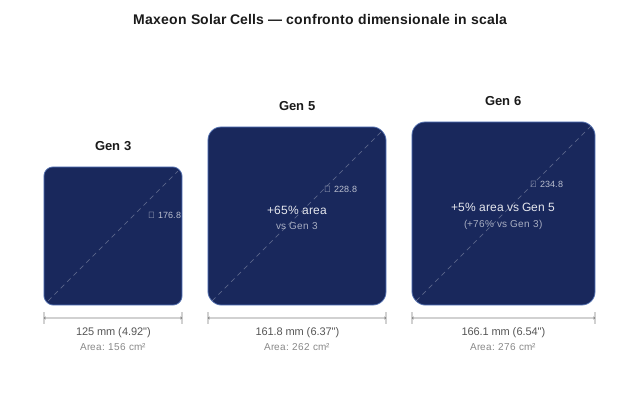
[Foto: differenze tra vari modelli di celle SunPower]
Applications: Where SunPower Cells Shine
RC Modeling and Aeromodelling
SunPower cells are the number one choice among advanced modelers for a simple reason: minimum weight, maximum power. A 60 cm wing covered with Gen 3 cells can generate enough energy to power the receiver and recharge LiPo batteries in flight. Perfect for:
- Long-range RC gliders
- Autonomous solar airplanes (solar UAVs)
- Solar-powered RC boats
- Drones with integrated solar charging
- Solar RC cars for races and student competitions
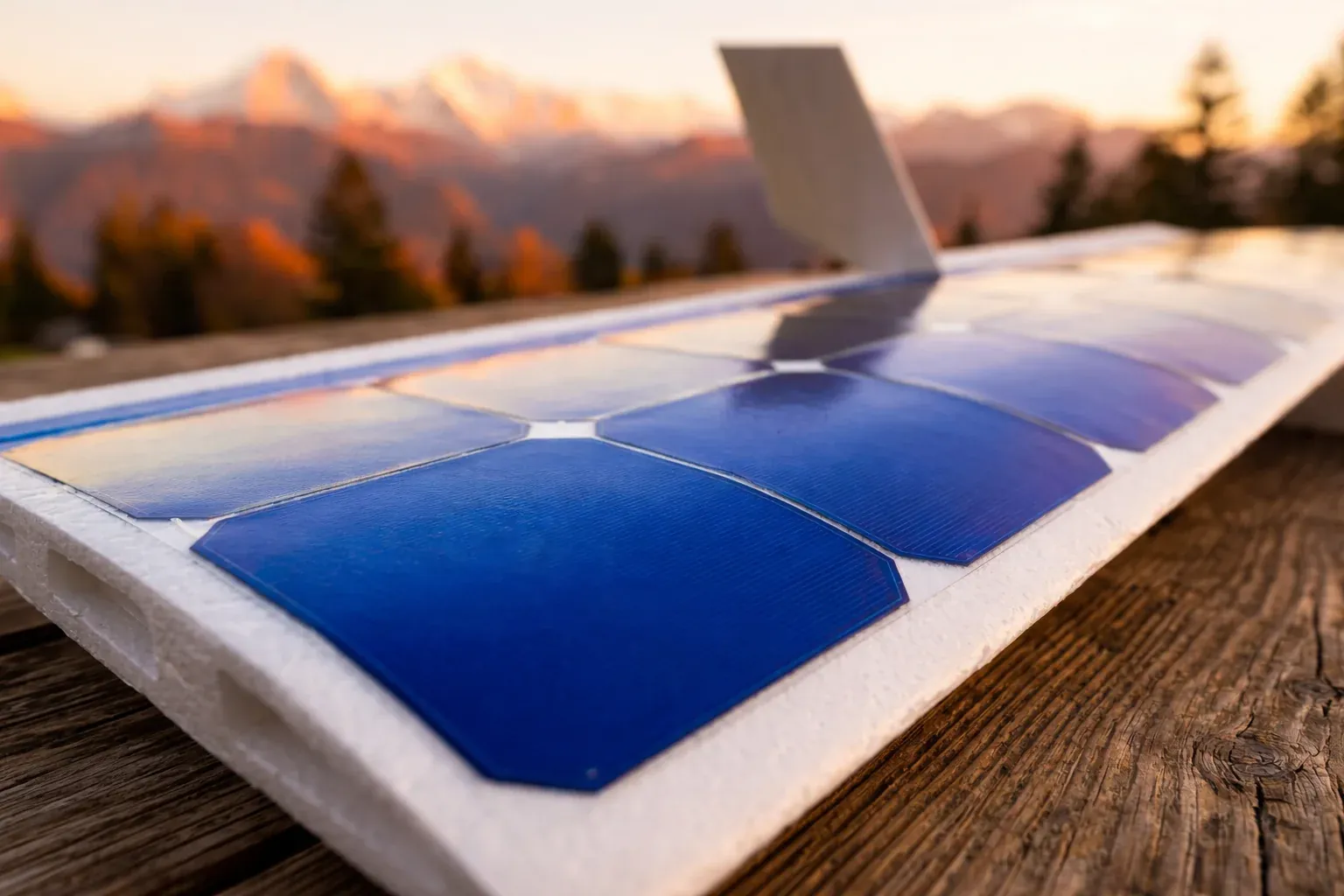
[Foto: celle SunPower montate su ala di drone RC]
Maker and IoT Projects
Thanks to their compact size, Gen 3 cells are also ideal for powering remote sensors, autonomous weather stations, solar GPS trackers, and any IoT device that needs energy autonomy without access to the electrical grid.
How to Solder SunPower Cells: Dogbone Connectors and Proper Technique
IBC back-contact cells require a different soldering technique than traditional cells. Since they have no front contacts, the connection is made exclusively on the back using special flat conductors called Dogbone connectors (or dogbone-shaped tab wire).
What Are Dogbone Connectors?
Dogbone connectors are flat-section tinned copper strips, shaped to connect the positive pole of one cell to the negative pole of the next. Their characteristic shape ensures contact with both the positive and negative conductive grids, both located on the back of the cell.
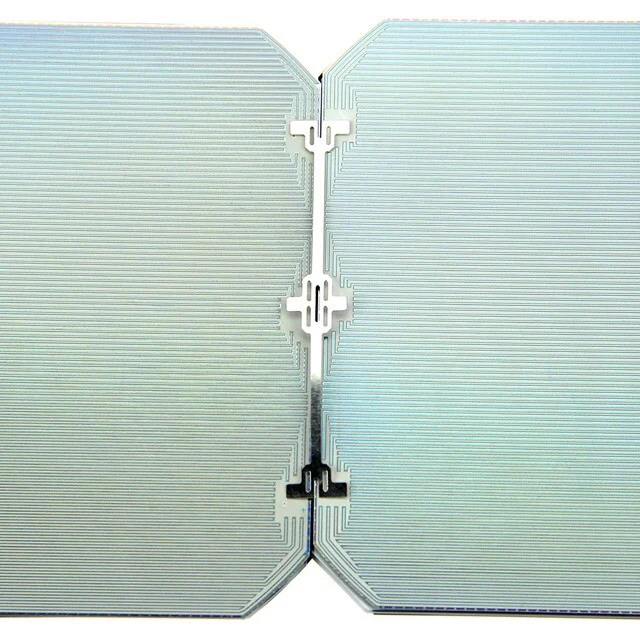
[Foto: connettori dogbone su retro cella SunPower Gen 3]
Required Tools
- Adjustable temperature soldering iron — set between 320°C and 350°C
- Dogbone connectors compatible with the chosen cell generation
- No-clean flux — essential to facilitate soldering without aggressive residues
- Low-temperature solder (Sn63/Pb37 or lead-free solder specific for cells)
- Tweezers, flat antistatic surface, magnifying glass
Step-by-Step Soldering Procedure
- Place the cell with the back facing up on a clean, flat surface.
- Apply a small amount of no-clean flux to the contact points (the gold strips on the back).
- Align the Dogbone connector with the positive and negative contacts.
- With the soldering iron at 330°C, briefly touch the connector for 1-2 seconds per point — do not drag, just touch and lift.
- Let it cool without moving the cell for at least 30 seconds.
- Check with a multimeter that the connection is correct before proceeding to the next cell.
Project Ideas to Get Started Right Away
You have the cells, you have the tools — here are some ideas for your first solar project:
- 15W Flexible Solar Panel — 4 Gen 3 cells in series to charge 12V batteries on boats or campers
- USB Solar Charger — 2 Gen 3 cells + step-up regulator to recharge smartphones and USB devices while camping
- Solar Wing for 1.5m RC Glider — 10-12 Gen 3 cells encapsulated in ETFE film on the upper surface of the wing
- Solar Backpack — 6 Gen 6 cells laminated on a rigid backpack panel for off-grid trekking
- Autonomous Weather Station — 2 Gen 3 cells + 1000mAh LiPo + ESP32 for remote monitoring without battery changes
Want to replicate something more ambitious? Check out our solar airplane project: an aeronautical demonstrator powered entirely by SunPower cells, developed by the MR WATT team.
FAQ — Frequently Asked Questions About SunPower Cells
What is the main difference between SunPower Gen 3 and Gen 6 cells?
Gen 3 measures 125×125 mm and produces about 3.5 Wp per cell; Gen 6 measures 166×166 mm and produces about 5.4 Wp. Both use IBC back-contact technology with efficiency above 22%. Gen 3 is more flexible and suitable for curved surfaces; Gen 6 offers higher power per cell count.
Can I use SunPower cells for a solar RC airplane?
Yes, it’s one of the most common uses. Gen 3 (125mm) is the preferred choice for aeromodelling thanks to its low weight and flexibility. A glider with a 2-meter wingspan can accommodate 15-20 Gen 3 cells, generating 50-70 Wp in optimal conditions.
What are Dogbone connectors and where can I find them?
They are tinned copper connectors shaped like a dog bone, used to connect IBC back-contact cells in series. They are specific to the cell generation (Gen 3 or Gen 6) and are included in the MR WATT accessory kit or can be purchased separately.
What flux should I use to solder SunPower cells?
Use a no-clean flux (non-corrosive, does not require cleaning after soldering). Common electronics flux is fine, but avoid acid-based products. Gel flux is easier to apply precisely than liquid flux.
What temperature should I set the soldering iron to?
Between 320°C and 350°C with a fine tip. Short contact times (1-2 seconds per point). Temperatures above 380°C risk delaminating the contacts from the cell substrate.
Do SunPower cells withstand the shocks and vibrations of modeling?
IBC cells are relatively fragile if not encapsulated. For RC applications, it is essential to laminate them with ETFE film or encapsulate them in transparent epoxy resin before assembly. This protects them from impacts, moisture, and prolonged UV exposure.
How many cells do I need to reach 12V?
SunPower cells have an open-circuit voltage (Voc) of about 0.68V and a maximum power point voltage (Vmp) of about 0.57V. To recharge a 12V battery, you need at least 22-24 cells in series (to obtain Vmp ≈ 13-14V). For a 5V (USB) system, 9-10 cells in series are enough.