



BATTERIES - SERIES/PARALLEL CONNECTION
What is series and parallel connection?
When designing a battery bank for an off-grid photovoltaic system, a camper, a boat, or any storage system, it is essential to choose the correct type of connection. There are two main methods:
- Series: voltages add up, ampere-hours remain unchanged
- Parallel: ampere-hours add up, voltage remains unchanged
- Series + Parallel: both voltage and ampere-hours increase simultaneously
Are you looking for a battery for your photovoltaic system or your project? Take a look
Series battery connection
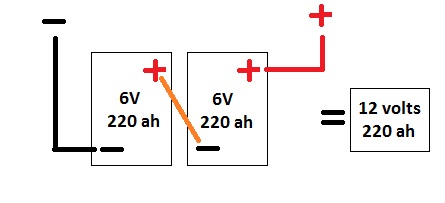
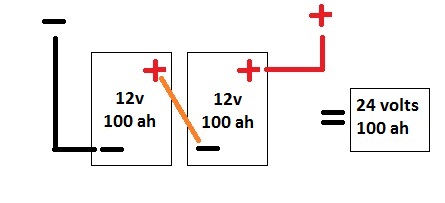
In a series connection, the positive terminal (+) of one battery is connected to the negative terminal (−) of the next. The voltages add up, the capacity in ampere-hours (Ah) remains that of a single battery.
Rule of thumb: N identical batteries in series → voltage × N, Ah unchanged.
Example 1: 2 batteries of 6V in series → 12V 220Ah
Example 2: 2 batteries of 12V in series → 24V 100Ah
Parallel battery connection
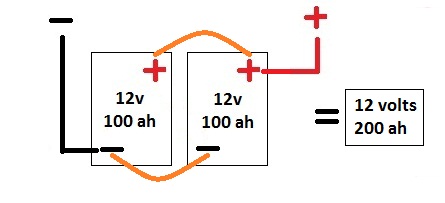
In a parallel connection, all positive terminals (+) are connected together and all negative terminals (−) are connected together. The voltage remains that of a single battery, while the capacity in ampere-hours is multiplied.
Rule of thumb: N identical batteries in parallel → Ah × N, voltage unchanged.
Example 3: 2 batteries of 12V in parallel → 12V 200Ah
Example 4: 4 batteries of 12V in parallel → 12V 400Ah

Combined series and parallel battery connection
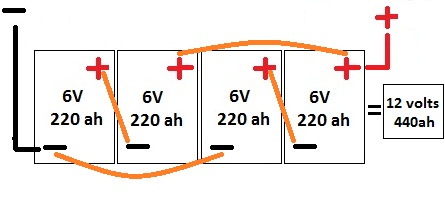
You can combine both methods to obtain both the desired voltage and capacity. Useful when you have batteries with a voltage different from what is required by the inverter or charge controller.
Example 5: 4 batteries of 6V in series-parallel → 12V 440Ah
The most common voltages for solar and wind systems are 12V, 24V, and 48V. Most inverters and charge controllers are available in these standard voltages.
Summary table: series vs parallel
| Parameter | Series | Parallel | Series + Parallel |
|---|---|---|---|
| Voltage (V) | Multiplied | Unchanged | Multiplied |
| Ampere-hours (Ah) | Unchanged | Multiplied | Multiplied |
| When to use | To increase voltage | To increase autonomy | To increase both |
Which configuration should you choose for your system?
- 24V inverter with 12V batteries? → Connect 2 batteries in series
- 48V inverter with 12V batteries? → Connect 4 batteries in series
- Want more autonomy without changing voltage? → Connect in parallel
- Want more voltage AND more autonomy? → Combine series and parallel
Important note: always connect batteries of the same type, brand, capacity, and state of charge. Mixing different batteries causes imbalances that reduce the useful life of the bank.
FAQ — Frequently Asked Questions about battery connection
What is the difference between series and parallel connection?
In series, voltages (Volts) add up and Ah remain unchanged. In parallel, ampere-hours (Ah) add up and voltage remains unchanged. The choice depends on the voltage required by your inverter or charge controller.
Can I connect batteries of different capacities in parallel?
Technically yes, but it is not recommended. Batteries with different Ah will charge and discharge asymmetrically, reducing overall efficiency and accelerating the wear of the smaller battery.
How many batteries can I connect in parallel?
For lead-acid batteries, manufacturers recommend a maximum of 4 in parallel. For larger banks, it is preferable to use higher voltage batteries (24V or 48V) with fewer parallel strings. LiFePO4 batteries handle configurations with more parallel strings better thanks to the integrated BMS.
How do you calculate the total capacity of a battery bank?
Multiply voltage × Ah to get the total Wh. Example: 4 batteries of 12V 100Ah in a 2 series + 2 parallel configuration → 24V 200Ah = 4,800 Wh (4.8 kWh).
Which voltage should you choose for an off-grid photovoltaic system?
Up to 1 kW of power: 12V. From 1 to 3 kW: 24V. Over 3 kW: 48V. Higher voltages reduce currents, allowing for thinner cables and lower losses due to the Joule effect.
Do batteries in series charge evenly?
With a BMS (Battery Management System), yes. Without a BMS, differences between cells can cause imbalances over time. For lead-acid batteries in series, a periodic charge equalizer is recommended.
Series or parallel: which extends battery life more?
Neither configuration is inherently superior for longevity. What matters is keeping the batteries balanced, avoiding deep discharges (DoD > 80% for lead-acid), and fully recharging them at each cycle.
Want to know how long it takes for the battery to discharge? Read this interesting article written by Elettronica Grillo
``` Let me know if you need any further adjustments!