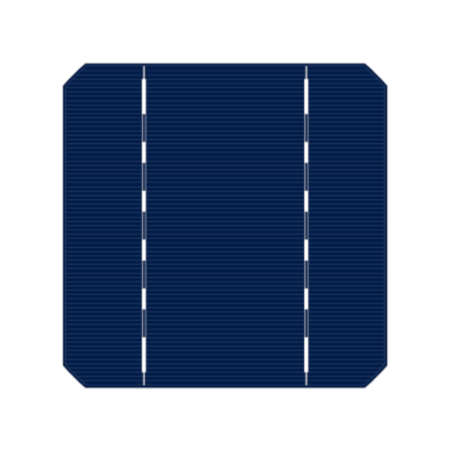


Monocrystalline Solar Cell 5"x5" or 125x125mm with 2BB
Monocrystalline solar cell 125x125 mm, 2BB: 3.1 W.
For DIY modules and prototypes; interconnection and encapsulation required.
Building a small panel, repairing a module or creating an educational prototype? This photovoltaic cell provides a defined size and contacts for planning the layout and interconnections.
It is a component, not a ready-to-use panel: compatible interconnections, controlled processing, mechanical protection and encapsulation are required. Calculate complete-circuit voltage and current before assembly.
Electrical Data
| Maximum Nominal Power (Pmax) | 3.1 W |
| Operating Voltage (Vmp) | 0.54 V |
| Operating Current (Imp) | 5.67 A |
| Open Circuit Voltage (Voc) | 0.64 V |
| Open Circuit Current (Isc) | 5.94 A |
| Cell Efficiency | 19.9% |
| Cell Type | Monocrystalline |
| Connection Bands | 2BB |
| Number of Cells | 1 |
| Dimensions | 5”x5” or 125x125mm |
| Thickness | 200 ± 20 µm |
| Weight | 10 g |
Explore Flexibility with Our Photovoltaic Kits
In addition to individually sold solar cells, with the custom solar cell cutting service, we have also created DIY photovoltaic kits that are the ideal solution for those who wish to generate solar energy in a flexible and personalized way. These kits are the practical starting point to begin experimenting and understanding the mechanisms of generating electricity through the photovoltaic effect. For this reason, they are very successful in school, university, and research center laboratories. Suitable for small and medium-sized projects, these kits are perfect for "off-grid" applications, isolated from other energy sources like the national power grid.
The construction of solar panels is an educational and fun experience, allowing for a unique customization of voltage/current according to specific needs. A unique aspect of our kits is the ability to adapt the panel's voltage by modifying the number of solar cells used.
| Number of Solar Cells | Voltage (Volt) |
| 12 | 6V |
| 24 | 12V |
| 36 | 18V |
This table clearly shows how the voltage varies in relation to the number of solar cells. It is possible to experiment with different configurations to obtain the desired voltage level for your project.
For beginners, our Learning ZONE provides a comprehensive resource, including videos, detailing how to properly perform soldering and use all components correctly.
In each kit, we always provide about 5% spare cells, ensuring sufficient coverage for any breakages during soldering or transport. In case of problems due to shipping, we are ready to assist you and resolve any issues, as your complete satisfaction is our 100% priority.
Images may not accurately represent the product for sale. The dimensions of the solar cells may vary by 1-2mm. For example, nominal 156mm or 6” cells may be 156-159mm.
Frequently asked questions
Is this a complete solar panel?
No. It is a single cell to be integrated into a module designed, interconnected and protected by the user.
How can voltage and current be increased?
Cells in series add voltage; cells in parallel add current. Use matched cells and size the circuit for the load.
Is the cell fragile?
Yes. Avoid bending and point pressure and handle it with suitable tools and support.
How are the connections made?
The method and materials depend on front or rear contacts. Compatible ribbon or connectors and controlled temperature are required.
Can it be used outdoors without protection?
No. Moisture, impact and weather require properly designed encapsulation.