



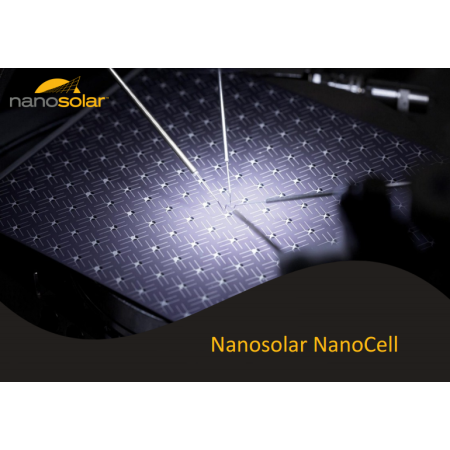


NanoSolar nanocell CIGS Flexible Solar Cell 6"x5" (156X135 mm) Class A with 2600mW power
Flexible NanoSolar nanocell CIGS Solar Cell 6"x5" (156X135 mm) Class A with 2600mW power Nanosolar Nanocell 2.6W
NanoSolar nanocell CIGS Flexible Solar Cell 6"x5" (156X135 mm) Class A with 2.6W Power
Directly from the United States, we present lightweight flexible solar cells made of aluminum with a power of 2.6 Watts. Thanks to their flexibility, it will be easier to position them in places where normal cells would not be possible.
Nanoscale Science Applied to Solar Energy
For decades, scientists have been trying to develop economically sustainable processes to convert sunlight into energy. In 2002, Nanosolar embarked on an ambitious path with the goal of revolutionizing solar energy production processes, and by 2010, the first photovoltaic modules ready for field installation were made available.
Nanosolar's proprietary approach is based on printing CIGS nanoparticle inks (copper, indium, gallium, and selenium), a solution that drastically reduces the use of expensive high-vacuum production equipment traditionally required for this type of cell.
In laboratory tests certified by the National Renewable Energy Laboratory (NREL), Nanosolar achieved an efficiency of 17.1%, demonstrating the potential of its technology to compete in the coming years with crystalline silicon panels. Additionally, the innovative design of Nanosolar utility panels significantly reduces overall system costs (balance of system), thanks to reduced use of mounting structures, electrical wiring, and installation labor.
What is CIGS
Copper indium gallium diselenide (CIGS) is a type I-III-VI₂ semiconductor material composed of copper, indium, gallium, and selenium. Nanosolar has developed a unique industrial printing process to coat aluminum foils with proprietary CIGS inks. This process uses custom-designed equipment to print the ink onto aluminum coils.
The so-called roll-to-roll process represents a fast and economical production technique compared to conventional methods, which involve processing glass plates using slow and expensive high-vacuum equipment.
In addition to printing the CIGS layer, the process includes further heating and chemical treatment stages, also carried out with specially developed machinery, to obtain functioning solar cells. All stages occur continuously, and at the end of the process, a single coil can be considered a single solar cell with a surface area greater than one square kilometer.
In the final stage, the continuous foil is cut into individual cells, which can be connected in various configurations to create Nanosolar Utility Panels. Nanosolar solar cells can be produced in varying sizes, depending on the application.
Technological Innovation at the Solar Cell Level
Nanosolar technology introduces several key innovations in the design and production of photovoltaic cells:
- use of a highly conductive and low-cost aluminum foil as the substrate and as the cell's lower electrode
- CIGS ink with predefined composition ratios, combined with a high-yield, high-productivity printing process to obtain an electronic-grade CIGS semiconductor
- innovative Metal-Wrap-Through (MWT) design with back contacts, based on high-productivity foil lamination processes
- transparent and thin top electrode, made using printing techniques
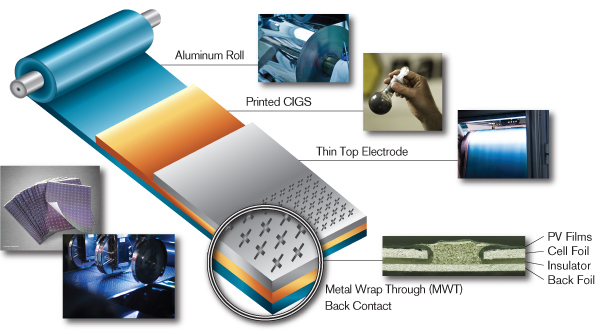
High Productivity Roll-to-Roll Printable Semiconductor Technology
The cell production process begins with a low-cost aluminum foil coil, coated with a series of thin-film layers whose total thickness is less than two microns. This high-productivity roll-to-roll printing technology makes it possible to produce thin-film solar panels with potentially some of the lowest costs in the world.
The CIGS solar cells and panels printed by Nanosolar are expected to reach efficiency levels comparable to crystalline silicon in the coming years. At the same time, the utility panel design allows for a substantial reduction in installation and system costs, leading to a lower levelized cost of energy (LCOE) compared to competing solar technologies.
These solar cells are extremely rare and have never been sold to the public until now.
As explained in the article, the cells are made of aluminum and can be connected using conductive glue, conductive tape, or even Alumiflux rosin; the American company Nanosolar used an ultrasonic soldering iron to connect the cells in production.
The back of the cell is the positive pole, while the aluminum strip on the side of the front of the cell is the negative pole, Here, a very interesting video on their assembly.
Our photovoltaic kits are the most economical way to provide electricity from the sun and are perfect for small/medium so-called island projects, i.e., isolated from other energy sources like the national power grid; the applications are numerous, such as boats, campers or camping in general, garden lighting, small appliances, electronics, and much more.
To solder these cells, we used this product: 3M / Tapecase 1182 double-sided conductive copper tape.
- Depth
- 0,5 mm
- Height
- 156 mm
- Width
- 135 mm
- Weight
- 20 g
- Power
- 2,6Wp
- Voltage
- 0,55 V
- Current
- 5,8 A
- Type
- Flessibile
- Feature
- Lightweight Aluminum Structure CIGS Solar Cells which are Semi-Flexible
- Voc
- 0,61 V
- Isc
- 6,7 A
- Temp Coeff Pmax
- -0.40 %/K
- Temp Coeff Voc
- -0.30 %/K
- Temp Coeff Isc
- +0.01 %/K
- Max Sys Voltage
- 600V UL / 1000V IEC
- Temperatura Operativa Modulo
- -40 to +85°C