



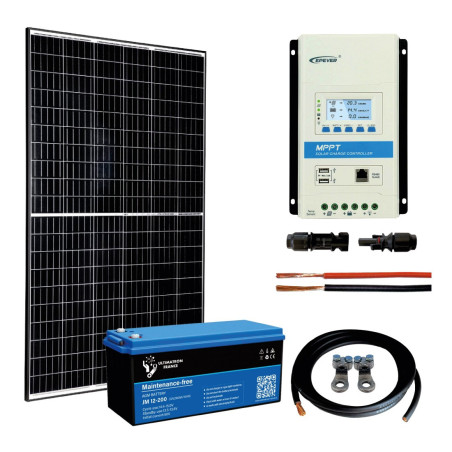


400 Wp 12V Off-Grid Solar Kit EUREKA L
400 Wp 12V Off-Grid Solar Kit EUREKA L with Triron MPPT 30 A, one 100 Ah lead battery and cabling.
Off-grid energy for cabins, country properties and remote sites.
Need power in a cabin, garage or country property where the grid is unavailable? EUREKA-L combines at least 400 Wp of solar power, an MPPT controller and one 100 Ah lead battery in a complete 12 V off-grid system.
Below you will find usable storage, expected production, supplied components and practical limits before choosing a separate inverter.
How the 12 V system works
The solar array charges the battery bank through a 30 A Triron MPPT controller. DC loads can use 12 V directly; 230 V appliances require a separate 12 V inverter. The system must remain isolated from the public grid.
Technical specifications
| Solar power | At least 400 Wp |
| System voltage | 12 V |
| Charge controller | Triron MPPT 30 A |
| Battery | 1 × 100 Ah slow-discharge lead battery |
| Nominal stored energy | About 1200 Wh |
| Prudent usable energy | About 600 Wh at 50% depth of discharge |
| Solar cable | 40 m plus 4 m of 16 mm² battery cable |
| Estimated annual production | 480-650 kWh depending on location |
| Reference | EUREKA-L |
What is included
- 1 solar panel for at least 400 Wp total
- Triron 30 A MPPT controller
- 1 × 100 Ah lead battery
- MC4 connectors and 40 m solar cable
- 4 m of 16 mm² battery cable and power terminals
The inverter, mounting structure, fuses, isolators and distribution panels are not listed as included.
Practical energy and use
The bank stores about 1200 Wh nominally. To preserve lead batteries, a cautious plan uses approximately 600 Wh before recharging. This is suitable for lighting, communications, surveillance and modest pumps; heating appliances would drain the bank quickly.
| Example load | Approximate runtime |
| LED lighting, 30 W total | About 16 hours including losses |
| Router and cameras, 20 W | About 24 hours |
| Laptop, 60 W | About 8 hours |
| Pump, 100 W | About 5 cumulative hours |
Installation checks
- Mount panels without persistent shade and on a wind-rated structure.
- Keep batteries and controller dry and ventilated.
- Install correctly sized fuses and isolators.
- Check polarity and controller voltage limits.
- Never connect the off-grid inverter output to the public grid.
Frequently asked questions
Is an inverter included?
No. A separate 12 V inverter is needed for 230 V appliances and must be sized for continuous and starting power.
How much energy can I use from the batteries?
The bank stores about 1200 Wh nominally; around 600 Wh is a prudent estimate at 50% discharge unless the battery maker specifies otherwise.
Does it work in winter?
Yes, but production is lower. Continuous winter use requires sizing for the least sunny month and the real daily load.
Does it require grid paperwork?
A genuinely isolated system does not export energy and normally does not follow grid-connection procedures. Local electrical rules still apply.
Can the system be expanded?
Only within the voltage, current and power limits of the controller and battery bank. Check the design before adding panels or batteries.