
SMA Three-Phase 10 kW Hybrid Inverter with Backup
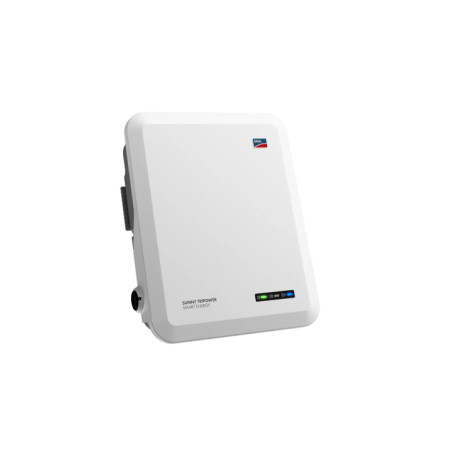
10 kW three-phase hybrid inverter SMA Sunny Tripower Smart Energy, the top size in the series: photovoltaic inverter and battery manager in a single device, PV array up to 15 kWp on 3 strings and high-voltage battery 150-600 V.
Integrated backup: 13.800 W connectable with grid present, 10.000 W three-phase in island mode, 30 ms switchover. Asymmetrical inputs (A: 1 string 12,5 A - B: 2 strings 25 A). IP65, 5+5-year warranty.
The SMA Sunny Tripower Smart Energy STP 10.0-3SE is a 10 kW three-phase hybrid inverter, the largest size in the Smart Energy family: it combines a photovoltaic inverter, high-voltage battery manager and backup function in a single 30 kg unit. It is the heart of a high-end SMA Energy System Home, where the goal is to bring self-sufficiency close to the maximum and cover essential loads even when the grid goes down.
An asymmetrical MPPT: the detail that changes the design
Unlike the smaller sizes, the 10.0-3SE has two inputs that are different from each other. Input A accepts one string, 12,5 A and 6.000 W; input B accepts two strings, 25 A and 12.000 W. In total, the generator can reach 15.000 Wp across three strings, but they must be distributed carefully: the main roof section on input B, the secondary exposure (east or west, or the shaded section) on input A. Reversing the two ends up limiting the most productive string. It is a constraint that no product sheet mentions and that is discovered once the system has been installed.
STP 10.0-3SE technical specifications
| Rated AC power (230 V, 50 Hz) | 10.000 W |
| Maximum AC apparent power | 10.000 VA |
| Maximum PV generator power | 15.000 Wp |
| Useful power input A / input B | 6.000 W / 12.000 W |
| Useful current input A / input B | 12,5 A / 25 A (Isc 20 A / 40 A) |
| Strings per input | A: 1 string - B: 2 strings |
| Maximum input voltage | 1.000 V |
| MPPT range / rated voltage | 280-800 V / 600 V |
| Rated / maximum output current | 3 x 14,5 A / 3 x 15,2 A |
| Battery | High-voltage lithium, 150-600 V, 30 A max charging and discharging, 1 battery can be connected |
| Backup with grid present | Up to 13.800 W connectable, 3 x 20 A |
| Backup in island mode (230 V, 50 Hz) | 3.330 W single-phase / 10.000 W three-phase |
| Backup switching time | From 30 ms to 10 s, adjustable |
| Maximum / European efficiency | 98,1% / 97,5% |
| Protections | DC disconnect switch, grid and ground fault monitoring, RCMU sensitive to all currents, type II DC and AC surge arresters |
| Protection rating | IP65, climate class 4K26, -25 °C / +60 °C |
| Noise level / night-time consumption | 30 dB(A) typical / 44 W |
| Interfaces | 1 Wi-Fi, 2 Ethernet, 1 BAT-CAN, 5 digital inputs and 1 digital output, Modbus SMA and SunSpec, Speedwire |
| Dimensions (W x H x D) / weight | 500 x 598 x 173 mm / 30 kg |
| Warranty | 5 years, extendable to 10 free of charge by registering the product on the SMA portal |
| Certifications | Internal and external CEI 0-21, EN 50549-1, IEC 62109-1/-2, CE |
What you can do with it in everyday life
A 12 kWp system with this inverter and a 10 kWh battery, in a home in Central Italy with a heat pump, typically covers 70-80% of annual demand. The photovoltaic system works during the day, the battery covers the evening and the first part of the night, and the grid steps in on overcast days in January and February.
In the event of a blackout, with 10 kW three-phase available, the essential loads panel can easily support the refrigerator, freezer, lighting, boiler or heat pump in reduced mode, router and service sockets. On a single phase, the limit drops to 3.330 W: the induction hob at full power remains out of reach, but the microwave and coffee machine do not. Switching, if set to the minimum value of 30 ms, is fast enough not to shut down computers and refrigerators.
What is needed to complete the system
- Compatible high-voltage battery (SMA Home Storage or BYD Battery-Box) with dedicated communication cable
- SMA Energy Meter for basic functions, or Sunny Home Manager 2.0 for predictive management with weather forecasts and heat pump and wallbox control
- Essential loads panel, separate from the main distribution board, for the backup function
- Interface panel with SPI and test report if the system power exceeds the 11,08 kW of CEI 0-21
Frequently asked questions
How many strings can I connect to the STP 10.0-3SE?
Three in total: one on input A and two on input B. The inputs are not equivalent — A supports 12,5 A and 6.000 W, B supports 25 A and 12.000 W — so the largest roof section should always go on input B.
How much battery capacity is it worth pairing with it?
The maximum current is 30 A for charging and discharging, and the actual power depends on the connected battery: a battery that is too small cannot deliver the current the inverter could manage, and this is noticeable in backup mode. For a home with a heat pump, the typical pairing is between 10 and 16 kWh, always on a single tower.
Does backup work even if the battery is discharged?
With the battery at zero and the grid absent, the inverter cannot form an island grid using only the photovoltaic system: a minimum charge reserve is required, which is set in the software and which the system keeps aside specifically for this purpose. With the reserve available, the photovoltaic system recharges the battery even in island mode.
Why is the efficiency lower than that of the 8 kW?
The 10.0-3SE declares 98,1% maximum and 97,5% European efficiency, compared to 98,2% and 97,8% for the 8.0-3SE: this is the effect of the asymmetrical input configuration and the higher currents. The difference is only a few tenths of a point, and in annual production it matters less than correct string orientation.
Is the Sunny Home Manager needed, or is the Energy Meter enough?
The Energy Meter is sufficient to measure at the grid connection point, limit feed-in and enable backup operation. The Sunny Home Manager 2.0 adds scheduled charging based on weather forecasts, learning of consumption profiles and direct control of the heat pump, wallbox and household appliances. It is worthwhile when the home has flexible loads that can be shifted to sunny hours.